 Back
BackMendelian Genetics and the Gene Idea: Patterns and Principles of Inheritance
Study Guide - Smart Notes
 Tailored notes based on your materials, expanded with key definitions, examples, and context.
Mendel and the Gene Idea
Introduction to Mendelian Genetics
Mendelian genetics forms the foundation of classical genetics, describing how traits are inherited from one generation to the next. Gregor Mendel's experiments with garden peas led to the discovery of fundamental laws governing heredity.
Character: A heritable feature that varies among individuals (e.g., flower color).
Trait: Each variant for a character (e.g., purple or white flowers).
True-breeding: Plants that produce offspring of the same variety when self-pollinated.
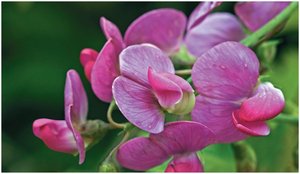
Mendel's Experimental Approach
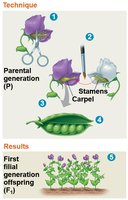
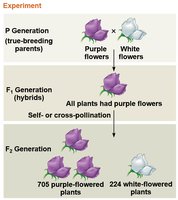
Mendel tracked characters with two distinct forms and started with true-breeding varieties. He mated two contrasting, true-breeding varieties (hybridization), producing the parental (P) generation, the first filial (F1) generation, and the second filial (F2) generation.
P Generation: True-breeding parents.
F1 Generation: Hybrid offspring of the P generation.
F2 Generation: Offspring from self- or cross-pollination of F1 individuals.
Results of Mendel's Crosses
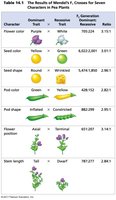
Mendel observed consistent ratios in the F2 generation for several characters, demonstrating predictable inheritance patterns.
Dominant traits appeared in a 3:1 ratio over recessive traits in the F2 generation.
Character | Dominant Trait | Recessive Trait | F2 Ratio |
|---|---|---|---|
Flower color | Purple | White | 3:1 |
Seed shape | Round | Wrinkled | 3:1 |
Seed color | Yellow | Green | 3:1 |
Pod shape | Inflated | Constricted | 3:1 |
Pod color | Green | Yellow | 3:1 |
Flower position | Axial | Terminal | 3:1 |
Stem length | Tall | Dwarf | 3:1 |
Mendel's Laws of Inheritance
Law of Segregation
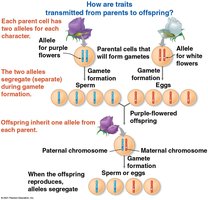
Mendel's first law states that two alleles for a heritable character segregate during gamete formation and end up in different gametes.
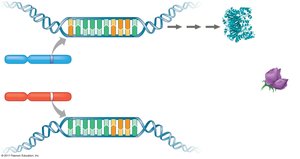
Allele: Alternative versions of a gene.
Locus: Specific location of a gene on a chromosome.
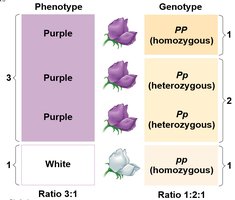
Homozygous: Two identical alleles for a gene.
Heterozygous: Two different alleles for a gene.
Dominant allele: Determines the organism's appearance.
Recessive allele: Has no noticeable effect on appearance.
Punnett Square and Genetic Ratios
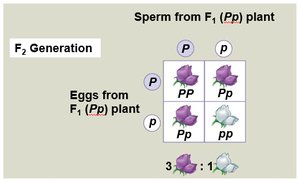
The Punnett square is a tool used to predict the possible combinations of alleles in offspring.
Capital letters represent dominant alleles; lowercase letters represent recessive alleles.
F2 generation shows a 3:1 ratio of dominant to recessive phenotypes.
Genetic Vocabulary
Phenotype and Genotype
Phenotype: The visible or measurable physical or biochemical characteristics of an organism.
Genotype: The particular pair of alleles present for any given gene.
The Testcross
A testcross is used to determine the genotype of an individual with a dominant phenotype by breeding it with a homozygous recessive individual.
If any offspring display the recessive phenotype, the mystery parent must be heterozygous.
The Law of Independent Assortment
Dihybrid Crosses
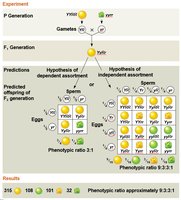
Crossing two true-breeding parents differing in two characters produces dihybrids in the F1 generation. A dihybrid cross determines whether two characters are transmitted as a package or independently.
Each pair of alleles segregates independently during gamete formation.
Applies only to genes on different, nonhomologous chromosomes or those far apart on the same chromosome.
Complex Patterns of Inheritance
Degrees of Dominance
Complete dominance: Phenotypes of heterozygote and dominant homozygote are identical.
Incomplete dominance: Phenotype of F1 hybrids is intermediate between parental varieties.
Codominance: Two dominant alleles affect the phenotype in separate, distinguishable ways.
Multiple Alleles and Codominance
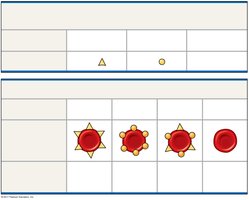
Some genes have more than two alleles, and codominance can occur, as seen in ABO blood groups.
Allele | Carbohydrate |
|---|---|
A | Specific carbohydrate |
B | Specific carbohydrate |
O | None |
Genotype | Phenotype (Blood Group) |
|---|---|
IAIA or IAi | A |
IBIB or IBi | B |
IAIB | AB |
ii | O |
Pleiotropy
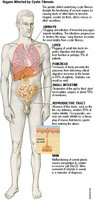
Most genes have multiple phenotypic effects, a property called pleiotropy. For example, pleiotropic alleles are responsible for multiple symptoms of hereditary diseases such as cystic fibrosis and sickle-cell disease. 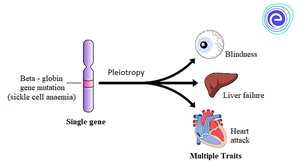
Epistasis
In epistasis, expression of a gene at one locus alters the phenotypic expression of a gene at a second locus. 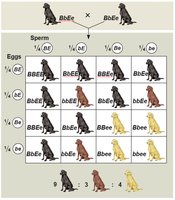
Polygenic Inheritance
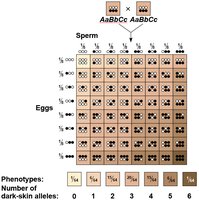
Quantitative characters vary in the population along a continuum, indicating polygenic inheritance—an additive effect of two or more genes on a single phenotype.
Height is a classic example, influenced by over 180 genes.
Mendelian Patterns in Human Genetics
Recessively Inherited Disorders
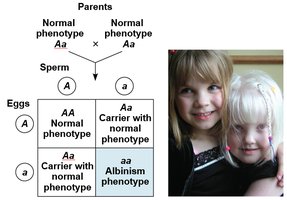
Recessive disorders appear only in individuals homozygous for the allele. Carriers are heterozygous individuals who carry the recessive allele but are phenotypically normal.
Albinism is a recessive condition characterized by lack of pigmentation.
Dominantly Inherited Disorders
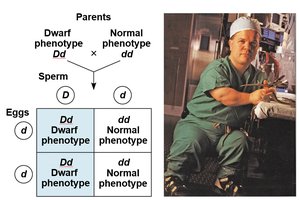
Some human disorders are caused by dominant alleles, which are rare and often arise by mutation.
Achondroplasia is a form of dwarfism caused by a dominant allele.
Huntington's disease is a degenerative nervous system disorder with late onset.
Summary Tables: Relationships Among Genes
Single Gene Relationships
Relationship | Description | Example |
|---|---|---|
Complete dominance | Heterozygous phenotype same as homozygous dominant | PP, Pp |
Incomplete dominance | Heterozygous phenotype intermediate | CRCR, CRCW, CWCW |
Codominance | Both phenotypes expressed in heterozygotes | IAIB |
Multiple alleles | More than two alleles in population | ABO blood group |
Pleiotropy | One gene affects multiple phenotypic characters | Sickle-cell disease |
Multiple Gene Relationships
Relationship | Description | Example |
|---|---|---|
Epistasis | Phenotypic expression of one gene affects another | BbEe |
Polygenic inheritance | Single phenotypic character affected by two or more genes | AaBbCc |
Additional info:
Mendel's principles are foundational for understanding inheritance, but many traits are influenced by more complex genetic interactions.
Modern genetics incorporates molecular biology to explain gene function and regulation.
