 Back
Mendelian Genetics and the Principles of Heredity
Study Guide - Smart Notes
 Tailored notes based on your materials, expanded with key definitions, examples, and context.
Chapter 14: Mendel and the Gene Idea
Big Idea: Mendel's Work Revealed the Fundamental Principles of Heredity
Gregor Mendel's experiments with pea plants established the foundation for modern genetics, demonstrating how traits are inherited from one generation to the next. His scientific approach led to the discovery of two key laws of inheritance: the law of segregation and the law of independent assortment.
Concept 14.1: Mendel's Scientific Approach and Laws of Inheritance
Mendel's Experimental, Quantitative Approach
Mendel used garden peas for his experiments due to their distinct traits, short generation time, and ability to control mating. He focused on characters with two alternative forms and started with true-breeding varieties.
Character: A heritable feature that varies among individuals (e.g., flower color).
Trait: Each variant for a character (e.g., purple or white flowers).
True-breeding: Plants that produce offspring of the same variety when self-pollinated.
Hybridization: Mating two contrasting, true-breeding varieties.
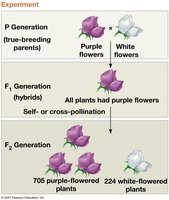
P Generation: True-breeding parents.
F1 Generation: Hybrid offspring of the P generation.
F2 Generation: Offspring from self- or cross-pollination of F1 hybrids.
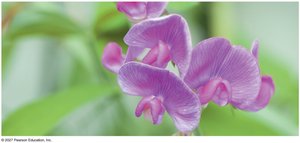
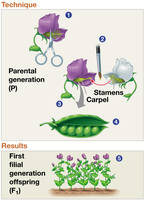
The Law of Segregation
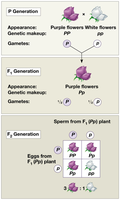
Mendel observed that crossing true-breeding purple and white flowered plants resulted in all purple F1 hybrids, contradicting the blending hypothesis. When F1 hybrids were crossed, the F2 generation showed a 3:1 ratio of purple to white flowers.
Law of Segregation: Two alleles for a gene segregate during gamete formation and are rejoined at random during fertilization.
Physical Basis: The movement of chromosomes during meiosis explains allele segregation.
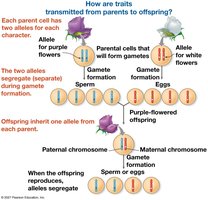
Mendel's Model of Inheritance
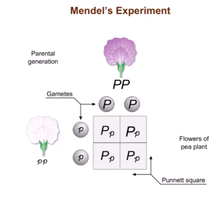
Mendel's model explains the 3:1 ratio observed in the F2 generation and consists of four concepts:
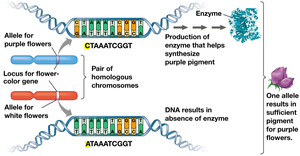
Alleles: Alternative versions of genes account for variations in inherited characters.
Inheritance: Each organism inherits two alleles, one from each parent.
Dominance: If two alleles differ, the dominant allele determines appearance; the recessive allele has no noticeable effect.
Segregation: The two alleles for a heritable character separate during gamete formation.
Useful Genetic Vocabulary
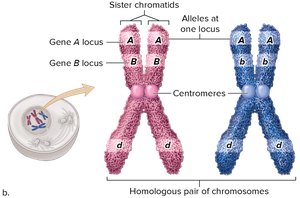
Homozygous: Two identical alleles for a gene.
Heterozygous: Two different alleles for a gene.
Phenotype: Physical appearance.
Genotype: Genetic makeup.
The Testcross
A testcross is used to determine the genotype of an individual with a dominant phenotype by breeding it with a homozygous recessive individual. If any offspring display the recessive phenotype, the mystery parent must be heterozygous.
Concept 14.2: The Law of Independent Assortment
Mendel's second law was derived by following two characters at the same time. Crossing two true-breeding parents differing in two characters produces dihybrids in the F1 generation, heterozygous for both characters. A dihybrid cross can determine whether two characters are transmitted together or independently.
Monohybrid Cross: Heterozygous for one character.
Dihybrid Cross: Heterozygous for two characters.
Law of Independent Assortment: Genes for different traits can segregate independently during the formation of gametes.
Concept 14.3: Extensions of Mendelian Genetics
Complex Patterns of Inheritance
Inheritance patterns can be affected by complete dominance, incomplete dominance, codominance, multiple alleles, pleiotropy, epistasis, and polygenic inheritance.
Complete Dominance: Heterozygote and dominant homozygote have identical phenotypes.
Incomplete Dominance: F1 hybrids have phenotypes intermediate between parental varieties.
Codominance: Two dominant alleles affect the phenotype in separate, distinguishable ways.
Multiple Alleles: Most genes exist in populations in more than two allelic forms (e.g., ABO blood group).
Pleiotropy: One gene affects multiple phenotypic traits.
Epistasis: One gene affects the phenotype of another gene.
Polygenic Inheritance: Multiple genes independently affect a single trait.
Concept 14.4: Human Genetics and Pedigree Analysis
Pedigree Analysis
Pedigrees are family trees that describe the inheritance of a trait across generations. They are used to predict the probability of specific phenotypes in future offspring.
Recessively Inherited Disorders: Disorders that appear only in individuals homozygous for the allele (e.g., albinism, cystic fibrosis, sickle-cell disease).
Dominantly Inherited Disorders: Disorders caused by dominant alleles (e.g., achondroplasia, Huntington's disease).
Carriers: Heterozygous individuals who carry the recessive allele but are phenotypically normal.
Genetic Testing and Counseling
Genetic counselors provide information to prospective parents about genetic disorders. Fetal and newborn testing can reveal genetic disorders, and tests for identifying carriers help define the odds of having an affected child.
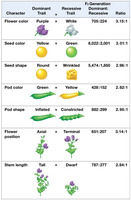
Summary Table: Mendel's Pea Plant Characters
Character | Dominant Trait | Recessive Trait | F2 Generation Dominant | F2 Generation Recessive | Ratio |
|---|---|---|---|---|---|
Flower color | Purple | White | 705 | 224 | 3.15:1 |
Seed color | Yellow | Green | 6,024 | 2,001 | 3.01:1 |
Seed shape | Round | Wrinkled | 5,474 | 1,850 | 2.96:1 |
Pod color | Green | Yellow | 428 | 152 | 2.82:1 |
Pod shape | Inflated | Constricted | 882 | 299 | 2.95:1 |
Flower position | Axial | Terminal | 651 | 207 | 3.14:1 |
Stem length | Tall | Dwarf | 787 | 277 | 2.84:1 |
Key Equations
Phenotypic Ratio (Monohybrid Cross):
Genotypic Ratio (Monohybrid Cross):
Probability Rule (Multiplication):
Probability Rule (Addition):
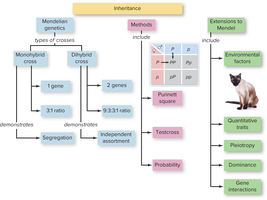
Summary Diagram: Mendelian Genetics Overview
Additional info:
Mendel's principles apply to all sexually reproducing organisms, not just pea plants.
Modern genetics has expanded on Mendel's work, incorporating molecular biology and environmental influences.
