 Back
Mendelian Genetics and the Principles of Heredity
Study Guide - Smart Notes
 Tailored notes based on your materials, expanded with key definitions, examples, and context.
Chapter 14: Mendel and the Gene Idea
Big Idea: Mendel's Work Revealed the Fundamental Principles of Heredity
Gregor Mendel's experiments with pea plants established the foundation for modern genetics, demonstrating how traits are inherited from one generation to the next. His scientific approach led to the discovery of two key laws of inheritance: the law of segregation and the law of independent assortment.
Concept 14.1: Mendel's Scientific Approach and Laws of Inheritance
Mendel's Experimental, Quantitative Approach
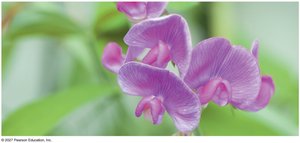
Mendel used garden peas for his experiments due to their distinct traits, short generation time, and ability to control mating. He focused on characters with two alternative forms and started with true-breeding varieties.
Character: A heritable feature that varies among individuals (e.g., flower color).
Trait: Each variant for a character (e.g., purple or white flowers).
True-breeding: Plants that produce offspring of the same variety when self-pollinated.
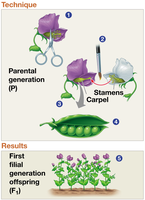
Hybridization: Mating two contrasting, true-breeding varieties.
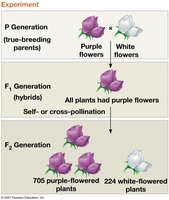
P generation: True-breeding parents.
F1 generation: Hybrid offspring of the P generation.
F2 generation: Offspring from self- or cross-pollination of F1 hybrids.
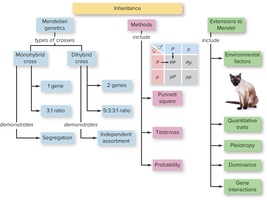
The Law of Segregation
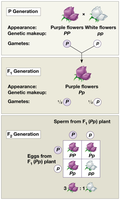
Mendel observed that crossing true-breeding purple and white-flowered pea plants resulted in all purple F1 hybrids, contradicting the blending hypothesis. When F1 hybrids were crossed, the F2 generation showed a 3:1 ratio of purple to white flowers, indicating that traits are inherited as discrete units.
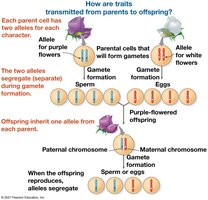
Law of Segregation: Two alleles for a gene segregate during gamete formation and are rejoined at random during fertilization.
Physical basis: Movement of chromosomes during meiosis.
Mendel's Model of Inheritance
Mendel proposed a model to explain the 3:1 ratio observed in the F2 generation, consisting of four key concepts:
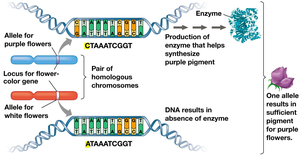
Alternative versions of genes (alleles) account for variations in inherited characters.
Each organism inherits two alleles, one from each parent.
If the two alleles differ, the dominant allele determines the phenotype; the recessive allele has no noticeable effect.
The two alleles segregate during gamete formation.
Useful Genetic Vocabulary
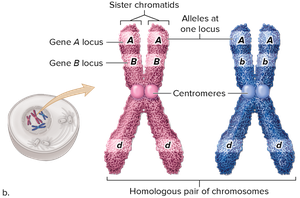
Homozygous: Two identical alleles for a gene.
Heterozygous: Two different alleles for a gene.
Phenotype: Physical appearance.
Genotype: Genetic makeup.
The Testcross
A testcross is used to determine the genotype of an individual with a dominant phenotype by breeding it with a homozygous recessive individual. If any offspring display the recessive phenotype, the mystery parent must be heterozygous.
Concept 14.2: The Law of Independent Assortment
Monohybrid and Dihybrid Crosses
Mendel derived the law of segregation by following a single character (monohybrid cross). He identified the law of independent assortment by following two characters simultaneously (dihybrid cross).
Monohybrid cross: Heterozygous for one character.
Dihybrid cross: Heterozygous for two characters.
Law of Independent Assortment: Genes for different traits can segregate independently during the formation of gametes.
Concept 14.3: Extensions of Mendelian Genetics
Complex Patterns of Inheritance
Inheritance patterns can be affected by various factors, including degrees of dominance, multiple alleles, pleiotropy, epistasis, and polygenic inheritance.
Complete dominance: Heterozygote and dominant homozygote have identical phenotypes.
Incomplete dominance: F1 hybrids have intermediate phenotypes.
Codominance: Both alleles affect the phenotype in separate ways.
Multiple alleles: More than two allelic forms exist in a population (e.g., ABO blood group).
Pleiotropy: One gene affects multiple phenotypic traits.
Epistasis: One gene affects the expression of another gene.
Polygenic inheritance: Multiple genes independently affect a single trait.
Environmental Impact on Phenotype
The phenotype for a character can depend on both genotype and environment. Phenotypic plasticity describes the ability to produce different phenotypes under varying environmental conditions. Multifactorial traits depend on multiple genes and environmental influences.
Concept 14.4: Human Genetics and Pedigree Analysis
Pedigree Analysis
Pedigrees are family trees that describe the inheritance of traits across generations. They are used to predict the probability of specific phenotypes in future offspring.
Pedigree: Diagram showing the inheritance of a trait.
Multiplication and addition rules: Used to predict probabilities.
Recessively Inherited Disorders
Many genetic disorders are inherited in a recessive manner. Carriers are heterozygous individuals who carry the recessive allele but are phenotypically normal. Examples include albinism, cystic fibrosis, and sickle-cell disease.
Cystic fibrosis: Defective chloride transport channels lead to mucus buildup and nutrient absorption issues.
Sickle-cell disease: Abnormal hemoglobin causes physical weakness, pain, and organ damage. Heterozygotes are less susceptible to malaria.
Dominantly Inherited Disorders
Some disorders are caused by dominant alleles, such as achondroplasia (dwarfism) and Huntington's disease (degenerative nervous system disorder).
Genetic Testing and Counseling
Genetic counselors provide information to prospective parents. Tests can identify carriers and assess the odds of having affected children. Fetal testing methods include amniocentesis, chorionic villus sampling, and ultrasound.
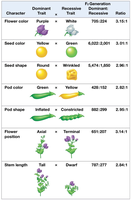
Summary Table: Mendel's Pea Plant Characters and Ratios
Character | Dominant Trait | Recessive Trait | F2 Generation Dominant | F2 Generation Recessive | Ratio |
|---|---|---|---|---|---|
Flower color | Purple | White | 705 | 224 | 3.15:1 |
Seed color | Yellow | Green | 6,024 | 2,001 | 3.01:1 |
Seed shape | Round | Wrinkled | 5,474 | 1,850 | 2.96:1 |
Pod color | Green | Yellow | 428 | 152 | 2.82:1 |
Pod shape | Inflated | Constricted | 882 | 299 | 2.95:1 |
Flower position | Axial | Terminal | 651 | 207 | 3.14:1 |
Stem length | Tall | Dwarf | 787 | 277 | 2.84:1 |
Key Equations and Concepts
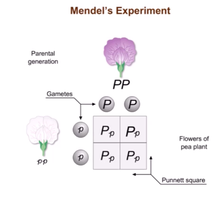
Punnett Square: Used to predict genotypic and phenotypic ratios.
Genotypic ratio for monohybrid cross:
Phenotypic ratio for monohybrid cross:
Law of Segregation:
Law of Independent Assortment:
Example: In a monohybrid cross between two heterozygous pea plants (Pp x Pp), the expected phenotypic ratio in the F2 generation is 3 purple:1 white.
Additional info: Mendel's principles apply to many organisms and form the basis for understanding inheritance, genetic disorders, and genetic counseling in humans.
