 Back
Mendelian Genetics and Types of Mutations: Study Notes
Study Guide - Smart Notes
 Tailored notes based on your materials, expanded with key definitions, examples, and context.
Mendelian Genetics
Principles of Mendelian Genetics
Mendelian genetics describes the basic principles of heredity discovered by Gregor Mendel through his experiments with pea plants. These principles explain how traits are inherited from one generation to the next and are foundational to understanding genetic inheritance.
Law of Segregation: Each individual has two alleles for each gene, which segregate during meiosis so that each gamete receives only one allele.
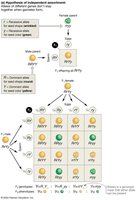
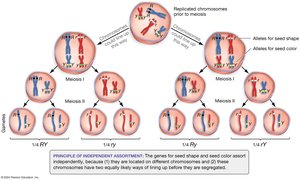
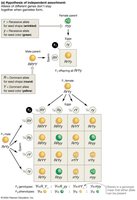
Law of Independent Assortment: Genes for different traits assort independently of one another during gamete formation, provided they are on different chromosomes.
Genotype vs. Phenotype: Genotype refers to the genetic makeup, while phenotype refers to the observable traits.
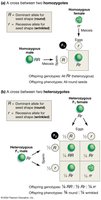
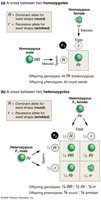
Homozygous: An organism with two identical alleles for a trait.
Heterozygous: An organism with two different alleles for a trait.
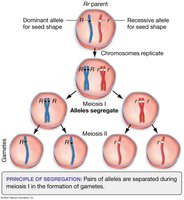
Punnett Squares and Probability Rules
Punnett squares are diagrams used to predict the outcome of genetic crosses. They help visualize the segregation and independent assortment of alleles.
Monohybrid Cross: A cross between individuals focusing on one trait.
Dihybrid Cross: A cross focusing on two traits, often used to demonstrate independent assortment.
Addition Rule: Used when calculating the probability of mutually exclusive events.
Multiplication Rule: Used when calculating the probability of independent events occurring together.
Mendel’s Experiments: Step-by-Step
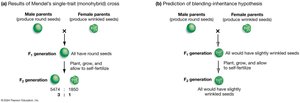
Mendel performed controlled crosses between pea plants to study inheritance patterns. He used pure breeding strains (P0), crossed them to produce F1, and then self-crossed F1 to produce F2. He counted and analyzed the phenotypes in F2 to construct hypotheses about inheritance.
P0 Generation: Pure breeding plants for a specific trait.
F1 Generation: Offspring of P0, all showing the dominant phenotype.
F2 Generation: Offspring of F1 self-cross, showing a 3:1 ratio of dominant to recessive phenotypes.
Example: Crossing round (dominant) and wrinkled (recessive) peas yields all round F1, and a 3:1 ratio in F2.
Test Crosses
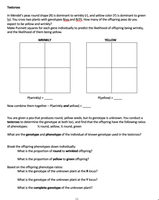
A test cross is used to determine the genotype of an individual with a dominant phenotype by crossing it with a homozygous recessive individual.
Purpose: To reveal whether the dominant phenotype is homozygous or heterozygous.
Application: Useful in plant and animal breeding to confirm genetic makeup.
Types of Mutations
Point Mutations
Point mutations are changes in a single base pair of DNA. They can affect protein coding sequences and alter gene function.
Types: Substitution, insertion, or deletion of a single nucleotide.
Effects: Can result in silent, missense, or nonsense mutations.
Example: Sickle cell anemia is caused by a point mutation in the hemoglobin gene.
Chromosomal Mutations
Mutations can also occur at the chromosome level, including deletions, duplications, inversions, and translocations. These changes can have significant effects on gene function and organismal health.
Translocation: A segment of one chromosome is transferred to another chromosome.
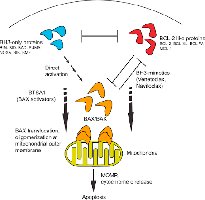
Example: Chromosomal translocation can cause Bcl2 to be always ON, leading to survival of cells with many mutations (as seen in some cancers).
Mutations and Cancer
Uncontrolled cell division is a hallmark of cancer. Loss of genes that cause apoptosis (programmed cell death) or mutations that inhibit cell death can lead to cancer development.
Bcl Proteins: B-cell lymphoma proteins inhibit cell death, allowing mutated cells to survive.
Apoptosis: The process of programmed cell death, essential for removing damaged or unwanted cells.
Summary Table: Mendelian Genetics vs. Mutation Types
Topic | Key Principle | Example |
|---|---|---|
Mendelian Genetics | Law of Segregation, Law of Independent Assortment | Pea plant crosses, 3:1 ratio in F2 |
Point Mutation | Single nucleotide change | Sickle cell anemia |
Chromosomal Mutation | Structural changes in chromosomes | Bcl2 translocation in cancer |
Key Equations
Probability of genotype in monohybrid cross:
for homozygous dominant, for heterozygous, for homozygous recessive
Probability of phenotype in dihybrid cross:
dominant for both traits, dominant for one trait, dominant for the other trait, recessive for both traits
Additional info: The notes also reference the Minnesota Study of Twins Reared Apart and nature vs. nurture, but these are not directly relevant to Mendelian genetics or mutation types and are not included in the testable content.
