 Back
Mendelian Genetics: Patterns, Extensions, and Human Applications
Study Guide - Smart Notes
 Tailored notes based on your materials, expanded with key definitions, examples, and context.
Mendelian Genetics: Principles and Patterns
Introduction to Mendelian Genetics
Gregor Mendel's experiments with pea plants established the foundational principles of heredity, which are central to modern genetics. By carefully breeding and counting offspring, Mendel deduced how traits are transmitted from parents to offspring.
Character: A heritable feature that varies among individuals (e.g., flower color).
Trait: Each variant for a character (e.g., purple or white flowers).
True-breeding: Plants that produce offspring of the same variety when self-pollinated.
Hybridization: Mating two contrasting, true-breeding varieties.
P generation: True-breeding parents.
F1 generation: Hybrid offspring of the P generation.
F2 generation: Offspring from self- or cross-pollination of F1 hybrids.
Mendel's Laws of Inheritance
Mendel formulated two key laws: the law of segregation and the law of independent assortment, which explain how alleles are distributed during gamete formation.
Law of Segregation: The two alleles for a heritable character separate during gamete formation and end up in different gametes.
Law of Independent Assortment: Each pair of alleles segregates independently of other pairs during gamete formation. Applies to genes on different chromosomes or far apart on the same chromosome.
Alleles: Alternative versions of a gene, residing at specific loci on chromosomes.
Dominant allele: Determines the organism's appearance.
Recessive allele: Has no noticeable effect on appearance unless homozygous.
Genotype and Phenotype
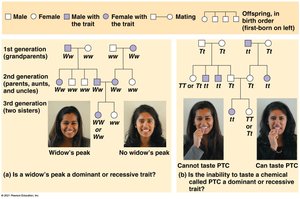
The distinction between genotype and phenotype is crucial in genetics. Genotype refers to the genetic makeup, while phenotype is the observable trait.
Homozygous: Two identical alleles for a gene.
Heterozygous: Two different alleles for a gene.
Testcross: Breeding a mystery individual with a homozygous recessive to determine genotype.
Probability in Genetics
Rules of Probability
Probability laws govern Mendelian inheritance, allowing prediction of genetic outcomes.
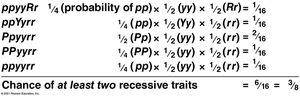
Multiplication rule: Probability of two independent events occurring together is the product of their individual probabilities.
Addition rule: Probability of any one of two or more mutually exclusive events is the sum of their individual probabilities.
Example: Calculating the probability of at least two recessive traits in a multicharacter cross.
Extensions of Mendelian Genetics
Degrees of Dominance
Inheritance patterns can deviate from simple Mendelian rules:
Complete dominance: Heterozygote and dominant homozygote have identical phenotypes.
Incomplete dominance: F1 hybrids have intermediate phenotypes.
Codominance: Both alleles affect the phenotype in distinguishable ways.
Multiple Alleles and Pleiotropy
Multiple alleles: Most genes exist in populations in more than two allelic forms (e.g., ABO blood group).
Pleiotropy: One gene affects multiple phenotypic traits (e.g., sickle-cell disease).
Epistasis and Polygenic Inheritance
Epistasis: One gene affects the expression of another gene (e.g., coat color in Labrador retrievers).
Polygenic inheritance: Multiple genes independently affect a single trait (e.g., height, skin color).
Environmental Impact on Phenotype
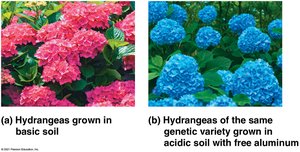
Phenotype can be influenced by environmental factors as well as genotype. Traits affected by both are called multifactorial.
Example: Hydrangea flower color varies with soil pH and aluminum content.
Human Genetics and Mendelian Patterns
Pedigree Analysis
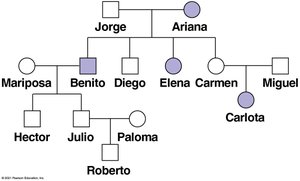
Pedigrees are used to track inheritance patterns in families, especially for traits and disorders.
Recessively and Dominantly Inherited Disorders
Recessive disorders: Require two copies of the allele (e.g., cystic fibrosis, sickle-cell disease).
Dominant disorders: Require only one copy of the allele (e.g., achondroplasia, Huntington's disease).
Carriers are heterozygous individuals who carry the recessive allele but are phenotypically normal.
Genetic Testing and Counseling
Genetic counselors: Help prospective parents assess risks based on family history and probability rules.
Fetal testing: Includes amniocentesis, chorionic villus sampling, and ultrasound.
Newborn screening: Routine tests for genetic disorders (e.g., phenylketonuria).
Summary Table: Key Mendelian Concepts
Concept | Definition | Example |
|---|---|---|
Law of Segregation | Alleles separate during gamete formation | Purple/white flower color |
Law of Independent Assortment | Alleles of different genes assort independently | Seed shape and color |
Complete Dominance | Dominant allele masks recessive | Purple flower |
Incomplete Dominance | Intermediate phenotype | Snapdragon color |
Codominance | Both alleles expressed | AB blood type |
Polygenic Inheritance | Multiple genes affect trait | Height, skin color |
Pleiotropy | One gene affects multiple traits | Sickle-cell disease |
Equations and Probability Calculations
Probability of a genotype in a multicharacter cross:
Chance of at least two recessive traits:
Conclusion
Mendelian genetics provides the foundation for understanding inheritance, but real-world patterns often involve more complex interactions, multiple genes, and environmental influences. These principles are essential for studying human genetics, predicting inheritance, and understanding genetic disorders.
