 Back
Mendelian Genetics: Principles and Applications
Study Guide - Smart Notes
 Tailored notes based on your materials, expanded with key definitions, examples, and context.
Mendelian Genetics: Principles and Applications
Historical Foundations of Genetics
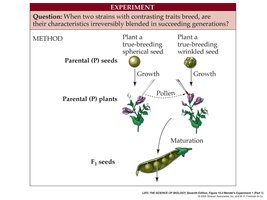
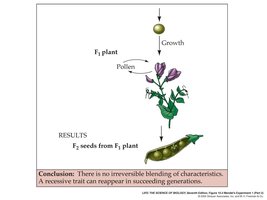
The science of heredity, or genetics, has roots in ancient selective breeding practices. Early biologists believed in the blending theory of inheritance, which suggested that offspring were an irreversible mix of parental traits. Modern genetics began with Gregor Mendel's experiments in the 19th century, which disproved the blending theory and established the particulate nature of inheritance.
Selective Breeding: Ancient attempts to improve crops and animals by choosing parents with desirable traits.
Blending Theory: The incorrect idea that traits from both parents blend irreversibly in offspring.
Gregor Mendel: Conducted quantitative experiments with pea plants, laying the foundation for modern genetics.
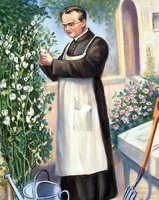
Mendel’s Experimental Approach
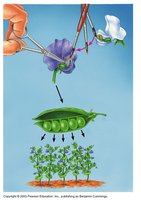
Mendel used pea plants for his experiments due to their distinct, easily observable traits and ability to self- or cross-pollinate. He performed controlled crosses to trace the inheritance of specific characteristics across generations.
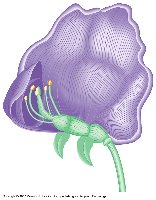
Stamen and Carpel: The male (stamen) and female (carpel) reproductive organs of pea flowers.
Cross-Fertilization Technique: Mendel removed stamens from one flower and transferred pollen from another to ensure controlled breeding.
Characters and Traits Studied by Mendel
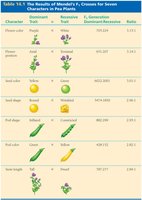
Mendel selected seven distinct characters in pea plants, each with two alternative traits. He hypothesized the existence of discrete units of heredity, now known as genes, with alternative forms called alleles.
Character: A heritable feature (e.g., flower color).
Trait: A specific form of a character (e.g., purple or white flowers).
Allele: Alternative forms of a gene.
Character | Dominant Trait | Recessive Trait | F1 Generation Ratio |
|---|---|---|---|
Flower color | Purple | White | 3:1 |
Flower position | Axial | Terminal | 3:1 |
Seed color | Yellow | Green | 3:1 |
Seed shape | Round | Wrinkled | 3:1 |
Pod shape | Inflated | Constricted | 3:1 |
Pod color | Green | Yellow | 3:1 |
Stem length | Tall | Dwarf | 3:1 |
Monohybrid Crosses and Mendel’s Principle of Segregation
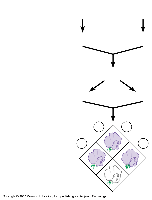
Mendel performed monohybrid crosses, tracking a single character (e.g., seed shape). He observed that the F1 generation showed only the dominant trait, but the recessive trait reappeared in the F2 generation in a 3:1 ratio. This led to the principle of segregation, which states that each organism carries two alleles for each gene, and these alleles segregate during gamete formation.
Monohybrid Cross: A cross involving one character with two traits.
Principle of Segregation: Alleles separate during gamete formation; each gamete carries only one allele.
Genotypic Ratio: 1 homozygous dominant : 2 heterozygous : 1 homozygous recessive.
Phenotypic Ratio: 3 dominant : 1 recessive.
Genetic Terminology and Chromosomal Basis
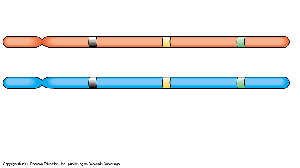
Genes are located at specific loci on homologous chromosomes. Each individual can be homozygous or heterozygous for a given gene. The chromosomal basis of inheritance explains how alleles are distributed during meiosis.
Locus: The specific location of a gene on a chromosome.
Homologous Chromosomes: Chromosome pairs that carry the same genes but may have different alleles.
Homozygous: Two identical alleles for a gene.
Heterozygous: Two different alleles for a gene.
Test Crosses: Determining Genotype
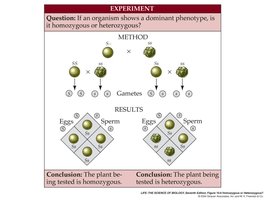
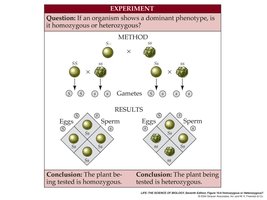
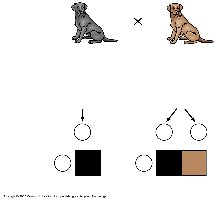
A test cross is used to determine whether an individual with a dominant phenotype is homozygous or heterozygous. This is done by crossing the individual with a homozygous recessive partner and analyzing the offspring.
Test Cross: Cross between an individual with a dominant phenotype and a homozygous recessive individual.
Result: If all offspring show the dominant trait, the tested individual is homozygous; if some show the recessive trait, it is heterozygous.
Dihybrid Crosses and the Principle of Independent Assortment
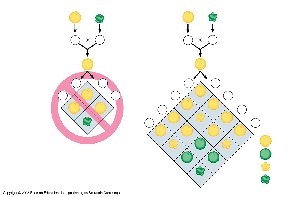
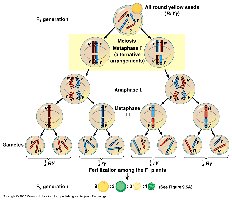
Mendel extended his experiments to dihybrid crosses, tracking two characters simultaneously. He found that alleles of different genes assort independently during gamete formation, leading to the principle of independent assortment.
Dihybrid Cross: A cross involving two characters, each with two traits.
Principle of Independent Assortment: Alleles of different genes segregate independently during gamete formation.
Phenotypic Ratio: 9:3:3:1 in the F2 generation for two traits.
Probability and Mendelian Inheritance
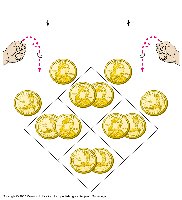
The inheritance of traits follows the rules of probability. The rule of multiplication and the rule of addition are used to calculate the likelihood of specific genotypes and phenotypes appearing in offspring.
Rule of Multiplication: Probability of two independent events occurring together is the product of their individual probabilities.
Rule of Addition: Probability of either of two mutually exclusive events occurring is the sum of their individual probabilities.
Mendelian Inheritance in Humans
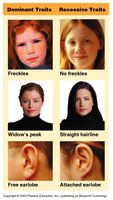
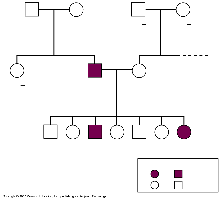
Many human traits follow Mendelian principles. Family pedigrees are used to track inheritance patterns and determine genotypes. Most inherited disorders are caused by autosomal recessive alleles, while some are due to dominant alleles.
Pedigree: A diagram showing the inheritance of traits across generations.
Autosomal Recessive Disorders: Require two copies of the recessive allele (e.g., cystic fibrosis, sickle-cell disease).
Autosomal Dominant Disorders: Require only one copy of the dominant allele (e.g., achondroplasia, Huntington’s disease).

Additional info:
Mendel’s principles are foundational for understanding inheritance, genetic variation, and the prediction of trait distribution in populations.
Modern genetics has expanded on Mendel’s work, incorporating molecular biology and chromosomal theory.
