 Back
Mendelian Genetics: Principles and Extensions
Study Guide - Smart Notes
 Tailored notes based on your materials, expanded with key definitions, examples, and context.
Mendelian Genetics
Introduction to Genetics and Heredity
Genetics is the study of heredity, the process by which traits are passed from parents to offspring. Gregor Mendel, an Augustinian monk, established the foundational principles of genetics through his experiments with garden peas. Mendel described 'heritable factors,' now known as genes, which are responsible for the inheritance of traits.
Heredity: Transmission of traits from parents to offspring.
Trait: Any characteristic of an individual, such as flower color or seed shape.
Gene: A unit of heredity that encodes information for a specific trait.
Mendel's work disproved earlier hypotheses such as blending inheritance and inheritance of acquired characteristics, establishing that traits are inherited as discrete units.
Mendel’s Experimental System
Mendel chose the garden pea (Pisum sativum) as his model organism due to its ease of cultivation, short generation time, and the presence of several polymorphic traits. He focused on traits that exhibited clear, either-or differences, such as purple versus white flowers.
Model organism: A species used for research due to its experimental advantages.
Polymorphic trait: A trait that appears in two or more distinct forms.
Results of Mendel’s Crosses
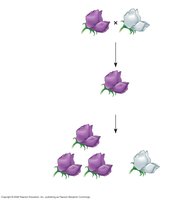
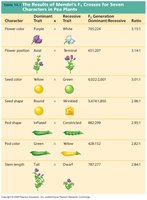
Mendel performed crosses between true-breeding plants (P generation) and observed the traits in the F1 and F2 generations. He consistently found a 3:1 ratio of dominant to recessive phenotypes in the F2 generation for several traits.
Character | Dominant Trait | Recessive Trait | F2 Generation Dominant:Recessive | Ratio |
|---|---|---|---|---|
Flower color | Purple | White | 705:224 | 3.15:1 |
Flower position | Axial | Terminal | 651:207 | 3.14:1 |
Seed color | Yellow | Green | 6,022:2,001 | 3.01:1 |
Seed shape | Round | Wrinkled | 5,474:1,850 | 2.96:1 |
Pod shape | Inflated | Constricted | 882:299 | 2.95:1 |
Pod color | Green | Yellow | 428:152 | 2.82:1 |
Stem length | Tall | Dwarf | 787:277 | 2.84:1 |
Genes, Alleles, and Genotypes
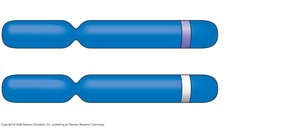
Mendel proposed that each individual has two versions of each gene, called alleles. The combination of alleles (genotype) determines the observable trait (phenotype). Alleles are located at specific loci on homologous chromosomes.
Allele: Alternative versions of a gene.
Genotype: The genetic makeup of an organism (e.g., PP, Pp, pp).
Phenotype: The observable characteristic (e.g., purple or white flowers).
Locus: The specific location of a gene on a chromosome.
Principle of Segregation
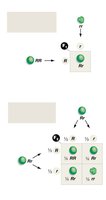
The principle of segregation states that the two alleles for a gene segregate during gamete formation, so each gamete carries only one allele for each gene. This explains the 3:1 ratio observed in the F2 generation of monohybrid crosses.
Homozygous: Both alleles are identical (e.g., RR or rr).
Heterozygous: Two different alleles (e.g., Rr).
Dominant and Recessive Traits
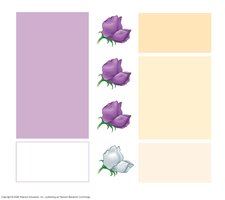
In Mendel’s experiments, the trait that appeared in the F1 generation was termed dominant, while the trait that was masked was termed recessive. The dominant trait reappeared in a 3:1 ratio in the F2 generation.
The Law of Independent Assortment
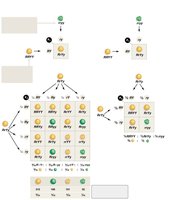
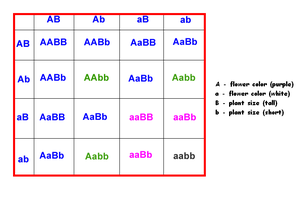
The law of independent assortment states that alleles of different genes assort independently during gamete formation. Mendel demonstrated this through dihybrid crosses, which involve two traits. The F2 generation from a dihybrid cross shows a 9:3:3:1 phenotypic ratio, supporting the principle of independent assortment.
Testcrosses
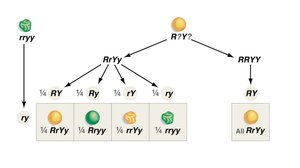
A testcross is used to determine the genotype of an individual with a dominant phenotype by crossing it with a homozygous recessive individual. The offspring phenotypes reveal the unknown genotype.
Sex Linkage and Chromosome Theory
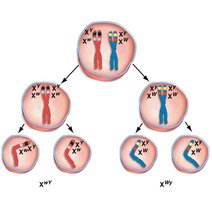
Sex chromosomes (X and Y) determine the sex of offspring. Genes located on sex chromosomes exhibit sex linkage. X-linked genes are found on the X chromosome, while Y-linked genes are on the Y chromosome. Linkage refers to genes located on the same chromosome that tend to be inherited together, potentially violating independent assortment.
Extensions of Mendelian Genetics
Inheritance patterns can be more complex than Mendel described. These include multiple alleles, incomplete dominance, codominance, pleiotropy, polygenic inheritance, and epistasis.
Multiple alleles: More than two alleles exist for a gene (e.g., ABO blood types).
Incomplete dominance: Heterozygotes show an intermediate phenotype.
Codominance: Both alleles are fully expressed in the phenotype.
Pleiotropy: One gene affects multiple traits.
Polygenic inheritance: Multiple genes influence a single trait.
Epistasis: One gene affects the expression of another gene.
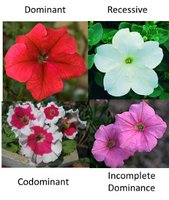
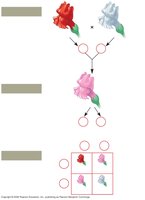
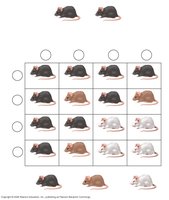
Example: Incomplete dominance is observed when crossing red and white flowers, resulting in pink offspring. Epistasis is seen in mouse coat color, where one gene determines pigment color and another gene determines pigment deposition.
Additional info: The principles of segregation and independent assortment apply broadly, but real-world inheritance often involves more complex interactions among genes and alleles.
