 Back
Mendelian Genetics: Principles and Extensions
Study Guide - Smart Notes
 Tailored notes based on your materials, expanded with key definitions, examples, and context.
Mendelian Genetics
Introduction to Genetics and Heredity
Genetics is the scientific study of heredity, the process by which traits are passed from parents to offspring. Gregor Mendel, an Augustinian monk, established the foundational principles of genetics through his experiments with garden peas. Mendel described "heritable factors," now known as genes, which are responsible for the transmission of traits.
Heredity: The transmission of traits from parents to offspring.
Trait: Any characteristic of an individual, such as flower color or seed shape.
Genes: Units of heredity that determine traits.
Mendel’s Experimental System
Mendel chose pea plants for his experiments due to their ease of cultivation, short generation time, and ability to produce many seeds. He tracked traits that appeared in distinct forms, such as purple versus white flowers, and used true-breeding varieties to ensure consistent results.
True-breeding: Plants that produce offspring identical to themselves when self-pollinated.
Polymorphic traits: Traits that appear in two or more distinct forms.
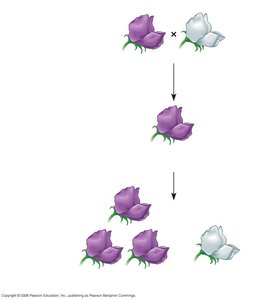
Mendel’s Crosses and Generations
Mendel controlled mating by cross-pollinating plants with contrasting traits. The parental generation (P) produced hybrid offspring (F1), which, when self-pollinated, produced the F2 generation. Mendel observed that traits did not blend but appeared in specific ratios.
P generation: True-breeding parents.
F1 generation: Hybrid offspring of the P generation.
F2 generation: Offspring of the F1 generation, showing a 3:1 ratio of dominant to recessive traits.
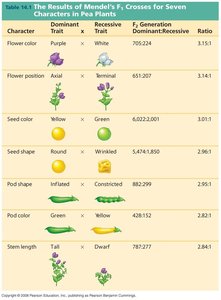
Dominant and Recessive Traits
Mendel identified dominant and recessive traits. Dominant traits mask the presence of recessive traits in hybrids. In the F2 generation, the dominant trait appeared in a 3:1 ratio over the recessive trait.
Dominant trait: Trait that appears in the F1 generation.
Recessive trait: Trait that is masked in the F1 generation but reappears in the F2 generation.
Particulate Inheritance
Mendel’s results contradicted the blending inheritance hypothesis. He proposed that hereditary determinants act as discrete, unchanging particles (genes), which do not blend or change through use.
Genes, Alleles, and Genotypes
Each individual has two versions of each gene, called alleles. The combination of alleles is the genotype, which determines the phenotype (observable trait). Each gene resides at a specific locus on a chromosome.
Allele: Alternative versions of a gene.
Genotype: The genetic makeup of an individual.
Phenotype: The physical expression of a trait.
Locus: The specific location of a gene on a chromosome.
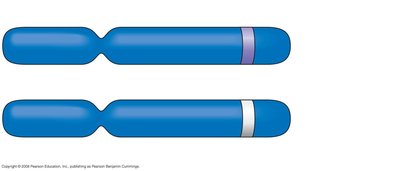
Principle of Segregation
Mendel’s principle of segregation states that the two alleles for each gene separate during gamete formation. Individuals can be homozygous (same alleles) or heterozygous (different alleles).
Homozygous: Two identical alleles (e.g., RR or rr).
Heterozygous: Two different alleles (e.g., Rr).
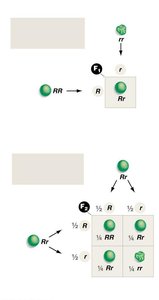
Punnett Squares and Genetic Ratios
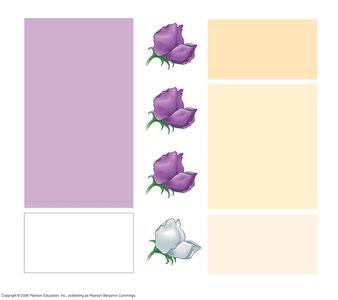
Punnett squares are diagrams used to predict the results of genetic crosses. Capital letters represent dominant alleles, and lowercase letters represent recessive alleles. The F2 generation shows a 3:1 phenotypic ratio and a 1:2:1 genotypic ratio.
Punnett square: Diagram for predicting genetic cross outcomes.
Phenotypic ratio: 3:1 (dominant:recessive).
Genotypic ratio: 1:2:1 (homozygous dominant:heterozygous:homozygous recessive).
The Law of Independent Assortment
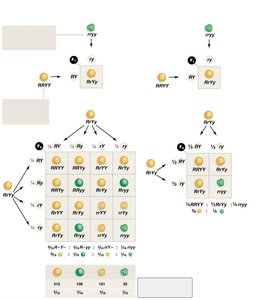
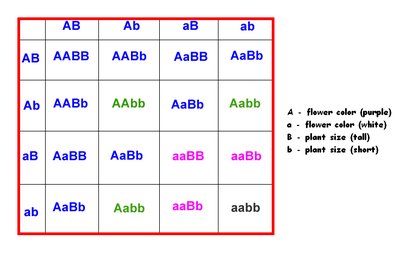
Mendel’s law of independent assortment states that alleles of different genes are transmitted independently of each other. Dihybrid crosses (involving two traits) demonstrate this principle, resulting in a 9:3:3:1 phenotypic ratio in the F2 generation.
Monohybrid cross: Inheritance pattern of a single trait.
Dihybrid cross: Inheritance pattern of two traits.
Independent assortment: Alleles of different genes are transmitted independently.
Testcrosses
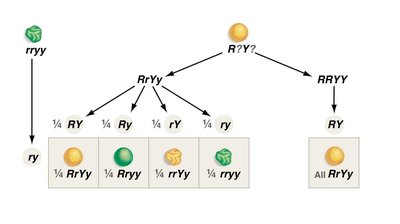
A testcross involves mating a homozygous recessive parent with a parent of unknown genotype to determine the genotype of the latter. Mendel used testcrosses to confirm the principle of independent assortment.
Sex Linkage and Chromosome Theory
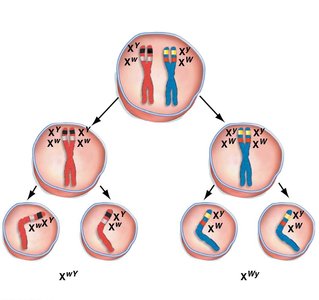
Sex chromosomes (X and Y) determine the sex of offspring. Genes located on the X or Y chromosome are called sex-linked genes. Linkage refers to genes located on the same chromosome, which tend to be inherited together and may violate independent assortment.
X-linkage: Gene located on the X chromosome.
Y-linkage: Gene located on the Y chromosome.
Sex linkage: General term for genes on sex chromosomes.
Linkage: Tendency of genes on the same chromosome to be inherited together.
Crossing Over and Genetic Mapping
Genes that are far apart on a chromosome are more likely to cross over during meiosis. The frequency of crossing over can be used to estimate the distance between genes and create genetic maps.
Genetic map: Diagram showing the relative positions of genes on a chromosome.
Complex Patterns of Inheritance
Inheritance patterns can be more complex than simple Mendelian genetics. Many traits are influenced by multiple genes or alleles, and the relationship between genotype and phenotype can vary.
Multiple Alleles and ABO Blood Groups
Some genes have more than two alleles, a phenomenon called multiple allelism. The ABO blood group in humans is determined by three alleles: IA, IB, and i, resulting in four possible phenotypes.
Allele | Carbohydrate | Genotype | Phenotype (Blood Group) |
|---|---|---|---|
IA | A | IAIA or IAi | A |
IB | B | IBIB or IBi | B |
i | None | ii | O |
IAIB | A and B | IAIB | AB |
Degrees of Dominance
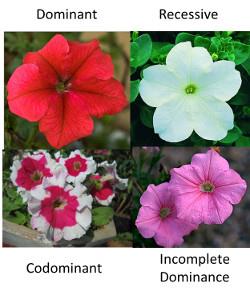
Alleles can show different degrees of dominance:
Complete dominance: Heterozygote and dominant homozygote have identical phenotypes.
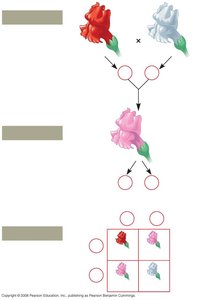
Incomplete dominance: Heterozygote phenotype is intermediate between the two parental phenotypes.
Codominance: Both alleles affect the phenotype in distinct ways.
Pleiotropy
Pleiotropy occurs when a single gene affects multiple phenotypic traits. Examples include cystic fibrosis and sickle-cell disease, where one gene mutation leads to several symptoms.
Polygenic Inheritance and Epistasis
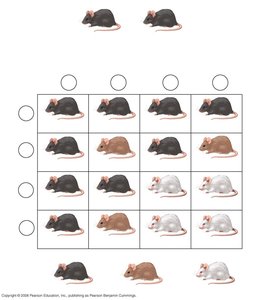
Polygenic inheritance involves the additive effects of two or more genes on a single trait, such as human skin color or height. Epistasis occurs when one gene alters the expression of another gene, as seen in coat color in mice.
Polygenic inheritance: Multiple genes contribute to a single trait.
Epistasis: One gene affects the expression of another gene.
Additional info: The notes expand on Mendel's principles, including modern terminology and examples, to provide a comprehensive overview suitable for General Biology students.
