Back
Mendelian Genetics: Principles and Extensions
Study Guide - Smart Notes
 Tailored notes based on your materials, expanded with key definitions, examples, and context.
Mendelian Genetics
Introduction to Genetics and Heredity
Genetics is the scientific study of heredity, focusing on how traits are transmitted from parents to offspring. Gregor Mendel, an Augustinian monk in the 1860s, established the foundational principles of genetics through his experiments with garden peas. He described 'heritable factors'—now known as genes—that are passed from one generation to the next.
Heredity: The transmission of traits from parents to offspring.
Trait: Any characteristic of an individual, such as flower color or seed shape.
Mendel's work disproved earlier hypotheses such as blending inheritance and inheritance of acquired characteristics.
Mendel’s Experimental System
Mendel selected the garden pea (Pisum sativum) as his model organism due to its ease of cultivation, short generation time, and the presence of several polymorphic traits (traits that appear in two or more distinct forms). He focused on traits with clear, either-or differences, such as purple versus white flowers.
True-breeding: Plants that produce offspring identical to themselves when self-pollinated.
Cross-pollination: Fertilization between different plants, allowing Mendel to control parentage.
Results of Mendel’s Crosses
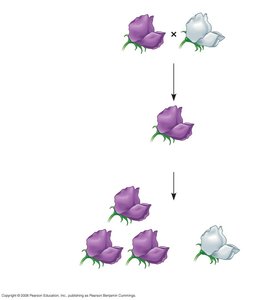
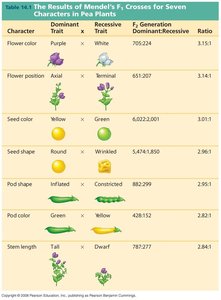
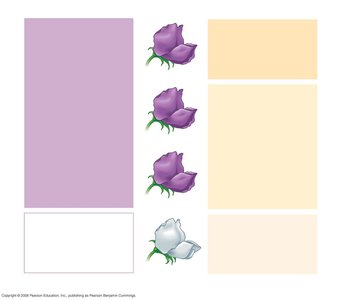
Mendel performed crosses between true-breeding plants with contrasting traits. The first generation (F1) always showed only one of the parental traits (dominant), while the second generation (F2) revealed a 3:1 ratio of dominant to recessive traits.
P generation: True-breeding parents.
F1 generation: All hybrids showing the dominant trait.
F2 generation: 3:1 ratio of dominant to recessive phenotypes.
Genes, Alleles, and Genotypes
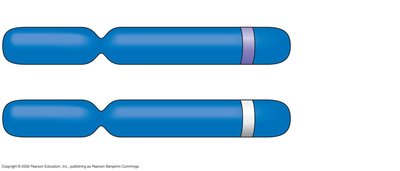
Mendel proposed that each trait is controlled by a pair of hereditary factors (genes), with different versions called alleles. The combination of alleles in an individual is its genotype, which determines its phenotype (observable trait).
Allele: Alternative versions of a gene found at the same locus on homologous chromosomes.
Homozygous: Two identical alleles (e.g., PP or pp).
Heterozygous: Two different alleles (e.g., Pp).
Mendel’s Laws
Law of Segregation
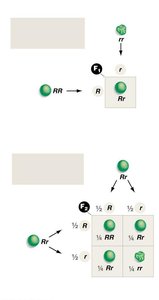
Each individual has two alleles for each gene, which segregate during gamete formation so that each gamete receives only one allele. This explains the 3:1 ratio observed in the F2 generation.
Punnett square: A diagram used to predict the outcome of a genetic cross.
Dominant alleles are represented by uppercase letters; recessive alleles by lowercase.
Law of Independent Assortment
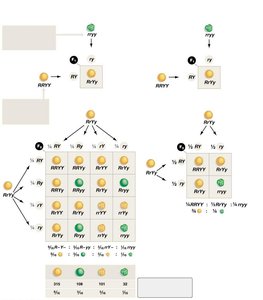
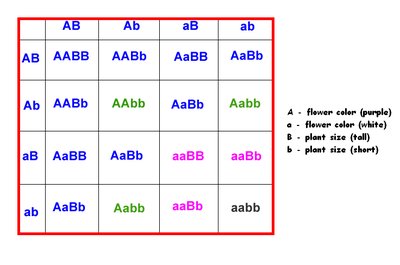
Alleles of different genes assort independently during gamete formation, leading to genetic variation. This law was demonstrated by Mendel's dihybrid crosses, which produced a 9:3:3:1 phenotypic ratio in the F2 generation.
Monohybrid cross: Inheritance pattern of a single trait.
Dihybrid cross: Inheritance pattern of two traits.
Testcrosses
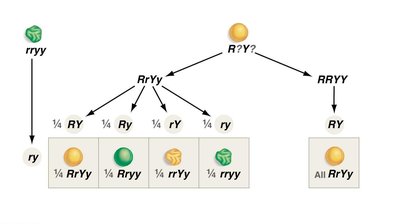
A testcross is used to determine the genotype of an individual with a dominant phenotype by crossing it with a homozygous recessive individual. The offspring phenotypes reveal the unknown genotype.
Sex Linkage and Chromosome Theory
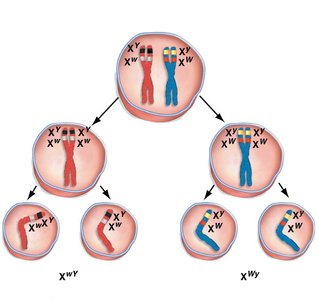
Sex chromosomes (X and Y) determine the sex of offspring. Genes located on these chromosomes exhibit sex linkage. Genes on the same chromosome may be linked and inherited together, violating independent assortment unless separated by crossing over.
Extensions of Mendelian Genetics
Multiple Alleles and Blood Types
Some genes have more than two alleles in a population, a phenomenon called multiple allelism. For example, the human ABO blood group is determined by three alleles: IA, IB, and i.
Degrees of Dominance
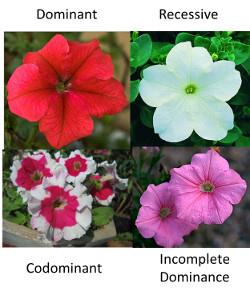
Complete dominance: Heterozygote and dominant homozygote are phenotypically identical.
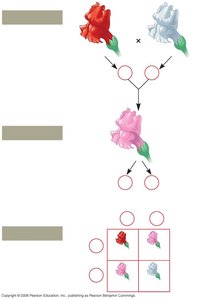
Incomplete dominance: Heterozygote phenotype is intermediate between the two homozygotes.
Codominance: Both alleles are fully expressed in the heterozygote.
Pleiotropy and Polygenic Inheritance
Pleiotropy: A single gene affects multiple phenotypic traits (e.g., Marfan syndrome, sickle-cell disease).
Polygenic inheritance: Multiple genes contribute additively to a single trait (e.g., human skin color, height).
Epistasis
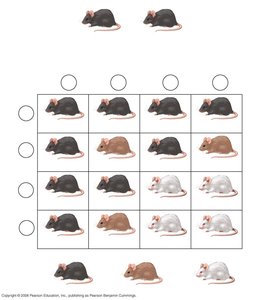
Epistasis occurs when the expression of one gene is affected by another gene. For example, in mice, one gene determines pigment color, while another gene determines whether pigment is deposited in the hair.