 Back
Mendelian Genetics: Principles and Patterns of Inheritance
Study Guide - Smart Notes
 Tailored notes based on your materials, expanded with key definitions, examples, and context.
Mendelian Genetics
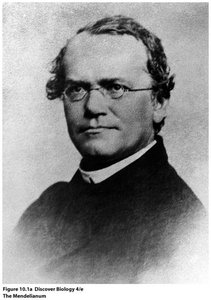
Gregor Mendel: The Father of Genetics
Gregor Mendel was an Austrian monk whose experiments with pea plants established the foundational principles of genetics. His work revealed how traits are inherited from one generation to the next, forming the basis for modern genetics.
Mendel's Experimental Approach
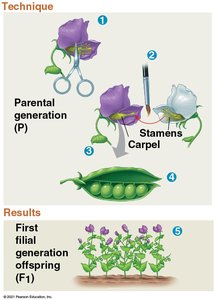
Mendel used controlled crosses between pea plants to study inheritance. He carefully manipulated the reproductive organs to ensure accurate pollination and observed the resulting offspring.
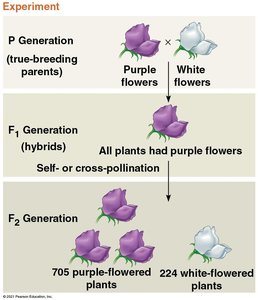
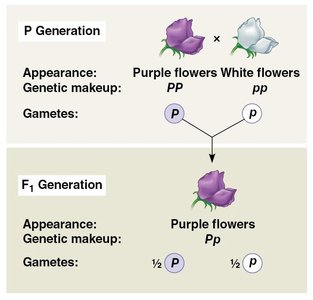
Parental Generation (P): True-breeding plants with distinct traits.
F1 Generation: Offspring of the parental cross, all showing the dominant trait.
F2 Generation: Offspring of F1 self- or cross-pollination, showing both dominant and recessive traits.
Characters and Traits Studied by Mendel
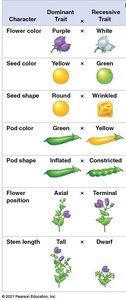
Mendel examined several traits in pea plants, each with a dominant and recessive form. These traits included flower color, seed color, seed shape, pod color, pod shape, flower position, and stem length.
Character | Dominant Trait | Recessive Trait |
|---|---|---|
Flower color | Purple | White |
Seed color | Yellow | Green |
Seed shape | Round | Wrinkled |
Pod color | Green | Yellow |
Pod shape | Inflated | Constricted |
Flower position | Axial | Terminal |
Stem length | Tall | Dwarf |
Basic Genetic Concepts
Genes, Alleles, and Chromosomes
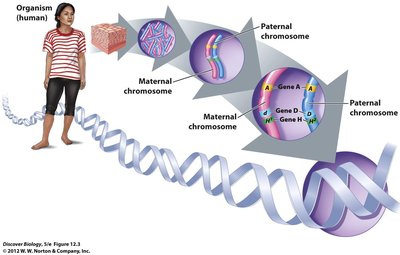
Genes are the basic units of inheritance, located on chromosomes. An allele is an alternate version of a gene. Each individual inherits two alleles for each gene, one from each parent.
Genotype: The genetic makeup of an organism (e.g., PP, Pp, pp).
Phenotype: The observable traits of an organism (e.g., purple or white flowers).
Homozygous: Having two identical alleles for a gene (e.g., PP or pp).
Heterozygous: Having two different alleles for a gene (e.g., Pp).
Dominance and Recessiveness
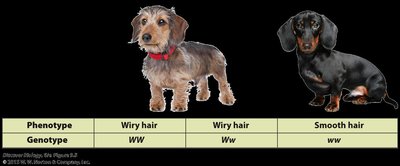
Dominant alleles mask the effect of recessive alleles in heterozygotes. For example, in pea plants, the allele for purple flowers (P) is dominant over the allele for white flowers (p).
Molecular Basis of Alleles
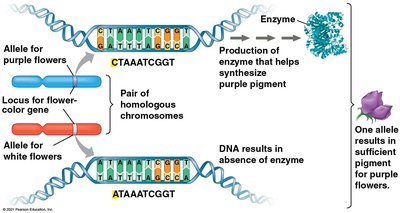
Alleles differ in their DNA sequence, which can affect the production of enzymes and the resulting phenotype. For example, the allele for purple flowers produces an enzyme that synthesizes purple pigment, while the allele for white flowers does not.
Genotype-Phenotype Relationships
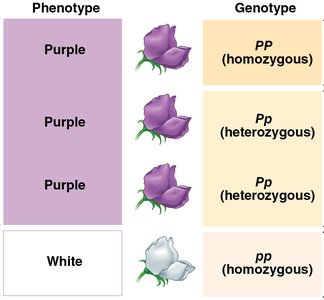
The relationship between genotype and phenotype can be illustrated as follows:
Phenotype | Genotype |
|---|---|
Purple | PP (homozygous) |
Purple | Pp (heterozygous) |
Purple | Pp (heterozygous) |
White | pp (homozygous) |
Mendel's Laws of Inheritance
Law of Segregation (Mendel's First Law)
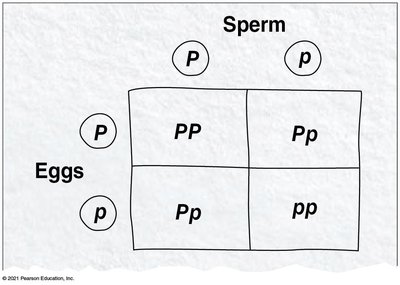
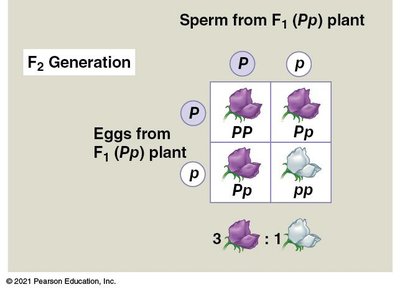
This law states that two alleles for a gene separate during meiosis and end up in different gametes. Mendel demonstrated this principle through monohybrid crosses, which follow a single character.
Monohybrid Cross: A cross between two individuals heterozygous for one gene (e.g., Pp x Pp).
F1 Generation: All offspring are heterozygous (Pp) and show the dominant phenotype.
F2 Generation: Offspring show a 3:1 phenotypic ratio and a 1:2:1 genotypic ratio.
Law of Independent Assortment (Mendel's Second Law)
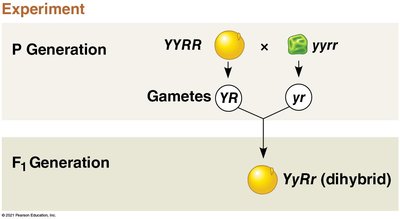
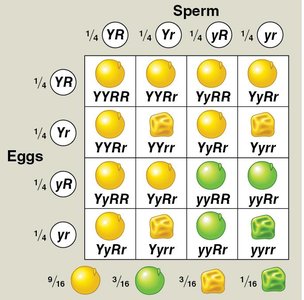
This law states that genes for different traits assort independently during meiosis. Mendel demonstrated this principle through dihybrid crosses, which follow two characters.
Dihybrid Cross: A cross between individuals heterozygous for two genes (e.g., YyRr x YyRr).
F1 Generation: All offspring are dihybrids (YyRr).
F2 Generation: Offspring show a 9:3:3:1 phenotypic ratio.
Extensions of Mendelian Genetics
Incomplete Dominance
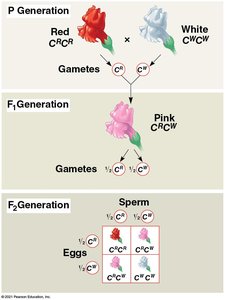
In incomplete dominance, the heterozygote displays a phenotype intermediate between the two homozygotes. For example, crossing red and white snapdragons produces pink offspring.
Genotypes: CRCW (pink), CRCR (red), CWCW (white)
F2 Generation: Shows a 1:2:1 genotypic and phenotypic ratio.
Codominance
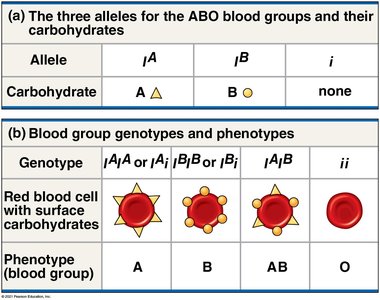
In codominance, both alleles are fully expressed in the heterozygote. The ABO blood group system in humans is a classic example.
Blood Types: A, B, AB, O
Genotypes: IAIA or IAi (A), IBIB or IBi (B), IAIB (AB), ii (O)
Allele | Carbohydrate |
|---|---|
IA | A |
IB | B |
i | none |
Genotype | Phenotype (Blood Group) |
|---|---|
IAIA or IAi | A |
IBIB or IBi | B |
IAIB | AB |
ii | O |
Human Sex Determination and Sex-linked Inheritance
Chromosomal Basis of Sex Determination
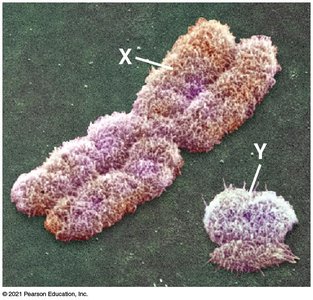
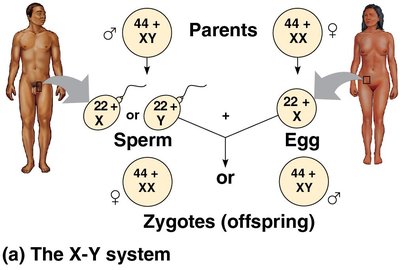
Sex in humans is determined by the presence of X and Y chromosomes. Females have two X chromosomes (XX), while males have one X and one Y chromosome (XY). The sperm determines the sex of the offspring.
Autosomal and Sex-linked Inheritance
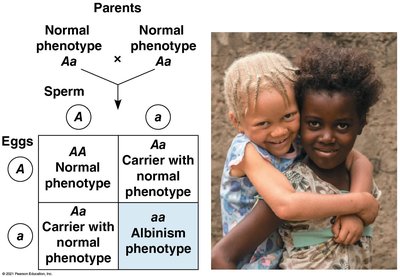
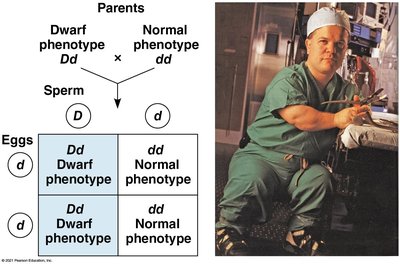
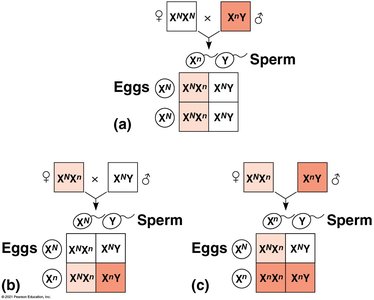
Autosomal traits are inherited through non-sex chromosomes, while sex-linked traits are carried on sex chromosomes, most commonly the X chromosome.
Autosomal Recessive: Both alleles must be recessive for the trait to be expressed (e.g., albinism).
Autosomal Dominant: Only one dominant allele is needed for the trait to be expressed (e.g., dwarfism).
Sex-linked (X-linked) Recessive: More likely to affect males, as they have only one X chromosome.
Key Terms and Concepts
Gene: Unit of heredity, segment of DNA encoding a trait.
Allele: Alternative form of a gene.
Dominant: Allele that masks the effect of another.
Recessive: Allele whose effect is masked by a dominant allele.
Homozygous: Two identical alleles for a gene.
Heterozygous: Two different alleles for a gene.
Genotype: Genetic makeup.
Phenotype: Observable traits.
Locus: Location of a gene on a chromosome.
F1: First filial generation.
F2: Second filial generation.
True-breeding: Organisms that produce offspring identical to themselves.
Additional Concepts
Pleiotropy: One gene affects multiple traits (e.g., sickle cell anemia).
Polygenic Inheritance: Multiple genes contribute to a single trait, leading to continuous variation (e.g., skin color).
Pedigree Analysis: Used to track inheritance patterns in families.
Additional info: Polygenic inheritance results in a range of phenotypes because many genes contribute additively to the trait. Pleiotropy occurs when a single gene influences several distinct phenotypic features.
