Back
Mendelian Genetics: Principles of Heredity and Patterns of Inheritance
Study Guide - Smart Notes
 Tailored notes based on your materials, expanded with key definitions, examples, and context.
Mendel and the Gene Idea
Introduction to Mendelian Genetics
Mendel's experiments with garden peas established the foundational principles of heredity. By carefully breeding pea plants, Mendel was able to deduce how traits are passed from one generation to the next.
Gene: A region of DNA whose product contributes to a characteristic.
Allele: Alternative versions of the same gene (e.g., purple vs. white flower color).
Locus: The specific location a gene occupies on a chromosome.
Genes and Alleles
Allelic Variation and Chromosomal Location
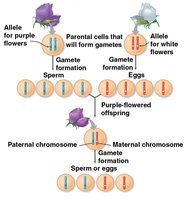
Each gene exists in multiple forms called alleles, which are responsible for the variation in traits.
Example: The gene for flower color in peas has two alleles: P (purple) and p (white).
Diploid cells have two alleles for each gene, one from each parent.
Mendel’s Law of Segregation
Allele Separation During Gamete Formation
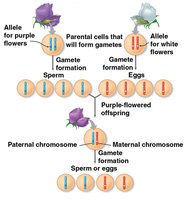
Mendel’s Law of Segregation states that allele pairs separate during gamete formation (meiosis), so each gamete receives only one allele for each gene.
The two alleles may be identical (homozygous) or different (heterozygous).
Gametes are haploid and carry only one allele per gene.
Phenotype vs. Genotype
Distinguishing Physical Appearance from Genetic Makeup
An organism’s traits (phenotype) do not always reveal its genetic composition (genotype).
Phenotype: Physical appearance (e.g., purple flowers).
Genotype: Genetic makeup (e.g., PP, Pp, or pp).
PP and Pp plants have the same phenotype (purple) but different genotypes.
Dominant and Recessive Alleles
Complete Dominance and Trait Expression
Complete dominance occurs when the phenotype of the heterozygote (Pp) is identical to the dominant homozygote (PP).
Dominant allele: Determines the organism’s appearance.
Recessive allele: Has no noticeable effect on appearance unless homozygous (pp).
Heterozygotes (Pp) carry the recessive allele and can pass it to offspring.
Mendel’s Hybridization Experiment
True-Breeding and Generational Crosses
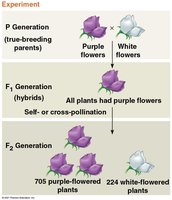
Mendel mated two contrasting true-breeding varieties (homozygous PP and pp) in a process called hybridization.
P generation: True-breeding parents (PP or pp).
F1 generation: Hybrid offspring (all Pp, purple flowers).
F2 generation: Produced by self- or cross-pollination of F1 hybrids, showing a 3:1 ratio of purple to white flowers.
Punnett Squares
Predicting Genetic Outcomes
Punnett squares are used to visualize possible combinations of sperm and egg and predict offspring genotypes and phenotypes.
Each box represents a possible fertilization outcome.
Capital letter (P) for dominant allele, lowercase (p) for recessive.
Testcross: Revealing Unknown Genotypes
Determining Homozygosity or Heterozygosity
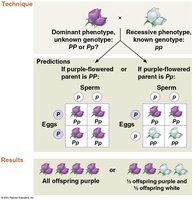
A testcross involves crossing a dominant phenotype (PP or Pp) with a homozygous recessive (pp) to determine the genotype.
If the dominant parent is PP, all offspring are purple.
If the dominant parent is Pp, half the offspring are purple and half are white.
Mendel’s Law of Independent Assortment
Independent Segregation of Alleles
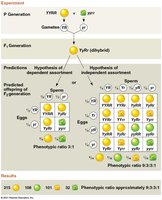
This law states that each pair of alleles segregates independently during gamete formation.
Applies to genes on different, nonhomologous chromosomes or those far apart on the same chromosome.
Genes close together on the same chromosome are genetically linked and tend to be inherited together.
Patterns of Dominance
Beyond Simple Mendelian Genetics
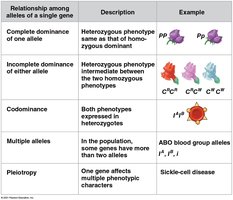
Inheritance patterns can be more complex than predicted by Mendel’s laws.
Complete dominance: Heterozygote phenotype matches homozygous dominant.
Incomplete dominance: Heterozygote phenotype is intermediate between two homozygotes.
Codominance: Both alleles are expressed in the phenotype.
Multiple alleles: More than two allelic forms exist in a population (e.g., blood groups).
Pleiotropy: One gene affects multiple phenotypic characters.
Relationship among alleles | Description | Example |
|---|---|---|
Complete dominance | Heterozygous phenotype same as homozygous dominant | Pp (purple flowers) |
Incomplete dominance | Heterozygous phenotype intermediate | CRCW (pink flowers) |
Codominance | Both phenotypes expressed in heterozygotes | IAIB (AB blood group) |
Multiple alleles | More than two alleles in population | ABO blood group alleles |
Pleiotropy | One gene affects multiple traits | Sickle-cell disease |
Blood Groups: An Example of Multiple Alleles and Codominance
ABO Blood Group System
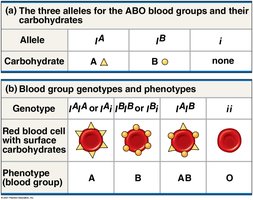
The ABO blood group system demonstrates both multiple alleles and codominance.
Three alleles: IA, IB, and i.
Genotypes and phenotypes:
IAIA or IAi: Type A
IBIB or IBi: Type B
IAIB: Type AB (codominant)
ii: Type O
Allele | Carbohydrate |
|---|---|
IA | A |
IB | B |
i | none |
Genotype | Phenotype (blood group) |
|---|---|
IAIA or IAi | A |
IBIB or IBi | B |
IAIB | AB |
ii | O |
Probability and Mendelian Inheritance
Rules of Probability in Genetics
Mendel’s laws reflect the rules of probability, similar to tossing coins or rolling dice.
The outcome of one event does not affect the outcome of another.
Alleles segregate independently into gametes.
Polygenic and Multifactorial Inheritance
Complex Traits and Environmental Influence
Some traits are controlled by multiple genes (polygenic inheritance) and influenced by environmental factors (multifactorial inheritance).
Polygenic inheritance: Additive effect of two or more genes on a single phenotype (e.g., height, skin pigmentation).
Multifactorial traits: Traits influenced by both genetic and environmental factors (e.g., heart disease, cancer).
Pedigrees
Tracking Traits Through Generations
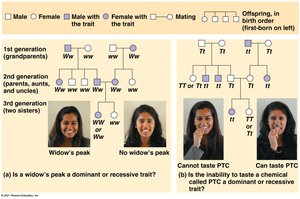
A pedigree is a diagram that tracks a characteristic through generations of a family.
Used to analyze inheritance patterns and predict genetic risks.