 Back
Mendelian Genetics: Principles of Heredity and Laws of Inheritance
Study Guide - Smart Notes
 Tailored notes based on your materials, expanded with key definitions, examples, and context.
Mendelian Genetics: Principles of Heredity
Introduction to Mendel’s Experiments
Gregor Mendel’s experiments with garden peas established the foundational principles of heredity. By carefully controlling plant breeding, Mendel identified predictable patterns in the inheritance of traits, leading to the formulation of two key laws of inheritance.
Character: A heritable feature that varies among individuals (e.g., flower color, seed shape).
Trait: Each variant of a character (e.g., purple vs. white flowers).
Mendel used true-breeding varieties, which consistently produce offspring with the same traits when self-pollinated.
Advantages of pea plants: short generation time, large number of offspring, and controlled mating.
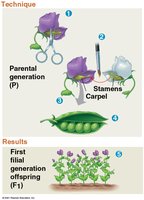
Mendel’s Experimental Design
Mendel performed hybridization by crossing two contrasting, true-breeding varieties. The parental generation (P) produced hybrid offspring (F1), which were then self- or cross-pollinated to yield the F2 generation.
P generation: True-breeding parents.
F1 generation: First filial generation, all hybrids.
F2 generation: Offspring from F1 self- or cross-pollination.
Results of Mendel’s Crosses
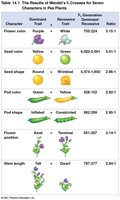
Mendel observed consistent inheritance patterns across seven pea plant characters, each with two distinct traits. The F2 generation typically showed a 3:1 ratio of dominant to recessive traits.
Character | Dominant Trait | Recessive Trait | Observed Ratio |
|---|---|---|---|
Flower color | Purple | White | 3.15:1 |
Seed color | Yellow | Green | 2.96:1 |
Seed shape | Round | Wrinkled | 2.96:1 |
Pod color | Green | Yellow | 2.82:1 |
Pod shape | Inflated | Constricted | 2.95:1 |
Flower position | Axial | Terminal | 3.14:1 |
Stem length | Tall | Dwarf | 2.84:1 |
Mendel’s Model of Inheritance
Key Concepts of Mendel’s Model
Mendel’s model explained the 3:1 inheritance pattern in the F2 generation using four related concepts, which align with modern genetic understanding:
Alternative Versions of Genes (Alleles): Genes exist in different forms called alleles, located at specific loci on chromosomes.
Inheritance of Alleles: Each organism inherits two alleles for each gene, one from each parent. These alleles may be identical (homozygous) or different (heterozygous).
Dominant and Recessive Alleles: If alleles differ, the dominant allele determines the phenotype, while the recessive allele is masked.
Law of Segregation: The two alleles for a gene segregate during gamete formation, so each gamete carries only one allele for each gene.
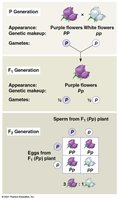
Punnett Square: A tool to predict the possible combinations of alleles in offspring. Dominant alleles are represented by capital letters, recessive by lowercase.
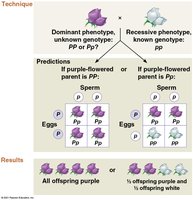
Testcross: Determining Genotype
To determine whether an individual with a dominant phenotype is homozygous or heterozygous, a testcross is performed by crossing with a homozygous recessive individual. The offspring phenotypes reveal the unknown genotype.
Mendel’s Laws of Inheritance
Law of Segregation
The Law of Segregation states that allele pairs separate during gamete formation, and each gamete receives only one allele. This explains the 3:1 ratio in the F2 generation.
Law of Independent Assortment
Mendel’s second law, the Law of Independent Assortment, states that each pair of alleles segregates independently of other pairs during gamete formation. This law applies to genes on different chromosomes or those far apart on the same chromosome. Genes located close together on the same chromosome tend to be inherited together.
Dihybrid cross: A cross between individuals heterozygous for two characters, used to test independent assortment.
From Mendel to Modern Genetics
Mendel’s “heritable factors” are now known as genes. His principles form the basis of classical genetics and are essential for understanding inheritance patterns in all organisms.
Example: The inheritance of flower color in peas (purple vs. white) follows Mendel’s laws and can be predicted using Punnett squares and knowledge of dominant/recessive relationships.
Additional info: Modern genetics has expanded on Mendel’s work, identifying exceptions such as incomplete dominance, codominance, and gene linkage, but Mendel’s laws remain foundational for understanding basic inheritance.
