 Back
Mendelian Inheritance Patterns: Principles, Experiments, and Applications
Study Guide - Smart Notes
 Tailored notes based on your materials, expanded with key definitions, examples, and context.
Mendelian Inheritance Patterns
Introduction to Mendelian Genetics
Mendelian genetics is the foundation of classical genetics, describing how traits are inherited from one generation to the next. Gregor Mendel's experiments with garden peas led to the discovery of fundamental principles that explain inheritance patterns in sexually reproducing organisms.
Key Concepts in Mendelian Genetics
Genes, Alleles, and Genotypes
Gene: A segment of DNA that encodes information for a specific trait.
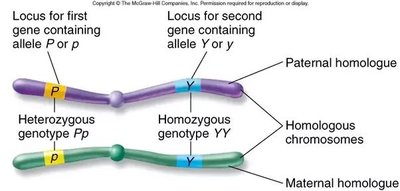
Allele: Different versions of the same gene. For example, the gene for flower color in peas may have a purple allele (P) and a white allele (p).
Genotype: The genetic makeup of an organism for a particular gene, represented by the alleles present (e.g., PP, Pp, or pp).
Homozygous: An individual with two identical alleles for a gene (e.g., PP or pp).
Heterozygous: An individual with two different alleles for a gene (e.g., Pp).
Dominant and Recessive Alleles
Dominant allele: The allele whose phenotypic effect is observed when present in either homozygous or heterozygous form (e.g., P for purple flowers).
Recessive allele: The allele whose phenotypic effect is only observed when present in the homozygous form (e.g., p for white flowers).
Phenotype: The observable trait or characteristic of an organism (e.g., purple or white flowers).
Examples of Mendelian Traits in Peas
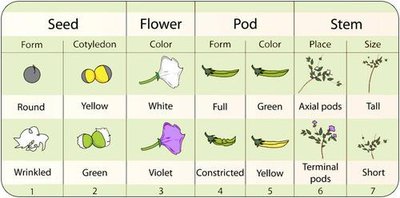
Mendel studied seven easily distinguishable traits in garden peas, each controlled by a single gene with two alleles.
Trait | Dominant Phenotype | Recessive Phenotype |
|---|---|---|
Seed Shape | Round | Wrinkled |
Seed Color | Yellow | Green |
Pod Shape | Full | Constricted |
Pod Color | Green | Yellow |
Flower Color | Purple | White |
Flower Position | Axial | Terminal |
Stem Length | Tall | Short |
Mendel's Experiments and Principles
Monohybrid Crosses and the Principle of Segregation
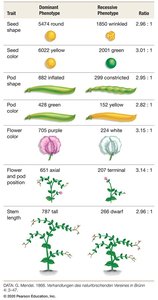
Mendel began his experiments with pure-breeding (homozygous) lines. When crossing two pure-breeding parents with different traits (e.g., round vs. wrinkled seeds), all F1 offspring displayed the dominant trait. Self-fertilization of F1 hybrids produced F2 offspring with a 3:1 phenotypic ratio (dominant:recessive).
Principle of Segregation: During meiosis, the two alleles for a gene separate, so each gamete receives only one allele. Fertilization restores the diploid state.
Punnett Squares
Punnett squares are used to visualize and predict the outcome of genetic crosses. They model the segregation of alleles and the resulting genotypic and phenotypic ratios.
Genotypic ratio (F2): 1 homozygous dominant : 2 heterozygous : 1 homozygous recessive
Phenotypic ratio (F2): 3 dominant : 1 recessive
Dihybrid Crosses and the Principle of Independent Assortment
Mendel extended his experiments to crosses involving two traits (dihybrid crosses). He found that alleles of different genes assort independently during gamete formation, leading to new combinations of traits in the offspring.
Principle of Independent Assortment: Alleles of different genes are distributed independently of one another during meiosis, provided the genes are on different chromosomes.
Dihybrid cross phenotypic ratio (F2): 9:3:3:1 (for two genes with complete dominance and independent assortment)
Chromosomal Basis of Mendel's Principles
Meiosis and Segregation
Meiosis explains Mendel's principles at the cellular level. Homologous chromosomes (and thus alleles) separate during meiosis I, ensuring each gamete receives only one allele for each gene.
Fertilization restores the diploid state, combining alleles from both parents.
Meiosis and Independent Assortment
During meiosis, the orientation of homologous chromosome pairs is random, leading to independent assortment of genes located on different chromosomes. Genes that are close together on the same chromosome (linked genes) may not assort independently unless crossing over occurs.
Summary Table: Mendel's Seven Traits and Ratios
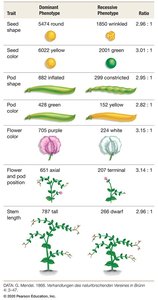
Trait | Dominant Phenotype | Recessive Phenotype | Ratio (F2) |
|---|---|---|---|
Seed shape | Round | Wrinkled | 2.96:1 |
Seed color | Yellow | Green | 2.01:1 |
Pod shape | Inflated | Constricted | 2.95:1 |
Pod color | Green | Yellow | 2.82:1 |
Flower color | Purple | White | 3.15:1 |
Flower position | Axial | Terminal | 3.14:1 |
Stem length | Tall | Dwarf | 2.96:1 |
Applications and Problem Solving
Use the principle of segregation to predict outcomes of monohybrid crosses.
Apply the principle of independent assortment to predict outcomes of dihybrid crosses.
Understand how meiosis explains Mendel's principles at the cellular level.
Example Problem
If a heterozygous pea plant for seed color (Yy) is crossed with a plant with green seeds (yy), what percentage of offspring will be heterozygous?
Possible offspring: Yy and yy (50% each)
Answer: 50% heterozygous
Conclusion
Mendel's principles of segregation and independent assortment form the basis of classical genetics. These principles, supported by the chromosomal behavior during meiosis, allow for the prediction of inheritance patterns in sexually reproducing organisms.
