 Back
Lecture Slides 6: Metabolism and Energy: Principles of Biological Energy Transformation
Study Guide - Smart Notes
 Tailored notes based on your materials, expanded with key definitions, examples, and context.
Metabolism and Energy
Introduction to Metabolism
Metabolism is the sum of all chemical reactions that occur within a living organism. These reactions are essential for maintaining life, enabling organisms to grow, reproduce, and respond to their environment. Metabolism is an emergent property resulting from the orderly interactions between molecules within cells.
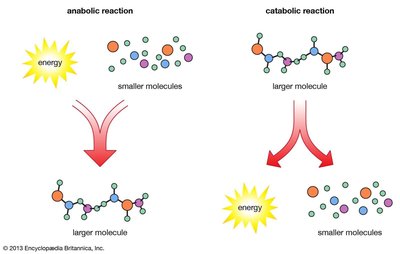
Catabolic pathways break down complex molecules into simpler ones, releasing energy.
Anabolic pathways build complex molecules from simpler ones, consuming energy.
Energy in Biological Systems
Energy is the capacity to cause change or do work. In biological systems, energy exists in various forms and is constantly transformed during metabolic processes.
Chemical energy: Stored in the bonds of molecules (e.g., glucose, ATP).
Potential energy: Energy due to position or structure (e.g., a stretched slingshot).
Kinetic energy: Energy of motion (e.g., a moving cyclist).



Open and Closed Systems
Biological systems are open systems, exchanging energy and matter with their surroundings. This is essential for sustaining life, as cells must constantly import energy and materials and export waste.
Open system: Energy and matter can be transferred between the system and its environment.
Closed system: Isolated from its environment; no exchange of energy or matter.

Laws of Thermodynamics in Biology
First Law of Thermodynamics
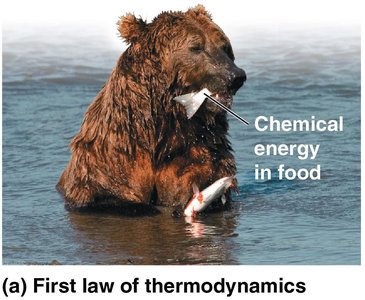
The first law of thermodynamics states that energy cannot be created or destroyed, only transferred or transformed. In living organisms, chemical energy from food is converted into other forms of energy to power cellular processes.
Also known as the law of conservation of energy.
Example: Chemical energy in food is converted to kinetic energy and heat in animals.
Second Law of Thermodynamics
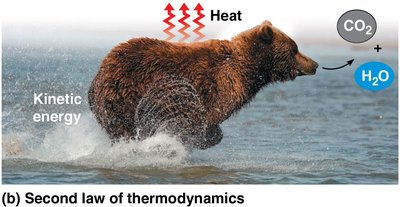
The second law of thermodynamics states that every energy transfer or transformation increases the entropy (disorder) of the universe. Living systems maintain order by increasing the entropy of their surroundings.
Entropy (S): A measure of molecular disorder or randomness.
Biological processes create local order but increase overall entropy.
Free Energy and Spontaneity of Reactions
Free Energy (G)
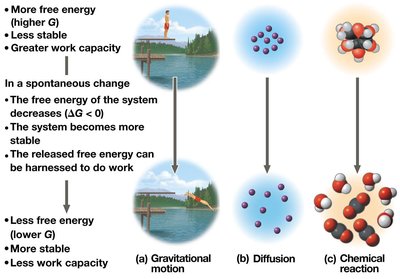
Free energy (G) is the portion of a system's energy that can perform work when temperature and pressure are uniform. The change in free energy () determines whether a process is spontaneous.
Unstable systems (higher G) tend to become more stable (lower G).
Equilibrium: State of maximum stability; no net change in free energy.

Exergonic and Endergonic Reactions
Metabolic reactions can be classified based on their energy changes:
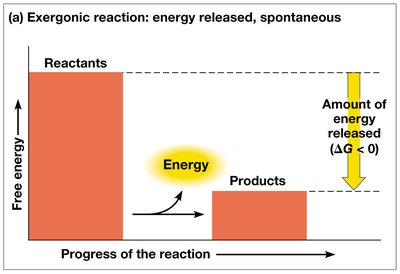
Exergonic reactions: Release free energy; spontaneous ().
Endergonic reactions: Absorb free energy; nonspontaneous ().
Free Energy and Work
Free energy changes can be harnessed to do work in cells, such as moving molecules, synthesizing macromolecules, or generating electrical gradients.
Spontaneous changes release free energy that can be used for cellular work.
Nonspontaneous changes require an input of energy.
ATP: The Energy Currency of the Cell
Role of ATP in Metabolism
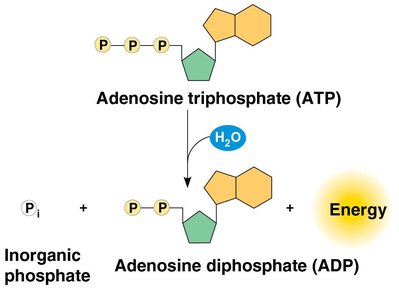
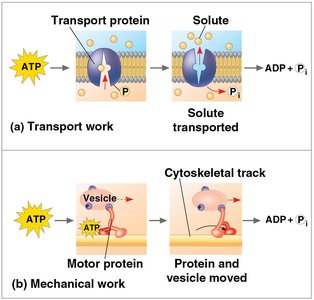
Adenosine triphosphate (ATP) is the primary energy carrier in cells. It couples exergonic and endergonic reactions, allowing cells to perform work.
ATP stores energy in its high-energy phosphate bonds.
Hydrolysis of ATP releases energy that can be used for cellular processes.
ATP Cycle
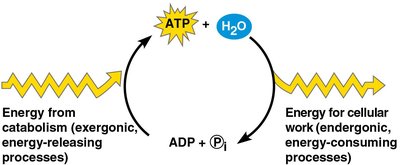
The ATP cycle describes the continuous regeneration of ATP from ADP and inorganic phosphate () using energy from catabolic reactions. This cycle is essential for maintaining the energy balance in cells.
Energy from catabolism (exergonic reactions) is used to synthesize ATP.
ATP hydrolysis provides energy for cellular work (endergonic reactions).
Types of Cellular Work Powered by ATP
Cells use ATP to perform three main types of work:
Chemical work: Driving endergonic reactions (e.g., synthesis of macromolecules).
Transport work: Pumping substances across membranes against their concentration gradients.
Mechanical work: Movement of cellular structures (e.g., muscle contraction, movement of vesicles).
Metabolic Pathways: Anabolism and Catabolism
Anabolic and Catabolic Reactions
Metabolism is divided into two complementary processes:
Anabolic reactions: Build larger molecules from smaller ones, requiring energy input.
Catabolic reactions: Break down larger molecules into smaller ones, releasing energy.
Metabolic Pathways and Cellular Organization
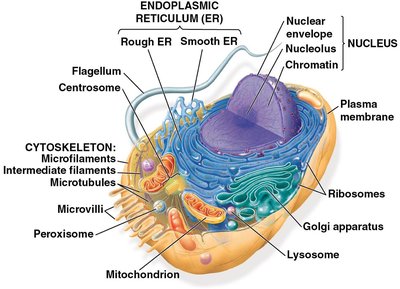
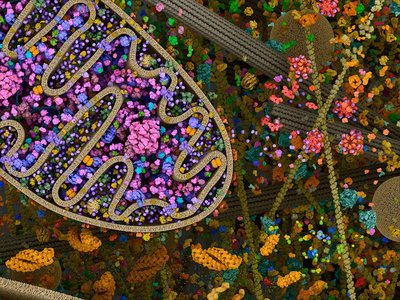
Metabolic pathways are sequences of enzymatically catalyzed chemical reactions in cells. These pathways are highly regulated and compartmentalized within organelles, such as mitochondria, to maximize efficiency and control.
Summary Table: Exergonic vs. Endergonic Reactions
Feature | Exergonic Reaction | Endergonic Reaction |
|---|---|---|
Energy Change () | Negative () | Positive () |
Spontaneity | Spontaneous | Nonspontaneous |
Energy Flow | Releases energy | Requires energy input |
Example | Cellular respiration | Photosynthesis |
Key Equations
Change in free energy: Where: = change in free energy, = change in enthalpy (total energy), = temperature in Kelvin, = change in entropy.
ATP hydrolysis:
Conclusion
Metabolism is the foundation of all biological activity, integrating the laws of thermodynamics with the chemical processes of life. The transformation of energy, the role of ATP, and the balance between anabolic and catabolic pathways are central to understanding how cells function and maintain order in a universe tending toward disorder.
