 Back
Metabolism, Cellular Respiration, and Photosynthesis: Core Concepts and Mechanisms
Study Guide - Smart Notes
 Tailored notes based on your materials, expanded with key definitions, examples, and context.
Metabolism: The Chemical Reactions of Life
Overview of Metabolism
Metabolism encompasses all chemical reactions occurring within an organism, divided into two main categories: catabolism and anabolism. These processes are fundamental to maintaining life by managing energy and matter transformation.
Catabolism: The breakdown of complex molecules into simpler ones, releasing energy. Example: Protein → amino acids.
Anabolism: The synthesis of complex molecules from simpler ones, requiring energy input. Example: Amino acids → protein.
Mnemonic: "Cats break, anabolic steroids build."

Conservation of Matter and Energy
Biological systems obey the laws of conservation of matter and energy. Matter and energy are neither created nor destroyed, only transformed. In biological contexts, this means the elements and energy entering a reaction are present in different forms in the products.
Photosynthesis: Light energy → electron energy → hydrogen ion gradient energy → chemical energy in ATP → chemical energy in sugar.
Gibbs Free Energy and Reaction Spontaneity
Gibbs Free Energy ()
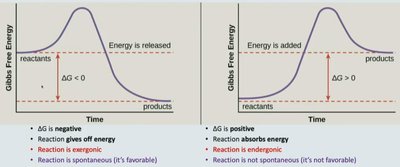
Gibbs free energy determines whether a reaction is spontaneous. The change in free energy () predicts the direction and favorability of chemical reactions.
Exergonic Reaction: ; energy is released; reaction is spontaneous.
Endergonic Reaction: ; energy is absorbed; reaction is non-spontaneous.
Activation Energy and Enzymes
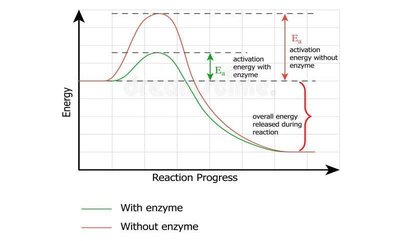
All reactions require an initial input of energy, called activation energy, to proceed. Enzymes are biological catalysts that lower the activation energy, increasing the rate of reactions without being consumed.
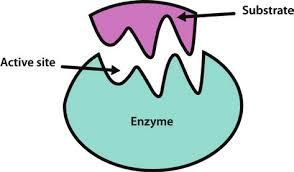
Enzymes have specific active sites that bind substrates.
They can align substrates, strain bonds, create favorable environments, or temporarily form covalent bonds.
Enzyme activity is sensitive to pH and temperature; extreme changes can cause denaturation.
Cellular Respiration
Overview and Purpose
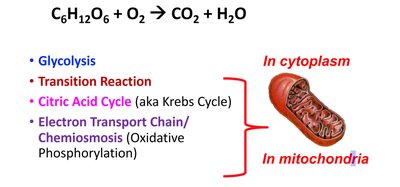
Cellular respiration converts energy stored in glucose into ATP, the cell's usable energy currency. The process involves several stages, each with specific locations, inputs, and outputs.
Overall equation:
Stages: Glycolysis, Transition Reaction, Citric Acid Cycle (Krebs Cycle), Oxidative Phosphorylation
Glycolysis
Glycolysis is the first step of cellular respiration, occurring in the cytoplasm. It splits one glucose (6C) into two pyruvate (3C) molecules, producing ATP and NADH.
Location: Cytoplasm
Products: 2 ATP, 2 NADH, 2 pyruvate
Transition Reaction
Pyruvate is transported into the mitochondrial matrix, where it is converted to acetyl CoA, releasing CO2.
Location: Mitochondrial matrix
Products: 2 acetyl CoA, 2 CO2
Citric Acid Cycle (Krebs Cycle)
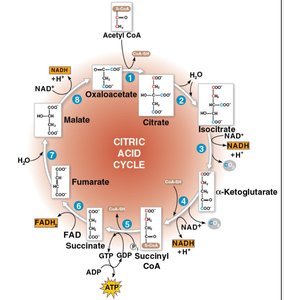
The citric acid cycle completes the breakdown of glucose derivatives, generating NADH, FADH2, ATP, and CO2. It is a cyclic pathway where acetyl CoA combines with oxaloacetate to form citrate, which is then metabolized back to oxaloacetate.
Location: Mitochondrial matrix
Products (per glucose): 6 NADH, 2 FADH2, 2 ATP, 4 CO2
Oxidative Phosphorylation
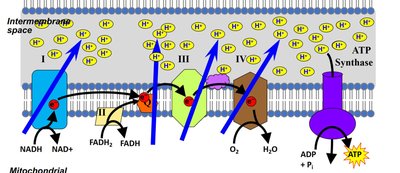
This stage includes the electron transport chain (ETC) and chemiosmosis. High-energy electrons from NADH and FADH2 are transferred through protein complexes, creating a proton gradient used by ATP synthase to generate ATP.
Electron Transport Chain: Transfers electrons to O2, forming H2O and pumping H+ into the intermembrane space.
Chemiosmosis: H+ flows back through ATP synthase, driving ATP production (26-28 ATP per glucose).
Fermentation (Oxygen-Free Energy Production)
When oxygen is absent, cells rely on fermentation to regenerate NAD+ from NADH, allowing glycolysis to continue. End products include lactic acid (in muscle cells and some bacteria) or ethanol and CO2 (in yeast).
Redox Reactions in Metabolism
Oxidation and Reduction
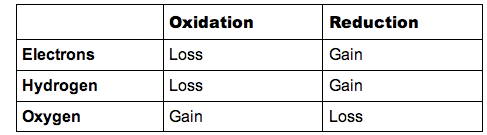
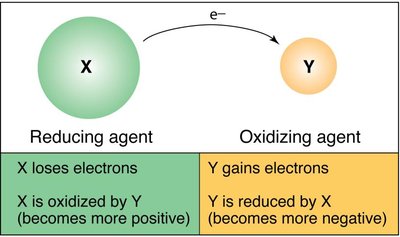
Many metabolic reactions involve the transfer of electrons. Oxidation is the loss of electrons, while reduction is the gain of electrons. The mnemonic "OIL RIG" helps remember this: Oxidation Is Loss, Reduction Is Gain.
Oxidation | Reduction | |
|---|---|---|
Electrons | Loss | Gain |
Hydrogen | Loss | Gain |
Oxygen | Gain | Loss |
Photosynthesis
Overview and Equation
Photosynthesis is the process by which plants, algae, and some bacteria convert CO2 and H2O into glucose and O2 using light energy. It is essentially the reverse of cellular respiration.
Overall equation:

Light-Dependent Reactions
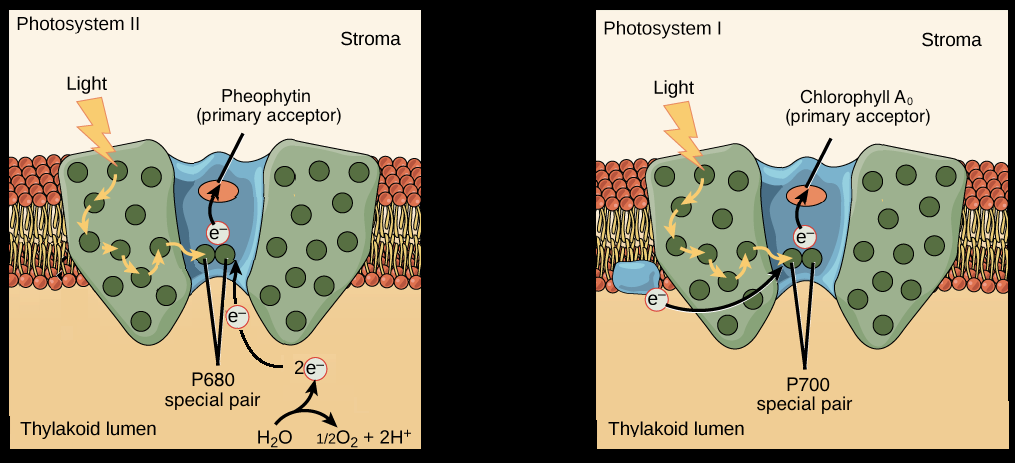
These reactions occur in the thylakoid membranes and convert light energy into chemical energy (ATP and NADPH). They involve two photosystems (PSII and PSI) and an electron transport chain.
Photosystem II (PSII): Splits water to replace lost electrons, produces O2, and generates ATP via chemiosmosis.
Photosystem I (PSI): Receives electrons from PSII, uses light energy to further energize them, and produces NADPH.
Calvin Cycle (Light-Independent Reactions)
The Calvin cycle uses ATP and NADPH from the light reactions to fix CO2 into G3P, which can be used to synthesize glucose and other organic molecules. The cycle involves three main phases:
Fixation: Rubisco enzyme attaches CO2 to RuBP, forming PGA.
Reduction: PGA is converted to G3P using ATP and NADPH.
Regeneration: Some G3P is used to regenerate RuBP, enabling the cycle to continue.
Key Takeaways and Applications
Distinguish between spontaneous (exergonic) and non-spontaneous (endergonic) reactions using .
Understand how enzymes lower activation energy and how their activity is affected by environmental factors.
Describe the stages of cellular respiration and their inputs, outputs, and locations.
Explain the role of redox reactions in energy transfer during metabolism.
Compare and contrast the light-dependent reactions and Calvin cycle in photosynthesis, including their roles, inputs, and outputs.
