 Back
Metabolism: Energy and Enzymes – General Biology Study Notes
Study Guide - Smart Notes
 Tailored notes based on your materials, expanded with key definitions, examples, and context.
Metabolism: Energy and Enzymes
6.1 Cells and the Flow of Energy
Energy is fundamental to all cellular processes, enabling organisms to perform work and maintain life. Energy exists in various forms, including kinetic (energy of motion) and potential (stored energy), such as chemical energy in food.
Kinetic Energy: The energy of motion, exemplified by moving water or muscle contraction.
Potential Energy: Stored energy, often in chemical bonds; food is a primary source.
Mechanical Energy: A form of kinetic energy used by organisms for movement.
Example: Plants convert solar energy into chemical energy, which animals use for mechanical work.
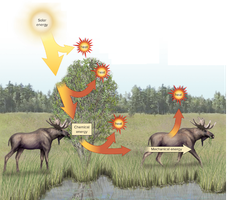
Flow of Energy in Biological Systems
Energy flows from the sun to producers (plants), then to consumers (animals), and is eventually lost as heat. This process is governed by the laws of thermodynamics.
Law of Conservation of Energy: Energy cannot be created or destroyed, only transformed.
Law of Entropy: Energy transformations increase disorder (entropy); some energy is always lost as heat.
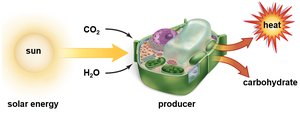

Cells and Entropy
Cellular processes transform energy and increase entropy. Organized molecules like glucose are less stable and have higher potential energy than their breakdown products (CO2 and H2O).
Glucose: More organized, higher potential energy, less stable.
CO2 and H2O: Less organized, lower potential energy, more stable.
Energy Input: Required to build organized molecules from less organized ones (e.g., photosynthesis).
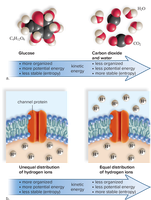
6.2 Metabolic Reactions and Energy Transformations
Metabolism encompasses all chemical reactions in cells. These reactions involve reactants and products, and are classified by their energy changes.
Exergonic Reactions: Release energy; products have less free energy than reactants. Occur spontaneously.
Endergonic Reactions: Require energy input; products have more free energy than reactants. Nonspontaneous.
Free Energy (G): The energy available to do work.
ATP: Energy for Cells
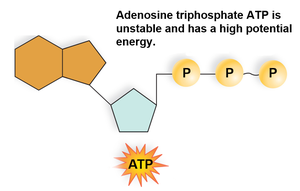
Adenosine triphosphate (ATP) is the primary energy carrier in cells. It is constantly regenerated from adenosine diphosphate (ADP) and phosphate (P) in the ATP cycle.
Structure: Adenine, ribose, and three phosphate groups.
Coupled Reactions: Energy from exergonic reactions is stored in ATP, which then powers endergonic reactions.
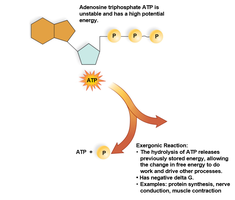
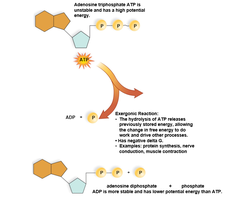
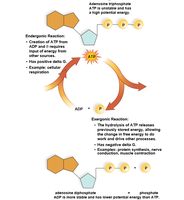
ATP During Muscle Contraction
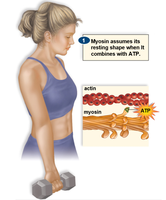
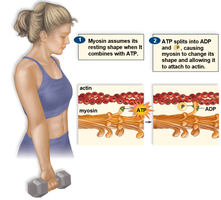
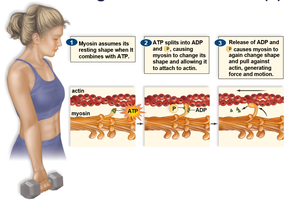
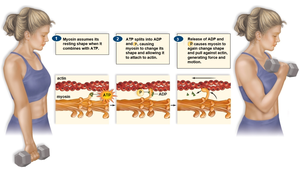
Muscle contraction is powered by ATP. The process involves the interaction of actin and myosin filaments, with ATP hydrolysis driving the mechanical movement.
Myosin binds ATP and assumes its resting shape.
ATP splits into ADP and phosphate, allowing myosin to attach to actin.
Release of ADP and phosphate causes myosin to pull against actin, generating force.
6.3 Metabolic Pathways and Enzymes
Metabolic pathways are sequences of linked reactions, each catalyzed by a specific enzyme. The product of one reaction becomes the substrate for the next.
Metabolic Pathway: A → B → C → D → E → F → G (A = initial reactant, G = end product).
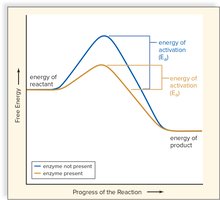
Enzymes: Protein catalysts that accelerate specific reactions by lowering the energy of activation.
Substrates: Reactants in enzymatic reactions.
Enzyme-Substrate Complex
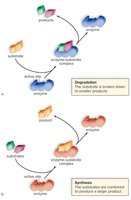
The enzyme's active site binds substrates, causing a shape change that facilitates bond formation (induced fit model).
Degradation: Enzyme breaks substrate into smaller products.
Synthesis: Enzyme joins substrates into a larger product.
Energy of Activation
Activation energy is required to initiate reactions. Enzymes lower this energy, increasing reaction rates and preventing spontaneous degradation.
Enzyme Operation: Brings substrates together, lowers activation energy.
Factors Affecting Enzymatic Rate
Substrate Concentration: Higher concentration increases enzyme activity.
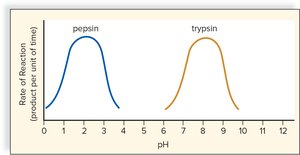
Optimal pH: Each enzyme has a pH optimum (e.g., pepsin in acidic, trypsin in basic conditions).
Temperature: Activity increases with temperature up to a point; high temperatures denature enzymes.
6.4 Oxidation-Reduction Reactions and Metabolism
Redox reactions involve the transfer of electrons between molecules. Oxidation is the loss of electrons, reduction is the gain. These reactions are central to energy transformations in cells.
OIL RIG: Oxidation Is Loss, Reduction Is Gain (of electrons).
Example: Sodium is oxidized, chlorine is reduced in NaCl formation.
Photosynthesis and Cellular Respiration
Photosynthesis reduces CO2 to carbohydrate, storing energy. Cellular respiration oxidizes carbohydrate, releasing energy to build ATP. The equations for these processes are essentially opposites.
Photosynthesis: CO2 + H2O + energy → carbohydrate + O2
Cellular Respiration: carbohydrate + O2 → CO2 + H2O + energy
Relationship of Chloroplasts to Mitochondria
Chloroplasts produce carbohydrates via photosynthesis; mitochondria break them down to generate ATP. Energy flows from the sun, through these organelles, and is eventually lost as heat.
Cycle: Carbohydrate produced in chloroplasts is used in mitochondria for cellular respiration.
Energy Flow: Energy does not cycle; it flows and dissipates as heat.
*Additional info: The study notes expand on brief points with academic context, definitions, and examples for clarity and completeness.*
