 Back
BackMetabolism: Energy, Enzymes, and Cellular Work
Study Guide - Smart Notes
 Tailored notes based on your materials, expanded with key definitions, examples, and context.
Metabolism: Energy and Enzymes
Introduction to Metabolism
Metabolism encompasses all the chemical reactions that occur within living organisms to maintain life. These reactions are organized into metabolic pathways, which are sequences of enzymatically catalyzed steps that transform molecules and transfer energy.
Energy in Biological Systems
Forms of Energy
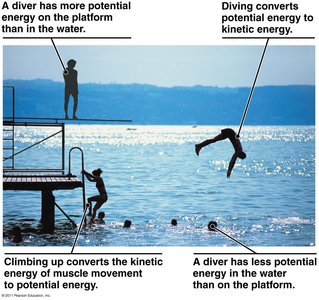
Kinetic Energy: The energy of motion. Examples include the movement of molecules, muscle contraction, and the flow of ions across membranes.
Thermal Energy: A type of kinetic energy associated with the random movement of atoms or molecules, measurable as temperature. It can be transferred as heat.
Light Energy: Another form of kinetic energy, which can be harnessed by organisms (e.g., in photosynthesis).
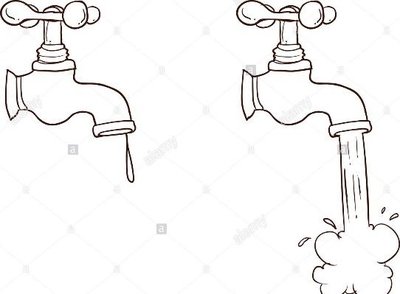
Potential Energy: Stored energy due to position or structure. In cells, chemical energy is a form of potential energy stored in the bonds of molecules, such as glucose or ATP.
Chemical Energy in Cells
Chemical energy is stored in the bonds of molecules and released during chemical reactions to power cellular work.
Example: The energy stored in glucose is released during cellular respiration to produce ATP.
The Laws of Thermodynamics
First Law of Thermodynamics
Energy cannot be created or destroyed, only transformed or transferred. For example, the chemical energy in food is converted to kinetic energy for movement in animals.

Second Law of Thermodynamics
Every energy transfer increases the entropy (disorder) of the universe. Some energy is always lost as heat in each transformation, making energy conversions inefficient.
Free Energy and Chemical Reactions
Exergonic and Endergonic Reactions
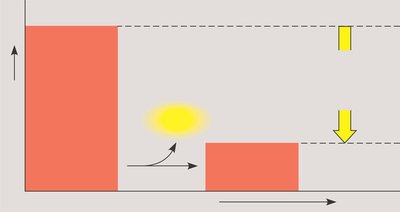
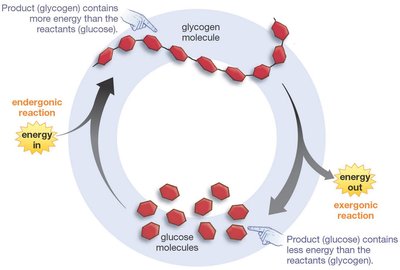
Exergonic Reactions: Release free energy; products have less energy than reactants. These reactions are spontaneous (e.g., cellular respiration).
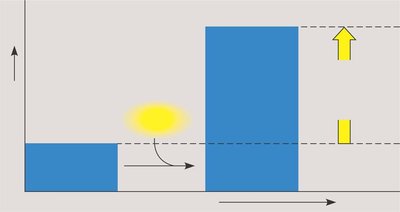
Endergonic Reactions: Require an input of energy; products have more energy than reactants (e.g., synthesis of glucose during photosynthesis).
Free energy change (\(\Delta G\)):
\(\Delta G < 0\): Exergonic (energy released)
\(\Delta G > 0\): Endergonic (energy required)
Coupling Reactions
Cells couple exergonic reactions (which release energy) to endergonic reactions (which require energy) to drive essential processes. This coupling is often mediated by ATP.
ATP: The Energy Currency of the Cell
Structure and Function of ATP
Adenosine triphosphate (ATP) consists of adenine, ribose, and three phosphate groups.
ATP stores energy in its high-energy phosphate bonds.
ATP Hydrolysis and the ATP Cycle
Hydrolysis of ATP (breaking off a phosphate group) releases energy:
ATP is regenerated from ADP and inorganic phosphate (\(P_i\)) using energy from exergonic reactions.
Phosphorylation: Transfer of a phosphate group from ATP to another molecule, making it more reactive.
Types of Cellular Work Powered by ATP
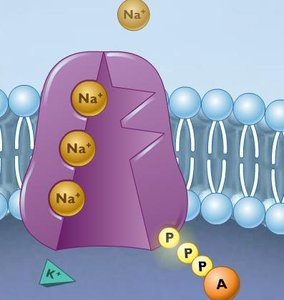
Mechanical Work: Movement of motor proteins (e.g., muscle contraction).
Transport Work: Pumping substances across membranes (e.g., sodium-potassium pump).
Chemical Work: Driving endergonic reactions (e.g., synthesis of macromolecules).
Enzymes and Activation Energy
Role of Enzymes in Metabolism
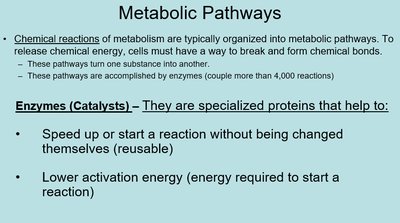
Enzymes are biological catalysts—usually proteins—that speed up chemical reactions by lowering the activation energy required for the reaction to proceed. They are not consumed in the reaction and can be reused.
How Enzymes Work
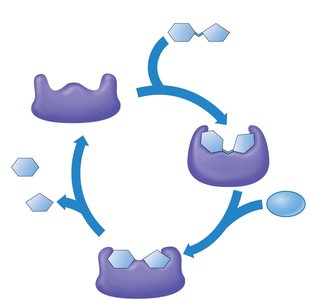
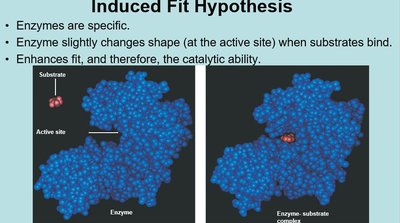
An enzyme binds to its substrate (the reactant) at a specific region called the active site.
The enzyme-substrate complex forms, and the enzyme facilitates the conversion of substrate to product.
After the reaction, the enzyme releases the product and is free to catalyze another reaction.
Induced Fit Hypothesis
Enzymes are specific for their substrates.
Binding of the substrate induces a slight change in the enzyme's shape, enhancing the fit and catalytic activity.
Environmental Factors Affecting Enzyme Activity
Enzyme activity is influenced by temperature and pH.
Each enzyme has an optimal temperature and pH at which it functions most efficiently.
Deviations from optimal conditions can reduce enzyme activity or denature the enzyme.
Regulation of Metabolic Pathways
Feedback Inhibition
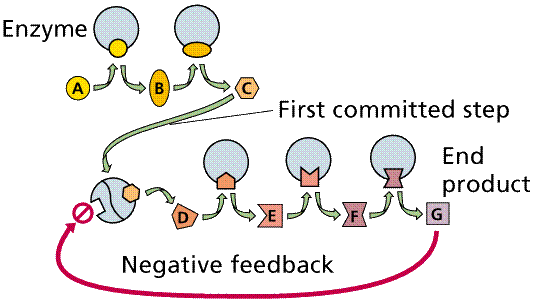
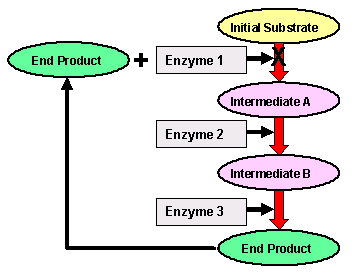
Feedback inhibition is a regulatory mechanism in which the end product of a metabolic pathway inhibits an enzyme involved earlier in the pathway. This prevents the overproduction of the end product and conserves resources.
Summary Table: Exergonic vs. Endergonic Reactions
Characteristic | Exergonic Reaction | Endergonic Reaction |
|---|---|---|
Energy Change (\(\Delta G\)) | Negative (\(\Delta G < 0\)) | Positive (\(\Delta G > 0\)) |
Energy Flow | Energy released | Energy required |
Spontaneity | Spontaneous | Non-spontaneous |
Example | Cellular respiration | Photosynthesis |
Key Terms
Metabolism: All chemical reactions in a cell.
Enzyme: Protein catalyst that speeds up reactions.
Activation Energy: Energy required to start a reaction.
ATP: Main energy currency of the cell.
Feedback Inhibition: End product inhibits pathway to regulate production.
