 Back
BackMetabolism I: Energy and Enzymes – Thermodynamics and Catalysis in Biological Systems
Study Guide - Smart Notes
 Tailored notes based on your materials, expanded with key definitions, examples, and context.
Metabolism and Energy in Biological Systems
Introduction to Metabolism
Metabolism encompasses all controlled, enzyme-catalyzed chemical reactions by which cells acquire and use energy to perform work. Understanding metabolism requires knowledge of energy conversions, thermodynamics, and the role of enzymes in catalyzing reactions.
Energy: The capacity to do work or supply heat.
Metabolism: The sum of all chemical reactions in a cell, regulated by enzymes.
Forms of Energy: Includes potential energy (stored energy, e.g., chemical bonds) and kinetic energy (energy of motion, e.g., heat, mechanical movement).
Energy Conversions in Ecosystems and Organisms
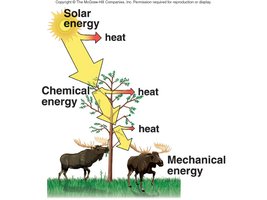
Energy flows through ecosystems and organisms, transforming from one form to another, often accompanied by heat loss.
Solar energy is converted to chemical energy in plants, which is then transferred to animals as mechanical energy.
Each transformation results in some energy being lost as heat, increasing entropy.
Thermodynamics in Biological Systems
Laws of Thermodynamics
Biological systems obey the laws of thermodynamics, which govern energy transformations and the direction of spontaneous processes.
First Law (Conservation of Energy): Energy cannot be created or destroyed, only transformed.
Second Law (Increasing Entropy): Energy transformations increase disorder (entropy) in a closed system.
Entropy (S): A measure of disorder; higher entropy means greater stability and less order.
Energy Transformation and Entropy
Every energy transformation is accompanied by a loss of usable energy, reflected as an increase in entropy.
Cells maintain order by constantly acquiring energy.
Spontaneous reactions tend to produce products with lower potential energy and higher entropy.
Free Energy and Spontaneity of Reactions
Gibbs Free Energy (G)
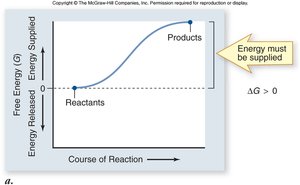
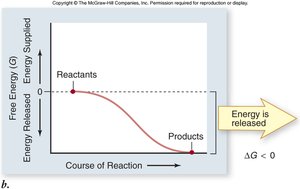
Gibbs free energy combines potential energy and entropy to predict whether a reaction will occur spontaneously.
Equation:
Spontaneous reactions: (exergonic, energy released)
Non-spontaneous reactions: (endergonic, energy required)
Exergonic vs. Endergonic Reactions
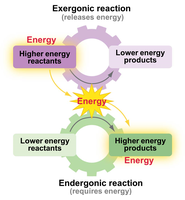
Exergonic reactions release energy and occur spontaneously, while endergonic reactions require energy input.
Exergonic: Hydrolysis, catabolic pathways
Endergonic: Biosynthesis, anabolic pathways
Coupled Reactions and ATP
Coupling Exergonic and Endergonic Reactions
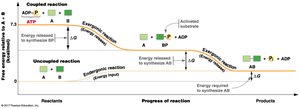
Cells couple exergonic reactions to endergonic ones to drive non-spontaneous processes. Enzymes facilitate this coupling, making the net reaction spontaneous.
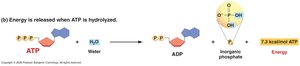
ATP hydrolysis is a common exergonic reaction used to drive endergonic processes.
Coupling often involves transfer of phosphate groups or electron carriers.
Redox Reactions in Metabolism
Oxidation-Reduction (Redox) Reactions
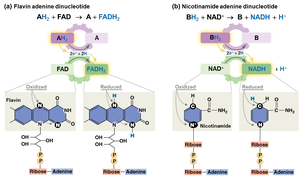
Redox reactions involve the transfer of electrons (and often protons), enabling energy conservation and transfer in metabolic pathways.
Oxidation: Loss of electrons (OIL: Oxidation Is Loss)
Reduction: Gain of electrons (RIG: Reduction Is Gain)
Electron carriers (e.g., NAD, FAD) facilitate these transfers.

Enzymes: Biological Catalysts
Enzyme Structure and Function
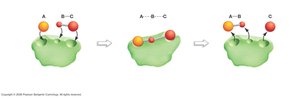
Enzymes are proteins that catalyze biological reactions by lowering activation energy and stabilizing the transition state.
Catalyst: Substance that increases reaction rate without being consumed.
Enzymes bring substrates together in a precise orientation and facilitate effective collisions.
Enzymes are specific for their substrates and are recycled after the reaction.
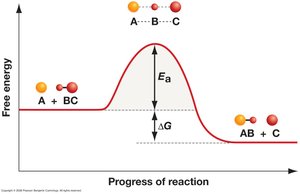
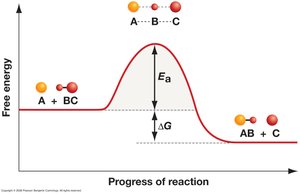
Transition State and Activation Energy
The transition state is a high-energy intermediate that must be achieved for a reaction to proceed. Activation energy () is the energy required to reach this state.
Enzymes lower , increasing reaction rates.
The net change in free energy () is unaffected by enzymes.

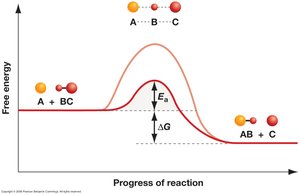
Enzyme-Catalyzed Reaction Steps
Enzyme-catalyzed reactions proceed through three main steps: initiation, transition state facilitation, and termination.
Initiation: Substrates bind to the active site in a specific orientation.
Transition state facilitation: Enzyme-substrate interactions lower activation energy.
Termination: Products are released; enzyme is unchanged.
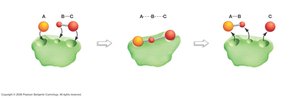
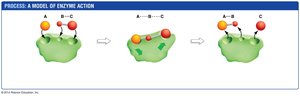
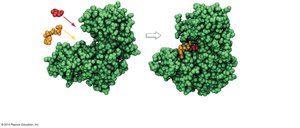
Induced-Fit Model
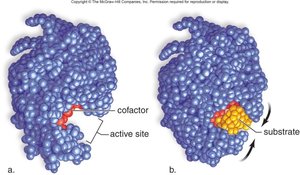
Enzymes undergo a conformational change upon substrate binding, reorienting substrates and pushing them toward the transition state.
Specific substrate binds to the enzyme's active site.
Shape change facilitates catalysis.
Factors Affecting Enzyme Activity
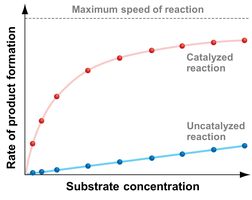
Substrate Concentration
Reaction rate increases with substrate concentration until the enzyme becomes saturated, reaching a maximum rate.
Temperature and pH
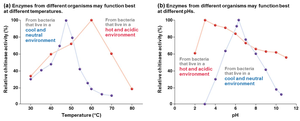
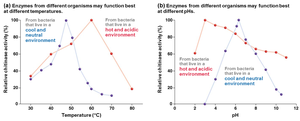
Enzyme activity is sensitive to temperature and pH, with optimal conditions varying by enzyme and organism.
Extreme temperatures or pH can denature enzymes, reducing activity.
Enzymes from different organisms have different optimal conditions.
Cofactors
Cofactors are non-protein molecules that assist enzyme function, including inorganic ions (e.g., Cu++, Zn++, Fe++) and organic coenzymes (e.g., NAD+, FAD, vitamins).
Enzyme Inhibition and Regulation
Types of Enzyme Inhibition
Enzyme inhibition decreases enzyme activity and can be competitive or non-competitive.
Competitive inhibition: Inhibitor resembles substrate and competes for active site binding.
Allosteric (non-competitive) inhibition: Regulator binds to a site other than the active site, causing a conformational change that affects substrate binding.
Feedback inhibition: End-product of a pathway inhibits an early enzyme, regulating pathway activity.
Summary Table: Exergonic vs. Endergonic Reactions
Type of Reaction | ΔG | Energy Flow | Example |
|---|---|---|---|
Exergonic | < 0 | Energy released | ATP hydrolysis |
Endergonic | > 0 | Energy required | Biosynthesis |
Summary Table: Types of Enzyme Inhibition
Type | Mechanism | Effect |
|---|---|---|
Competitive | Inhibitor binds active site | Blocks substrate binding |
Non-competitive (Allosteric) | Inhibitor binds allosteric site | Changes enzyme shape, reduces activity |
Feedback | End-product binds allosteric site | Shuts down pathway |
Additional info: Academic context was added to clarify mechanisms, definitions, and examples for completeness and exam preparation.
