 Back
Microbial Mechanisms of Pathogenicity
Study Guide - Smart Notes
 Tailored notes based on your materials, expanded with key definitions, examples, and context.
Microbial Mechanisms of Pathogenicity
Portals of Entry
Pathogens gain access to the host through specific routes known as portals of entry. The main portals include mucous membranes, skin, and the parenteral route. The effectiveness of a pathogen often depends on its ability to enter through its preferred portal.
Mucous membranes: Entry via the respiratory, gastrointestinal, genitourinary tracts, or conjunctiva of the eye.
Skin: Most microorganisms cannot penetrate unbroken skin, but some can enter through hair follicles or sweat ducts.
Parenteral route: Pathogens are deposited directly into tissues beneath the skin or mucous membranes via punctures, injections, bites, cuts, wounds, surgery, or other trauma.
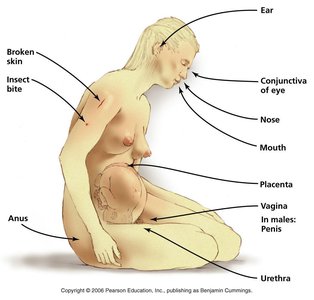
Preferred Portal of Entry and Infectious Dose
Many pathogens have a preferred portal of entry that is essential for causing disease. The number of microbes required to cause infection or death is measured by ID50 and LD50:
ID50: Infectious dose for 50% of the test population.
LD50: Lethal dose of a toxin for 50% of the test population.
Portal of Entry | ID50 (Bacillus anthracis) |
|---|---|
Skin | 10–50 endospores |
Inhalation | 10,000–20,000 endospores |
Ingestion | 250,000–1,000,000 endospores |
Toxin | LD50 |
|---|---|
Botulinum | 0.03 ng/kg |
Shiga toxin | 250 ng/kg |
Staphylococcal enterotoxin | 1350 ng/kg |
Adherence to Host Tissues
Almost all pathogens must adhere to host tissues to establish infection. This is achieved through adhesins or ligands that bind to specific receptors on host cells. Examples include:
Glycocalyx: Streptococcus mutans
Fimbriae: Escherichia coli
M protein: Streptococcus pyogenes
Pathogens may also form biofilms for enhanced adherence and protection.
Penetration of Host Defenses
To cause disease, pathogens must evade or overcome host defenses. There are four general strategies:
Capsule and Cell Walls: Capsules prevent phagocytosis; cell wall components can resist digestion or inhibit immune cells.
Enzymes: Pathogens produce enzymes that break down host tissues or immune factors.
Antigenic Variation: Pathogens alter their surface antigens to evade immune detection.
Using the Host's Cytoskeleton: Some pathogens manipulate the host cytoskeleton to enter or move within cells.
Capsule and Cell Wall Components
Capsules can inhibit phagocytosis, but not all encapsulated bacteria are virulent. Cell wall components such as M protein, Opa protein, and mycolic acid contribute to virulence by resisting immune responses.
M protein: Resists phagocytosis (Streptococcus pyogenes).
Opa protein: Inhibits T helper cells (Neisseria gonorrhoeae).
Mycolic acid: Waxy lipid resists digestion (Mycobacterium tuberculosis).
Enzymes
Pathogens secrete enzymes that facilitate invasion and spread:
Coagulases: Cause blood clotting to protect bacteria.
Kinases: Dissolve clots to release bacteria.
Hyaluronidase and Collagenase: Break down connective tissue, aiding spread.
IgA Proteases: Destroy IgA antibodies.
Antigenic Variation
Some pathogens can periodically change their surface antigens, making it difficult for the immune system to recognize and eliminate them.
Manipulation of Host Cytoskeleton
Certain bacteria use proteins called invasins to rearrange actin filaments, allowing them to enter host cells or move between them (e.g., Salmonella, Listeria).
How Pathogens Damage Host Cells
Pathogens can disrupt host cells by:
Using host nutrients (e.g., siderophores to acquire iron).
Causing direct damage (disrupting cell function, producing waste products).
Producing toxins (exotoxins and endotoxins).
Exotoxins
Exotoxins are proteins secreted by mostly Gram-positive bacteria. They are highly specific and potent, and can be neutralized by antitoxins.
Property | Exotoxins |
|---|---|
Source | Mostly Gram + |
Relation to microbe | By-products of growing cell |
Chemistry | Protein |
Fever? | No |
Neutralized by antitoxin? | Yes |
LD50 | Small |
Types of exotoxins include:
A-B toxins: Two-part toxins with an active (A) and binding (B) component.
Membrane-disrupting toxins: Form pores in host cell membranes (e.g., hemolysins).
Superantigens: Trigger excessive immune responses.
Endotoxins
Endotoxins are components of the outer membrane of Gram-negative bacteria (specifically, Lipid A of lipopolysaccharide). They are released when bacteria die and can cause fever and shock.
Property | Endotoxins |
|---|---|
Source | Gram - |
Relation to microbe | Outer membrane |
Chemistry | Lipid A |
Fever? | Yes |
Neutralized by antitoxin? | No |
LD50 | Relatively large |
Pathogenic Properties of Fungi, Protozoa, and Helminths
Fungi: Cause disease via waste products, toxins (e.g., ergot, aflatoxin, amatoxin), and allergic responses.
Protozoa: Cause damage through waste products, growth in phagocytes, and antigenic variation.
Helminths: Cause disease by interfering with host function and producing metabolic waste.
Portals of Exit
Pathogens leave the host through specific portals, often the same as the portals of entry:
Respiratory tract: Coughing and sneezing
Gastrointestinal tract: Feces and saliva
Genitourinary tract: Urine and vaginal secretions
Skin
Blood: Biting arthropods, needles, or syringes
Summary Table: Mechanisms of Pathogenicity
Mechanism | Description |
|---|---|
Portal of Entry | How pathogens enter the host |
Adherence | Attachment to host tissues |
Penetration of Defenses | Evading or overcoming immune responses |
Damage to Host | Using nutrients, direct damage, toxins |
Portal of Exit | How pathogens leave the host |
