 Back
BackMicroevolution and Natural Selection in Rock Pocket Mice
Study Guide - Smart Notes
 Tailored notes based on your materials, expanded with key definitions, examples, and context.
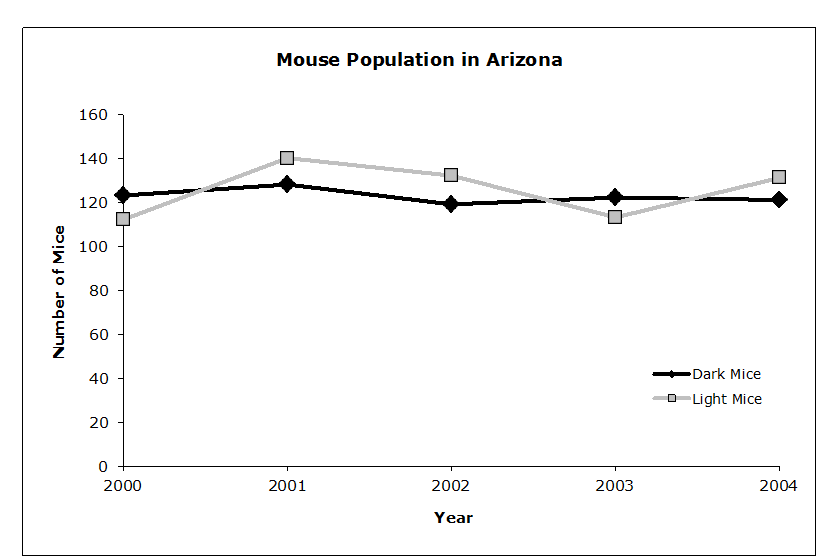
Q10a. Summarize the data presented in the graph.
Background
Topic: Population Genetics and Microevolution
This question asks you to interpret a graph showing the population sizes of dark-colored and light-colored mice in Arizona over several years. It tests your ability to analyze population data and understand how environmental factors and selection pressures can influence allele frequencies.
Key Terms:
Population size: The number of individuals of each phenotype (dark or light) in the population.
Phenotype: Observable traits, such as coat color.
Selection pressure: Environmental factors that influence survival and reproduction.
Step-by-Step Guidance
Examine the graph's axes: The x-axis shows years (2000–2004), and the y-axis shows the number of mice.
Identify the two lines: One represents dark-colored mice, the other light-colored mice.
Observe trends: Note how the numbers of each phenotype change over time. Are there increases, decreases, or periods of stability?
Compare the two groups: Look for points where the population sizes of dark and light mice are similar or diverge.
Try summarizing the trends you see before moving on!
Q10b. Provide one possible hypothesis that would explain the observed data. Be sure to include the following key words in your answer: “selection” (or “selective”), “fitness” (or “fit”), and “survival” (or “survive”).
Background
Topic: Natural Selection and Adaptation
This question asks you to propose a hypothesis explaining the population trends, using key evolutionary terms. It tests your understanding of how selective pressures affect fitness and survival, leading to changes in population composition.
Key Terms:
Selection: The process by which certain traits become more common due to advantages in survival or reproduction.
Fitness: The ability of an organism to survive and reproduce in its environment.
Survival: The likelihood of an organism living long enough to reproduce.
Step-by-Step Guidance
Consider the environment: What selective pressures might exist (e.g., predation, camouflage)?
Think about fitness: Which phenotype (dark or light) might have higher fitness in this environment?
Relate survival to selection: How does survival of one phenotype over another lead to changes in population size?
Formulate a hypothesis: Use the key terms to explain why the observed population sizes might occur.
Try writing your hypothesis before checking the answer!
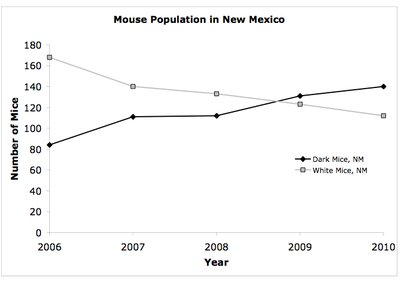
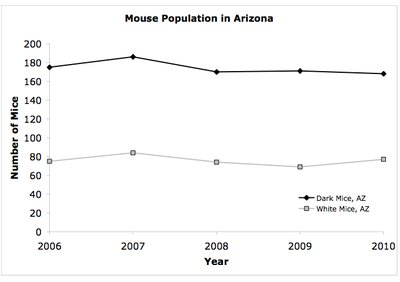
Q10c. Summarize the data presented in the graphs above.
Background
Topic: Comparative Population Genetics
This question asks you to compare mouse population data from Arizona and New Mexico, focusing on changes in dark and light (white) mice over time. It tests your ability to synthesize information from multiple graphs and recognize patterns in microevolution.
Key Terms:
Population trend: Direction of change in population size over time.
Phenotype frequency: Proportion of each phenotype in the population.
Step-by-Step Guidance
Examine each graph: Identify the years, population sizes, and phenotypes (dark vs. white mice).
Note differences: Compare how the populations of dark and white mice change in Arizona versus New Mexico.
Look for patterns: Are there consistent increases or decreases in either phenotype?
Summarize the main findings: Describe the overall trends for each population.
Try summarizing the data before moving on!
Q10d. Provide an explanation for these observations. Be sure to include the following key words in your answer: “selection” (or “selective”), “fitness” (or “fit”), and “survival” (or “survive”).
Background
Topic: Evolutionary Mechanisms
This question asks you to explain the population trends using evolutionary concepts. It tests your ability to connect data to the principles of natural selection, fitness, and survival.
Key Terms:
Selection: Environmental factors favoring certain traits.
Fitness: Advantage in survival and reproduction.
Survival: Persistence of individuals with advantageous traits.
Step-by-Step Guidance
Identify selective pressures: What environmental factors might favor dark or light mice?
Connect fitness to phenotype: Which phenotype is more fit in each environment?
Explain survival advantage: How does increased survival of one phenotype affect population trends?
Relate to microevolution: How do these changes reflect microevolutionary processes?
Try explaining the observations before checking the answer!
