Back
BackMicroscope Parts and Their Functions (Observing the Cell)
Study Guide - Smart Notes
 Tailored notes based on your materials, expanded with key definitions, examples, and context.
Observing the Cell
Microscope Parts
Microscopes are essential tools in biology for observing cells and their structures. Understanding the main parts of a microscope and their functions is fundamental for laboratory work and scientific inquiry.
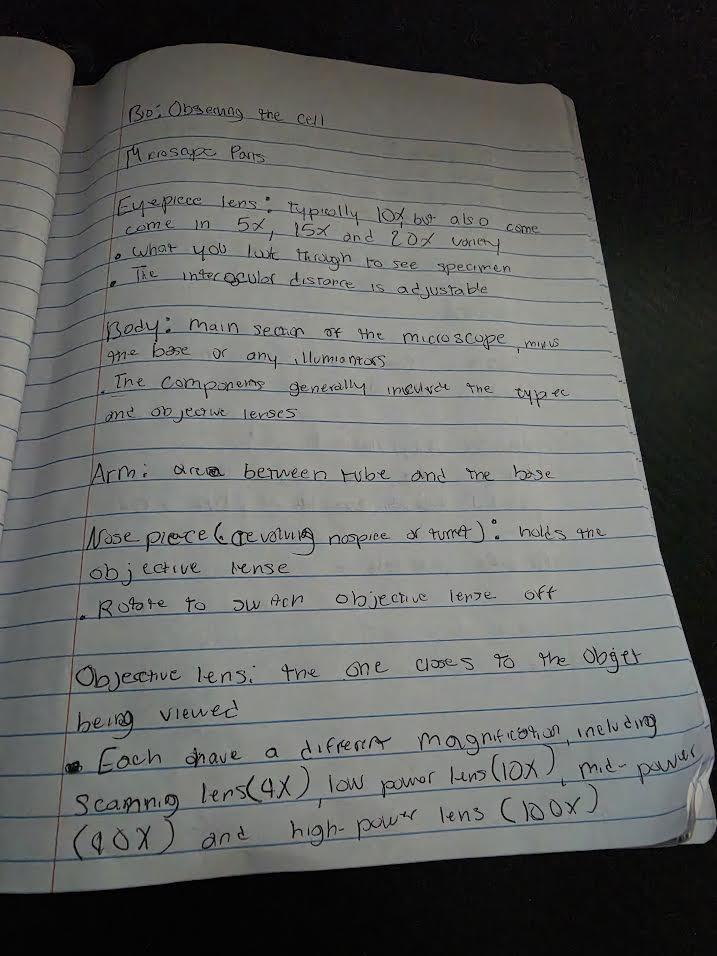
Eyepiece Lens: The lens you look through to see the specimen. Typically has a magnification of 10x, but variants with 5x, 15x, and 20x are also available. The interocular distance (distance between the eyepieces) is adjustable for user comfort.
Body: The main section of the microscope, excluding the base or any illuminators. This part generally houses the type and arrangement of the objective lenses and eyepiece lenses.
Arm: The area between the tube and the base. It provides structural support and is used to carry the microscope safely.
Nosepiece (Revolving Nosepiece or Turret): Holds the objective lenses and allows the user to rotate and switch between different objective lenses easily.
Objective Lens: The lens closest to the object being viewed. Each objective lens provides a different level of magnification, allowing for detailed examination of specimens.
Types of Objective Lenses and Magnification
Microscopes typically have several objective lenses, each with a different magnification power. These are used to view specimens at varying levels of detail:
Scanning Lens (4x): Used for quickly locating the specimen and providing a broad overview.
Low Power Lens (10x): Offers a closer look at the specimen with moderate detail.
Mid Power Lens (40x): Provides higher magnification for more detailed observation.
High Power Lens (100x): Used for observing fine details, often with oil immersion for clarity.
Example: If you use a 10x eyepiece lens with a 40x objective lens, the total magnification is calculated as:
Additional info: Proper handling and understanding of microscope parts are crucial for accurate observation and to prevent damage to the instrument. Always start with the lowest magnification and increase as needed.