 Back
BackMidterm Study Guide: Evolution, Plant Structure, and Diversity
Study Guide - Smart Notes
 Tailored notes based on your materials, expanded with key definitions, examples, and context.
History of Life and Evolutionary Events
Origin of Life and Prokaryote Evolution
The earliest life forms on Earth were likely simple, non-photosynthetic prokaryotes, which preceded photosynthetic cyanobacteria responsible for stromatolite formation.
Earth's Age: Earth is approximately 4.6 billion years old.
Origin of Life: Life began around 3.5-4 billion years ago, as evidenced by fossilized stromatolites.
Miller-Urey Experiments: Demonstrated that organic molecules could form under early Earth conditions, supporting hypotheses about abiogenesis.
Sequence of Life: Prokaryotes → Photosynthetic prokaryotes → Eukaryotes → Multicellular organisms → Plants, fungi, animals.
Geologic Record and Major Events
The geologic record is divided into eras separated by major events, such as mass extinctions and continental drift.
Mass Extinctions: Periods when large numbers of species disappear rapidly due to environmental changes.
Continental Drift: Movement of Earth's plates causes volcanoes, earthquakes, and changes in climate and biodiversity.
Exaptation and Homologous Structures
Exaptation: A trait that evolves for one function and is later adapted for another (e.g., feathers for insulation, later for flight).
Homologous Structures: Anatomical features inherited from a common ancestor, such as vertebrate limbs.
Phylogenetic Trees and Molecular Clocks
Phylogenetic Trees: Diagrams showing evolutionary relationships; closest ancestors are found at branching points.
Molecular Clocks: Use genetic differences to estimate divergence times between taxa.
Prokaryotes and Microbial Life
Importance of Bacteria and Prokaryotes
Prokaryotes are essential for nutrient cycling, decomposition, and human health.
Chemoautotrophs: Obtain energy from inorganic chemicals and carbon from CO2.
Chemoheterotrophs: Obtain energy and carbon from organic compounds.
Photoautotrophs: Use light energy to convert CO2 into organic compounds.
Prokaryotes in Extreme Environments
Extremophiles: Prokaryotes found in extreme conditions (e.g., thermophiles, halophiles).
Dinoflagellates
Group: Belong to the protists, specifically the alveolates.
Evolution of Plants, Fungi, and Animals
Origins and Evolutionary Sequence
Plants, Animals, Fungi: Arose from ancestral protists.
Vascular Plants: Evolved around 420 million years ago.
Carboniferous Period: Marked by extensive forests and evolution of seed plants.
Sporophyte and Gametophyte Generations in Conifers
Sporophyte: The dominant, diploid generation (tree itself).
Gametophyte: Reduced, haploid generation (cones and pollen).
Biodiversity and Plant Importance
Biodiversity: Ensures ecosystem stability, resilience, and provides resources for humans.
Lichens and Mycorrhizae
Lichens: Symbiotic association between fungi and algae/cyanobacteria.
Mycorrhizae: Fungi that form mutualistic relationships with plant roots, enhancing nutrient uptake.
Animal Evolution and Diversity
Cambrian Explosion
What: Rapid diversification of animal life about 540 million years ago.
Why: Environmental changes, genetic innovations.
Consequences: Emergence of most major animal phyla.
Tissue Layers and Digestive Tract
Sponges: Lack true tissues; composed of semi-independent cells.
Cnidarians: Have two tissue layers (ectoderm and endoderm); possess stinging cells.
Platyhelminthes: Bilateral symmetry; gastrovascular cavity with one opening.
Three Worm Phyla: Platyhelminthes, Nematoda, Annelida.
Arthropoda and Insect Body Plan
Characteristics: Exoskeleton, segmented body, jointed appendages.
Insect Modifications: Specialized wings and legs for various functions.
Tunicates and Chordates
Similarity: Tunicates share key chordate features during their larval stage.
Echinodermata
Characteristics: Spiny skin, water vascular system, tube feet, endoskeleton.
Plant Structure, Growth, and Transport
Monocots vs Dicots
Monocots: One cotyledon, parallel leaf veins, scattered vascular bundles.
Dicots (Eudicots): Two cotyledons, net-like leaf veins, ringed vascular bundles.
Basic Plant Structure
Leaf: Site of photosynthesis.
Node: Point of leaf attachment.
Cotyledon: Seed leaf in embryo.
Guard Cells, Xylem, and Phloem
Guard Cells: Regulate opening and closing of stomata for gas exchange.
Xylem: Transports water and minerals from roots to shoots.
Phloem: Transports sugars and other organic molecules throughout the plant.
Apical Meristems and Parenchyma Cells
Apical Meristems: Regions of active cell division at tips of roots and shoots, responsible for growth.
Parenchyma Cells: Thin-walled, totipotent cells capable of differentiating into various plant tissues.
Vascular Cambium and Tree Structure
Vascular Cambium: Produces secondary xylem (wood) and phloem, contributing to tree growth.
Angiosperm Reproductive Structures
Female: Ovary, style, stigma (carpel).
Male: Anther, filament (stamen).
Embryonic Root of Eudicot
Radicle: The first root to emerge from a germinating seed.
Root Hairs and Water Uptake
Root Hairs: Increase surface area for water and mineral absorption.
Transpiration
Definition: Loss of water vapor from plant leaves, driving water movement through xylem.
Source and Sink Dynamics in Plants
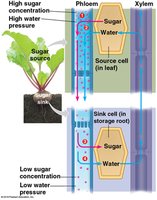
Leaves act as sugar sources, producing sugars via photosynthesis, while roots act as sugar sinks, storing or utilizing sugars. Phloem transports sugars from source to sink, driven by differences in concentration and water pressure.
Micronutrients in Plants
Function: Essential for enzyme activity, growth, and development (e.g., iron, zinc, copper).
Fertilizers and Carnivorous Plants
Inorganic Fertilizers: Provide nutrients in readily available forms; more efficient but can cause environmental issues.
Carnivorous Plants: Obtain minerals from prey, supplementing nutrient-poor soils.
Additional info: Academic context was added to clarify evolutionary sequences, plant structure, and physiological processes.
