 Back
BackMigration and Navigation in Vertebrates: Mechanisms, Patterns, and Evolution
Study Guide - Smart Notes
 Tailored notes based on your materials, expanded with key definitions, examples, and context.
Migration in Vertebrates
Remarkable Migratory Feats
Migration is a widespread phenomenon among vertebrates, especially birds, involving seasonal movement between breeding and non-breeding grounds. Some species undertake extraordinary journeys, covering vast distances and facing significant physiological challenges.
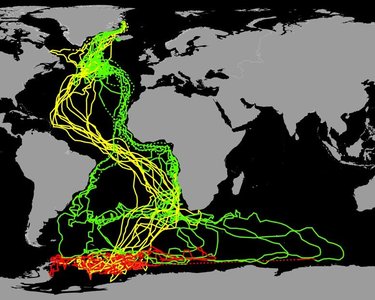
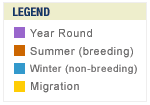
Arctic Tern: Migrates approximately 71,000 km annually, the longest migration of any vertebrate. Routes include southward (green), wintering (red), and northward (yellow) paths.
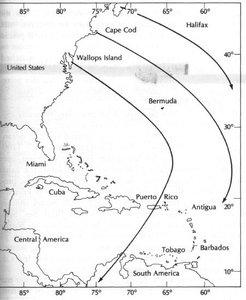
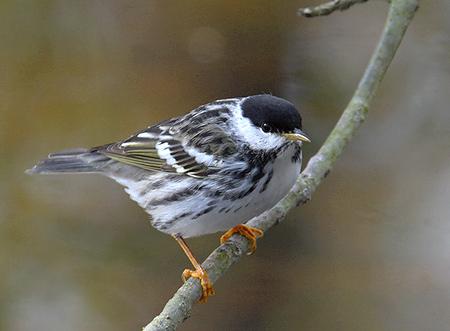
Blackpoll Warbler: Flies non-stop for 80–90 hours from the Northeast coast of North America to northern South America, covering about 4,000 km.
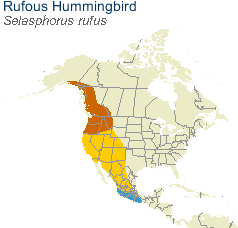
Rufous Hummingbird (Selasphorus rufus): Breeds farther north than any other hummingbird, with a round trip of about 12,800 km, one of the longest migrations relative to body size.
Definition and Patterns of Migration
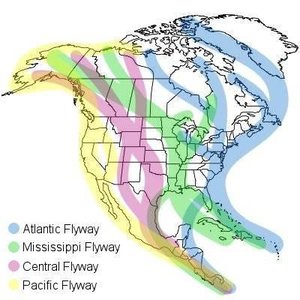
Migration is defined as the seasonal movement from one region or climate to another, primarily for feeding or breeding. In North America, migratory routes generally follow a north-south orientation, influenced by the alignment of coasts, mountain ranges, and river valleys. Some species, such as crossbills and waxwings, are nomadic, responding to patchy and irruptive food sources. In Europe and Asia, routes may initially be east-west, becoming north-south for some species.

Costs and Benefits of Migration
Physiological and Survival Costs
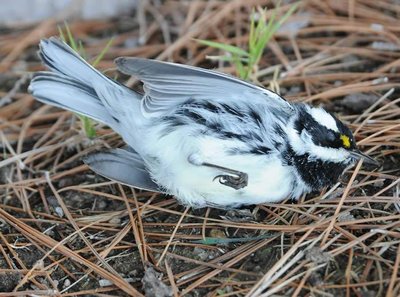
Migration is energetically expensive and risky. Birds experience physiological stress, reduced body condition, and high mortality rates. For example, more than 50% of passerines in the Northern Hemisphere do not return to their breeding grounds, and only 40 million out of 100 million migrating waterfowl return in North America.
Benefits to Fitness
Despite the costs, migration offers significant benefits:
Year-round activity: Allows birds to exploit seasonal resources and avoid harsh climates.
Improved nesting opportunities: Access to optimal breeding sites.
Enhanced survival: By moving to favorable environments, birds can increase their chances of survival and reproductive success.
Life History Traits and Fitness
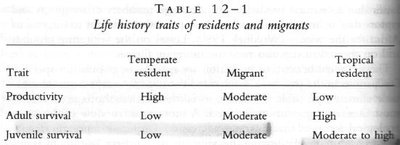
Fitness is the ability to survive and reproduce. Life history traits differ among temperate residents, migrants, and tropical residents, balancing productivity and survival.
Trait | Temperate Resident | Migrant | Tropical Resident |
|---|---|---|---|
Productivity | High | Moderate | Low |
Adult Survival | Low | Moderate | High |
Juvenile Survival | Low | Moderate | Moderate to high |

Evolution of Migratory Behavior
Stages of Migration Evolution
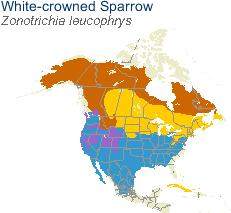
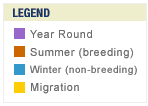
Migratory behavior is believed to evolve in three main stages:
Partial migration: Some individuals move short distances to exploit resources during environmental changes.
Division into migratory and resident populations: Populations split, with some individuals remaining resident and others adopting true migratory behavior.
Fully disjunct migration: Resident populations are lost, leaving only migratory populations.
Timing and Fueling of Migration
Timing Mechanisms
The timing of migration is regulated by internal and external cues:
Circadian rhythms: Daily hormonal and neural cycles.
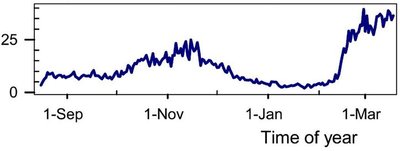
Zugunruhe: Migratory restlessness observed in birds during spring and fall.
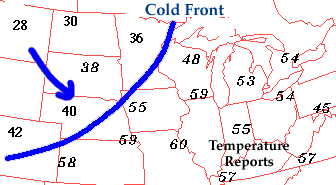
Zeitgebers: Environmental stimuli (e.g., photoperiod, weather) that synchronize biological rhythms with seasonal events.
Fuel for Migration
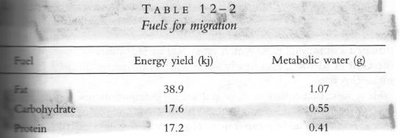
Birds rely on three main fuel types for migration: fats, carbohydrates, and proteins. Fat is the preferred fuel because it yields about twice as much energy and metabolic water as carbohydrates or proteins. Birds often build up significant fat reserves before migration.
Fuel | Energy yield (kJ) | Metabolic water (g) |
|---|---|---|
Fat | 38.9 | 1.07 |
Carbohydrate | 17.6 | 0.55 |
Protein | 17.2 | 0.41 |

Navigation Mechanisms in Birds
Overview of Navigation Methods
Birds use a variety of navigational tools to travel between breeding and wintering grounds. These mechanisms provide redundancy and adaptability in changing environmental conditions.
Visual landmarks: Birds use prominent landscape features such as rivers, coasts, and mountains for orientation, especially waterfowl and raptors.
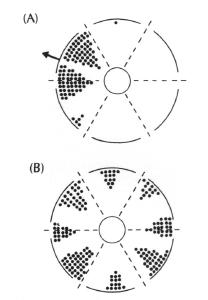
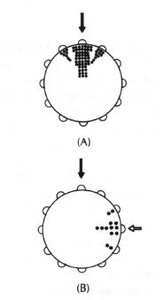
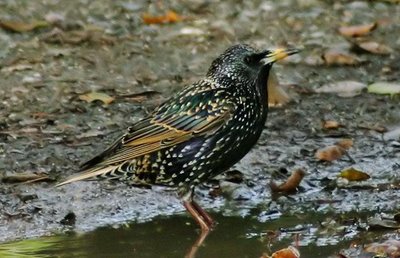
Solar compass: Birds can use the position of the sun for orientation, compensating for its movement throughout the day. Experiments with starlings and pigeons show correct orientation on sunny days but not on overcast days.
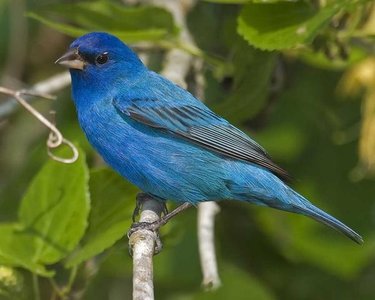
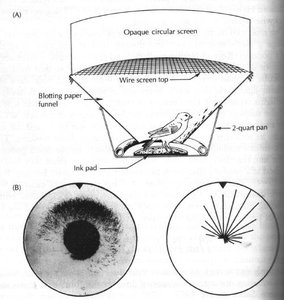
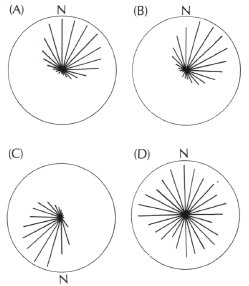
Stellar compass: Birds orient using stars at night. Experiments with the "Emlen Funnel" demonstrate that birds can use star patterns for navigation.
Olfaction: Some birds use their sense of smell to locate nest sites or home lofts, though this method is likely supplementary.
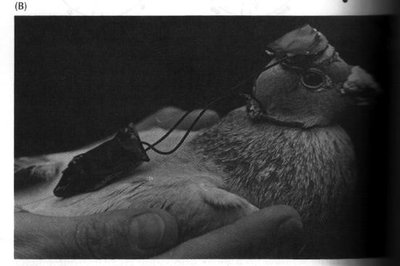
Geomagnetism: Birds can detect Earth's magnetic field, using it as a map for orientation, especially under overcast conditions when visual cues are unavailable.

Why Multiple Navigational Tools?
The diversity of navigational mechanisms reflects ecological differences and the need for redundancy. For example, raptors may rely on thermals and topography, while songbirds use other cues. If one system fails (e.g., cloudy skies obscure the sun and stars), others can compensate. Generally, geomagnetism is used for initial orientation, with solar and stellar compasses providing additional cues, and visual landmarks and olfaction fine-tuning navigation.
Key Definitions
Migration: Seasonal movement between regions for feeding or breeding.
Fitness: The ability of an organism to survive and reproduce in its environment.
Zugunruhe: Migratory restlessness observed in captive birds during migration seasons.
Zeitgeber: An environmental cue, such as light or temperature, that synchronizes biological rhythms.
Partial migration: A situation where only some individuals in a population migrate.
Geomagnetism: The use of Earth's magnetic field for orientation and navigation.
Additional info: Academic context was added to clarify the mechanisms of navigation, the evolutionary stages of migration, and the physiological basis for fuel selection. Tables were reconstructed for clarity and completeness.
