 Back
Mini-Exam Study Guide: Principles of Biology I (BIOL 1107)
Study Guide - Smart Notes
 Tailored notes based on your materials, expanded with key definitions, examples, and context.
Mini-Exam Study Guide: Principles of Biology I
General Exam Information
This section outlines the structure and expectations for the upcoming mini-exam in Principles of Biology I. Understanding the exam logistics and preparation strategies is essential for success.
Exam Format: 15-20 multiple choice questions, randomized for each student version.
Time Management: Approximately 1 minute per question is recommended.
Procedure: Work through questions on paper first, then submit answers via clicker poll.
Required Materials: Clicker device, scantron, pencils, and photo ID.
Exam Rules: No hats, hoodies, smart watches, or earbuds allowed during the exam.
Effective Study Strategies: The Study Cycle
The Study Cycle is a structured approach to mastering course material, emphasizing active engagement and self-assessment at each stage.
Preview: Skim new material before class (videos, readings, definitions).
Attend: Participate in lectures and activities, take notes, and ask questions.
Review: Go over notes soon after class to reinforce learning.
Study: Complete assignments and practice problems to deepen understanding.
Check: Assess your readiness by testing yourself without notes or resources.
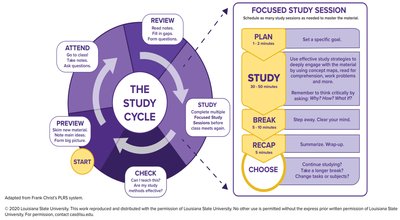
Focused Study Sessions
Each study session should be intentional and structured for maximum retention and understanding.
Plan: Set a specific goal for the session (2 minutes).
Study: Use active strategies (reading, summarizing, self-quizzing) for 30-50 minutes.
Break: Take a short break to clear your mind (5-10 minutes).
Recap: Summarize and wrap up what you learned.
Choose: Decide on the next study target or change tasks if needed.
Learning Objectives by Chapter/Topic
Scientific Process
Understanding the scientific process is foundational to biology. It involves systematic observation, experimentation, and analysis to answer questions about living organisms.
Biology: The scientific study of life and living organisms.
Role of Science: Science uses empirical evidence and the scientific method to investigate natural phenomena.
Scientific Method Steps: Observation, question, hypothesis, experiment, data collection, analysis, and conclusion.
Scientific Questions/Hypotheses: Must be testable, falsifiable, and based on observations.
Data Interpretation: Ability to analyze tables and figures to identify variables, controls, sample size, and summarize findings.
Properties of Life
Living organisms share a set of defining characteristics that distinguish them from non-living matter. Cells are the basic units that exhibit these properties.
Characteristics of Life: Organization, metabolism, homeostasis, growth, reproduction, response to stimuli, and adaptation.
Cells: All living things are composed of cells, which carry out life processes.
Determining Life: Use observations to assess if an object (e.g., vesicle) meets the criteria for life.
Cell Structure
Cells are classified as prokaryotic or eukaryotic based on structural and functional characteristics. Understanding organelles and their functions is crucial for interpreting cellular processes.
Prokaryotic vs. Eukaryotic Cells: Prokaryotes lack membrane-bound organelles; eukaryotes possess them.
Organelle: Specialized subunit within a cell with a specific function (e.g., nucleus, mitochondria).
Intracellular Components: Structure and function of organelles; effects of dysfunction (e.g., mitochondrial diseases).
Cell Structure and Function: Organization may change based on cellular function (e.g., muscle cells have more mitochondria).
Membrane Structure
The plasma membrane is a dynamic barrier that separates the cell from its environment, composed of a fluid mosaic of lipids and proteins.
Role of Plasma Membrane: Maintains homeostasis by regulating entry and exit of substances.
Fluid Mosaic Model: Describes the flexible arrangement of phospholipids and proteins.
Membrane Components: Lipids (phospholipids, cholesterol), proteins (integral, peripheral), and carbohydrates.
Membrane Formation: Phospholipids spontaneously form bilayers in aqueous environments due to hydrophobic and hydrophilic interactions.
Lipids / Intro to Biochemistry (Intramolecular)
Lipids are a diverse group of hydrophobic molecules essential for cell structure and energy storage. Understanding their chemical properties is key to biochemistry.
Lipid Types: Phospholipids, steroids, triglycerides/fats.
Primary Elements: Hydrogen (H), Carbon (C), Nitrogen (N), Oxygen (O) are the main elements in biomolecules.
Structural Formulas: Ability to interpret and distinguish hydrocarbon skeletons and functional groups.
Intramolecular Bonds: Nonpolar covalent (equal sharing of electrons), polar covalent (unequal sharing), and ionic bonds (transfer of electrons).
Resulting Charges: Nonpolar covalent (no charge), polar covalent (partial charges), ionic (full charges).
Molecular Interactions and Membrane Formation (Intermolecular)
Intermolecular forces are critical for the structure and function of biological molecules, including the formation of membranes and the properties of water.
Hydrophilic vs. Hydrophobic: Hydrophilic regions interact with water; hydrophobic regions avoid water.
Types of Intermolecular Interactions:
Ionic Bonds: Attraction between oppositely charged ions.
Hydrogen Bonds/Dipoles: Weak bonds between polar molecules.
Van der Waals Forces: Weak attractions due to transient dipoles.
Water's Unique Properties: Cohesion, adhesion, high specific heat, and solvent abilities arise from hydrogen bonding.
Predicting Interactions: Use knowledge of structure, functional groups, and bond types to predict molecular behavior.
Membrane Formation: Intramolecular covalent bonds hold molecules together; intermolecular interactions drive bilayer assembly.
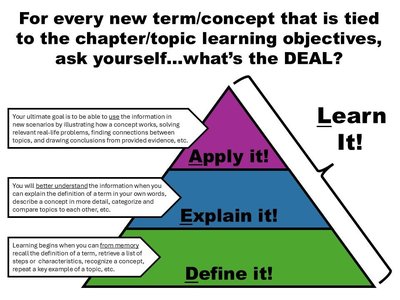
The DEAL Method for Mastery
The DEAL method is a structured approach to mastering new concepts by progressing through increasing levels of understanding.
Define it: Recall the definition and basic facts from memory.
Explain it: Describe the concept in your own words, compare and categorize related ideas.
Apply it: Use the concept in new scenarios, solve problems, and draw conclusions from evidence.
Sample Table: Types of Chemical Bonds
Bond Type | Description | Relative Strength | Example |
|---|---|---|---|
Nonpolar Covalent | Equal sharing of electrons | Strong | H2, O2 |
Polar Covalent | Unequal sharing of electrons | Strong | H2O |
Ionic | Transfer of electrons | Strong (in dry conditions) | NaCl |
Hydrogen Bond | Attraction between polar molecules | Weak | Between water molecules |
Van der Waals | Transient dipole interactions | Very weak | Lipid tails in membranes |
Key Equations and Concepts
Electronegativity Difference: Determines bond type.
Nonpolar covalent:
Polar covalent:
Ionic:
Water's Polarity: is a polar molecule due to the difference in electronegativity between H and O.
Additional info: The DEAL method and Study Cycle are evidence-based strategies to promote active learning and long-term retention, which are especially effective in science courses like General Biology.
