 Back
Mitochondria, Chloroplasts, and Peroxisomes: Energy Conversion and Organelle Function Part 2
Study Guide - Smart Notes
 Tailored notes based on your materials, expanded with key definitions, examples, and context.
Concept 6.5: Mitochondria and Chloroplasts Change Energy from One Form to Another
Overview of Organelle Function
Cells contain specialized organelles that are responsible for energy conversion and metabolic processes. The main organelles involved in these processes are mitochondria, chloroplasts, and peroxisomes. Each plays a distinct role in cellular metabolism and energy transformation.
Mitochondria: Sites of cellular respiration; use oxygen to generate ATP by extracting energy from sugars, fats, and other fuels.
Chloroplasts: Found in plants and algae; sites of photosynthesis, converting solar energy to chemical energy by synthesizing sugars from CO2 and H2O.
Peroxisomes: Oxidative organelles involved in the breakdown of fatty acids and detoxification of harmful substances.
Mitochondria: Chemical Energy Conversion
Presence and Quantity in Cells
Mitochondria are present in nearly all eukaryotic cells. The number of mitochondria per cell correlates with the cell’s energy demand; cells with higher aerobic metabolic activity contain more mitochondria.
Cells may have one large mitochondrion or hundreds to thousands of smaller ones.
More mitochondria are found in cells with greater energy requirements (e.g., muscle cells).
Structure of Mitochondria
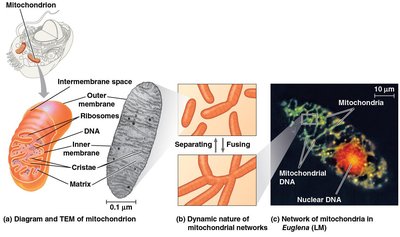
Mitochondria are double-membraned organelles with specialized internal compartments that facilitate their function in energy conversion.
Outer membrane: Smooth and encloses the organelle.
Inner membrane: Highly folded into structures called cristae, increasing surface area for ATP production.
Intermembrane space: Narrow region between the outer and inner membranes.
Mitochondrial matrix: Fluid-filled space inside the inner membrane containing mitochondrial DNA, ribosomes, and enzymes for cellular respiration.
Functional Specialization and Dynamics
Enzymes in the matrix catalyze steps of cellular respiration.
Proteins in the inner membrane, including ATP synthase, are critical for ATP production.
Cristae increase the surface area, enhancing ATP generation capacity.
Mitochondria are dynamic: they move, change shape, fuse, and divide within the cell.
Size: Typically 1–10 µm long.
Chloroplasts: Capture of Light Energy
Function and Components
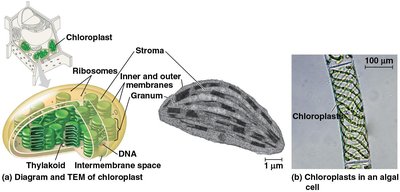
Chloroplasts are the organelles responsible for photosynthesis in plants and algae. They contain the pigment chlorophyll and the molecular machinery needed to convert light energy into chemical energy (sugars).
Found in leaves and other green organs of plants and algae.
Size: Typically 3–6 µm in diameter.
Internal Structure of Chloroplasts
Stroma: Fluid-filled space inside the inner membrane containing chloroplast DNA, ribosomes, and enzymes.
Thylakoids: Flattened membranous sacs where light energy is converted to chemical energy.
Grana: Stacks of thylakoids resembling poker chips.
Functional Compartments and Dynamics
Chloroplasts have three main internal compartments: intermembrane space, stroma, and thylakoid space.
Chloroplasts are dynamic, moving and changing shape within the cell along the cytoskeleton.
Plastids: The Family of Chloroplasts
Chloroplasts are members of the plastid family, a group of plant organelles with diverse functions.
Amyloplasts: Colorless plastids that store starch in roots and tubers.
Chromoplasts: Plastids that store pigments for fruits and flowers.
Peroxisomes: Oxidation and Metabolic Functions
Structure and Function
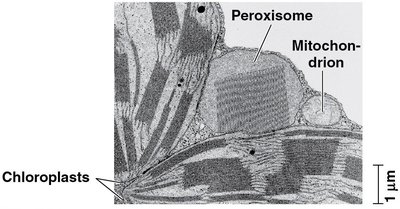
Peroxisomes are single-membrane-bound organelles containing enzymes that transfer hydrogen from various substrates to oxygen, producing hydrogen peroxide (H2O2) as a byproduct. They play key roles in metabolism and detoxification.
Break down fatty acids into smaller molecules for cellular respiration.
Detoxify alcohol and other harmful compounds, especially in liver cells.
Contain specialized forms such as glyoxysomes in plant seeds, which convert fatty acids to sugars for seedling growth.
Sample Exam Questions
What are the infoldings of the mitochondrial inner membrane called? Answer: Cristae
Which structure is common to plant and animal cells? Answer: Mitochondrion
Cyanide binds to at least one molecule involved in producing ATP. In a cell exposed to cyanide, most of the cyanide will be in: Answer: Mitochondria
What pigment is found in chloroplast? Answer: Chlorophyll
Which of the following is a common trait of chloroplasts and mitochondria? Answer: Both contain their own DNA
Peroxisomes in liver cells detoxify alcohol by removing hydrogen atoms and combining them with which of the following molecules? Answer: With oxygen molecules to generate hydrogen peroxide
Which cell organelle can break down fatty acids into sugar in plants? Answer: Glyoxysomes
Summary Table: Comparison of Mitochondria, Chloroplasts, and Peroxisomes
Organelle | Main Function | Membrane Structure | Genetic Material | Key Features |
|---|---|---|---|---|
Mitochondria | Cellular respiration (ATP production) | Double membrane (outer & inner with cristae) | Own DNA and ribosomes | Dynamic, found in most eukaryotes |
Chloroplasts | Photosynthesis (sugar production) | Double membrane, thylakoids, grana | Own DNA and ribosomes | Contain chlorophyll, found in plants/algae |
Peroxisomes | Oxidation of fatty acids, detoxification | Single membrane | No own DNA | Produce H2O2, contain catalase |
Additional info: Mitochondria and chloroplasts are believed to have originated from endosymbiotic events, which explains their double membranes and presence of their own DNA. Peroxisomes, while also involved in metabolism, do not contain their own genetic material and are not derived from endosymbiosis.
