 Back
Mitosis and Cell Division: Key Stages and Visual Identification
Study Guide - Smart Notes
 Tailored notes based on your materials, expanded with key definitions, examples, and context.
Q1. What are the four stages of mitosis?
Background
Topic: Cell Division – Mitosis
This question tests your understanding of the sequential phases that a eukaryotic cell undergoes during mitosis, which is essential for growth, repair, and asexual reproduction.
Key Terms and Concepts:
Mitosis: The process by which a cell divides its nucleus and contents to produce two genetically identical daughter cells.
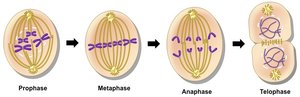
Phases of Mitosis: The four main stages are Prophase, Metaphase, Anaphase, and Telophase.
Step-by-Step Guidance
Recall that mitosis is divided into four main stages, each with distinct events and structural changes in the cell.
List the stages in order, starting from the condensation of chromosomes to the reformation of the nuclear envelope.
For each stage, briefly describe the key event (e.g., chromosome alignment, separation, etc.).
Try solving on your own before revealing the answer!
Q2. In mitosis, what phase does the cleavage furrow start to form in the animal cell?
Background
Topic: Cytokinesis in Animal Cells
This question focuses on identifying the specific phase of mitosis when the cell membrane begins to pinch in, forming a cleavage furrow, which is crucial for the physical separation of daughter cells.
Key Terms:
Cleavage Furrow: The indentation that begins the process of cytokinesis in animal cells.
Telophase: The stage where nuclear envelopes reform and the cell prepares to divide.
Step-by-Step Guidance
Recall the sequence of mitosis stages and what happens in each.
Identify the stage where the cell membrane starts to constrict in animal cells, forming the cleavage furrow.
Consider the timing of cytokinesis relative to the mitotic stages.
Try solving on your own before revealing the answer!
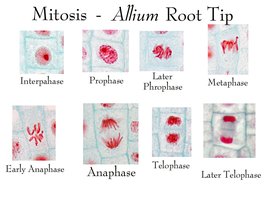
Q3. What phase of mitosis is this in an onion plant cell?
Background
Topic: Microscopic Identification of Mitosis Phases in Plant Cells
This question asks you to visually identify the phase of mitosis in a plant cell, such as those found in an onion root tip, based on cell structure and chromosome arrangement.
Key Terms:
Onion Root Tip: A common specimen for observing mitosis due to its rapid cell division.
Mitosis Phases: Interphase, Prophase, Metaphase, Anaphase, Telophase.
Step-by-Step Guidance
Examine the image for key features: chromosome condensation, alignment, separation, or reformation of nuclei.
Match these features to the descriptions of each mitosis phase.
Remember that plant cells do not form a cleavage furrow but instead build a cell plate during cytokinesis.
Try solving on your own before revealing the answer!
Q4. What is the name of the plate where chromosomes align during metaphase?
Background
Topic: Chromosome Alignment in Mitosis
This question tests your knowledge of the structure where chromosomes line up during metaphase, which is critical for equal chromosome segregation.
Key Terms:
Metaphase Plate: The imaginary plane where chromosomes align during metaphase.
Step-by-Step Guidance
Recall the events of metaphase and the arrangement of chromosomes.
Identify the term used for the central region where chromosomes are positioned before being separated.
Try solving on your own before revealing the answer!
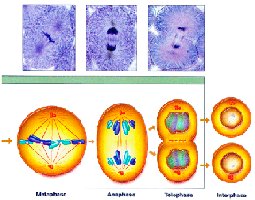
Q5. What are the visual differences between mitosis in plant cells and animal cells?
Background
Topic: Comparative Cell Biology
This question asks you to compare and contrast the process of mitosis in plant versus animal cells, focusing on structural differences during cytokinesis and spindle formation.
Key Terms:
Cell Plate: Structure that forms during cytokinesis in plant cells.
Cleavage Furrow: Structure that forms during cytokinesis in animal cells.
Step-by-Step Guidance
Review the process of cytokinesis in both plant and animal cells.
Identify the structures involved in dividing the cytoplasm in each cell type.
Note the presence or absence of centrioles and the difference in spindle formation.
Try solving on your own before revealing the answer!
