 Back
BackMitosis and Meiosis: Cellular Division and Genetic Diversity
Study Guide - Smart Notes
 Tailored notes based on your materials, expanded with key definitions, examples, and context.
Cell Division: Mitosis and Meiosis
Overview of Cell Division
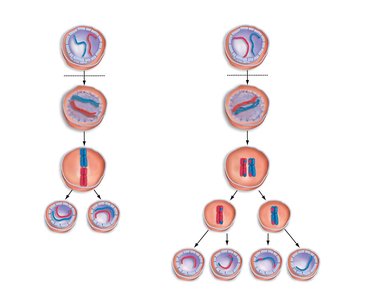
Cell division is a fundamental biological process that enables growth, development, and reproduction in all living organisms. The two main types of cell division are mitosis and meiosis. Mitosis produces genetically identical cells for growth and repair, while meiosis generates gametes (egg and sperm) with half the chromosome number, promoting genetic diversity.
Mitosis: Produces two diploid daughter cells identical to the parent cell.
Meiosis: Produces four haploid gametes, each genetically unique.
Mitosis: The Cell Cycle and Chromosome Dynamics
The Cell Cycle
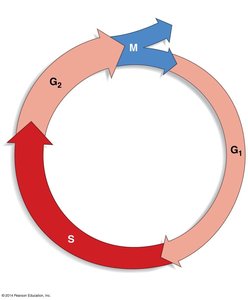
The cell cycle consists of a series of phases that prepare a cell for division. These include G1 (first gap), S (DNA synthesis), G2 (second gap), and M (mitosis).
G1 Phase: Cell grows and prepares for DNA replication.
S Phase: DNA is replicated, forming sister chromatids.
G2 Phase: Cell prepares for mitosis.
M Phase: Chromosomes condense, align, and are separated into daughter cells.
Chromosome Structure and Replication
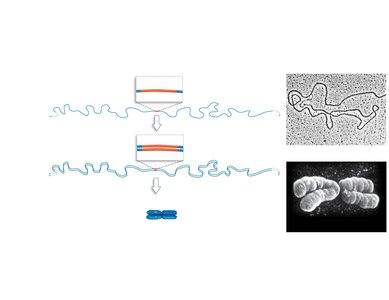
Chromosomes are composed of DNA and proteins. During the S phase, chromosomes are replicated, resulting in two identical sister chromatids joined at the centromere.
Unreplicated chromosome: Single DNA molecule.
Replicated chromosome: Two sister chromatids.
Condensed chromosome: Chromatids tightly packed for division.
Stages of Mitosis
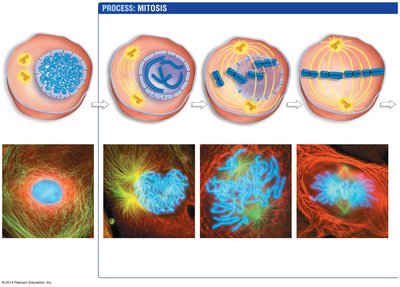
Mitosis is divided into several stages:
Prophase: Chromosomes condense, spindle apparatus forms.
Prometaphase: Nuclear envelope breaks down, microtubules attach to kinetochores.
Metaphase: Chromosomes align at the metaphase plate.
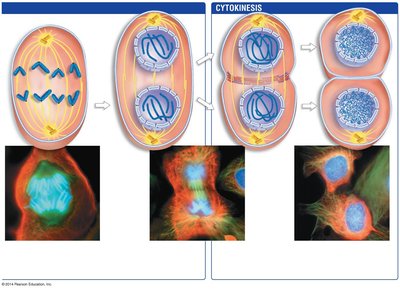
Anaphase: Sister chromatids separate and move to opposite poles.
Telophase: Nuclear envelope reforms, chromosomes decondense.
Cytokinesis: Cytoplasm divides, forming two daughter cells.
Meiosis: Generation of Genetic Diversity
Purpose and Process of Meiosis
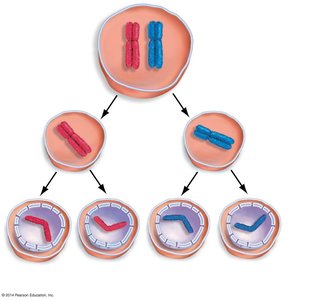
Meiosis is a specialized form of cell division that reduces the chromosome number by half, producing haploid gametes. It consists of two sequential divisions: Meiosis I and Meiosis II.
Meiosis I: Homologous chromosomes separate.
Meiosis II: Sister chromatids separate.
Key Terms in Chromosomal Makeup
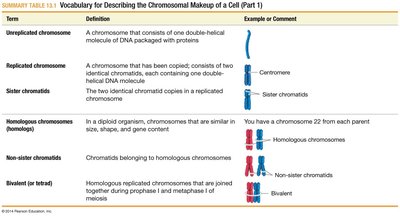
Term | Definition | Example or Comment |
|---|---|---|
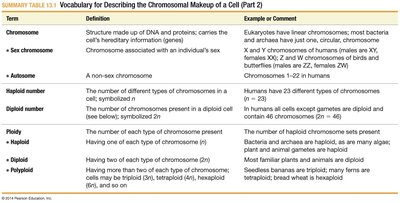
Chromosome | Structure made of DNA and proteins; carries hereditary information | Eukaryotes have linear chromosomes; most bacteria and archaea have just one, circular chromosome |
Homologous chromosomes | Chromosomes that are similar in size, shape, and gene content | You have a chromosome 22 from each parent |
Allele | Different versions of the same gene | Gene for eye color may have alleles for blue or brown |
Diploid (2n) | Having two of each type of chromosome | Humans are diploid; 2n = 46 |
Haploid (n) | Having one of each type of chromosome | Gametes are haploid; n = 23 in humans |
Meiosis I: Homolog Separation
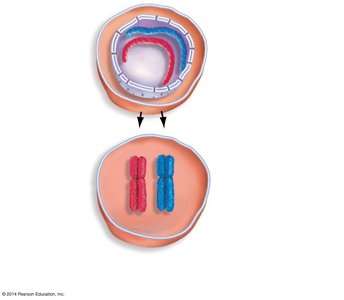
Meiosis I begins with DNA replication, followed by pairing and synapsis of homologous chromosomes. Crossing over occurs, increasing genetic diversity.
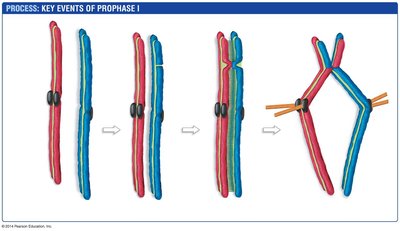
Prophase I: Chromosomes condense, homologs pair, crossing over occurs.
Metaphase I: Bivalents align at the metaphase plate.
Anaphase I: Homologs separate to opposite poles.
Telophase I: Chromosomes reach poles, cell divides.
Meiosis II: Chromatid Separation
Meiosis II resembles mitosis, where sister chromatids are separated, resulting in four haploid cells.
Prophase II: Spindle apparatus forms.
Metaphase II: Chromosomes align at the metaphase plate.
Anaphase II: Sister chromatids separate.
Telophase II: Chromosomes reach poles, cell divides.
Fertilization and Restoration of Diploidy
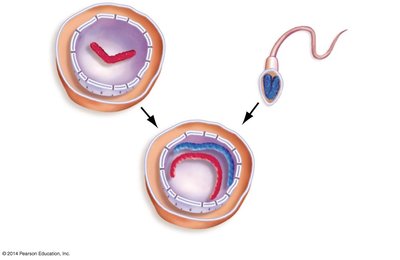
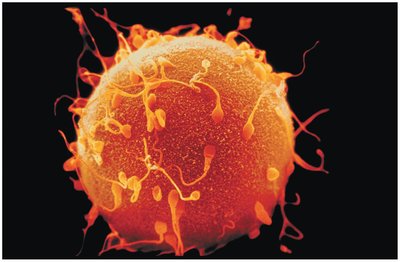
Fertilization is the fusion of two haploid gametes (egg and sperm), restoring the diploid chromosome number in the zygote.
Zygote: The first cell of a new organism, diploid (2n).
Gametes: Haploid cells produced by meiosis.
Genetic Variation in Meiosis
Sources of Genetic Variation
Meiosis promotes genetic diversity through several mechanisms:
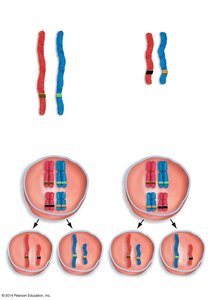
Independent Assortment: Homologous chromosomes are randomly distributed to gametes.
Crossing Over: Exchange of genetic material between non-sister chromatids during Prophase I.
Random Fertilization: Any sperm can fertilize any egg, further increasing variation.
Errors in Meiosis: Nondisjunction and Aneuploidy
Nondisjunction
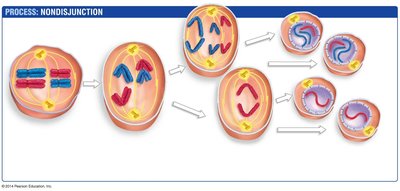
Nondisjunction is the failure of homologous chromosomes or sister chromatids to separate properly, resulting in gametes with abnormal chromosome numbers (aneuploidy).
Aneuploidy: Condition of having too many or too few chromosomes.
Example: Down syndrome is caused by trisomy 21 (an extra chromosome 21).
Comparing Mitosis and Meiosis
Key Differences
Feature | Mitosis | Meiosis |
|---|---|---|
Number of divisions | One | Two |
Daughter cells | Two, diploid, identical | Four, haploid, unique |
Function | Growth, repair | Gamete production, genetic diversity |
Crossing over | No | Yes, in Prophase I |
Benefits of Sexual Reproduction
Purifying Selection and Changing Environment Hypotheses
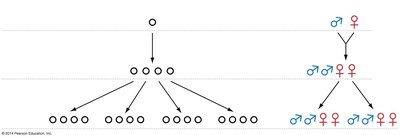
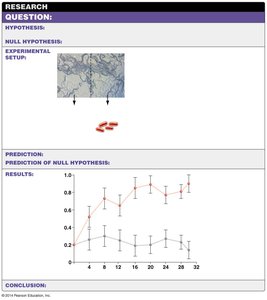
Sexual reproduction, through meiosis and fertilization, allows for the elimination of deleterious alleles and adaptation to changing environments.
Purifying Selection Hypothesis: Harmful mutations are less likely to be passed on.
Changing Environment Hypothesis: Genetic diversity increases the likelihood of survival in variable conditions.
Summary Table: Chromosomal Vocabulary
Vocabulary for Describing Chromosomal Makeup
Term | Definition | Example or Comment |
|---|---|---|
Unreplicated chromosome | One double-helical DNA molecule | Single chromosome |
Replicated chromosome | Two identical chromatids | Sister chromatids |
Homologous chromosomes | Similar in size, shape, gene content | One from each parent |
Non-sister chromatids | Belong to homologous chromosomes | Participate in crossing over |
Bivalent (or tetrad) | Paired homologous chromosomes | Formed during Prophase I |
Conclusion
Mitosis and meiosis are essential cellular processes for life. Mitosis ensures continuity and repair, while meiosis introduces genetic diversity, which is vital for evolution and adaptation. Understanding these processes is fundamental to biology and genetics. Key equations:
Diploid number:
Haploid number:
Example: In humans, and . Additional info: These notes expand on brief points with academic context, definitions, and examples for clarity and completeness.
