 Back
Mitosis (IPMAT) & Cytokinesis: Phases and Cellular Events
Study Guide - Smart Notes
 Tailored notes based on your materials, expanded with key definitions, examples, and context.
Mitosis (IPMAT) & Cytokinesis
Overview of Mitosis and Cytokinesis
Mitosis is the process by which a eukaryotic cell divides its nucleus and genetic material to produce two genetically identical daughter cells. It is followed by cytokinesis, the division of the cytoplasm. The process is essential for growth, repair, and asexual reproduction in multicellular organisms. Mitosis is divided into five main phases: Interphase, Prophase, Metaphase, Anaphase, and Telophase (IPMAT), followed by Cytokinesis.
1. Interphase
Nuclear Envelope: Intact and clearly visible, enclosing the genetic material.
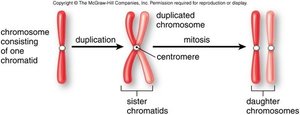
DNA Replication: Chromosomes are duplicated, each consisting of two identical DNA strands (sister chromatids). In humans, cells start with 46 chromosomes; after replication, there are still 46 chromosomes, but each is duplicated (92 chromatids).
Organelle Replication: Most organelles are duplicated, but some (e.g., centrioles in animal cells) do not automatically replicate.
Chromatin State: DNA exists as chromatin (loosely packed, not yet condensed into chromosomes).
Cell Growth: The cytoplasm and cell size double to accommodate new organelles.
Duration: Interphase is the longest and busiest phase, preparing the cell for division.
2. Prophase
Nuclear Envelope: Begins to degrade; phospholipids are recycled to the cell membrane.
Chromosome Condensation: DNA wraps around histone proteins, forming visible chromosomes ("X" or "Y" shapes).
Centrioles and Spindle Fibers: In animal cells, centrioles move to opposite poles and begin to release spindle fibers (not yet visible).
Chromosome Attachment: Chromosomes attach to spindle fibers at the centromere; each centromere binds two spindle fibers (one from each pole).
3. Metaphase
Nuclear Envelope: Completely disintegrated.
Chromosome Alignment: Spindle fibers pull chromosomes to align at the cell's equator (metaphase plate).
Duration: Shortest phase of mitosis; chromosomes are briefly lined up at the equator.
4. Anaphase
Chromatid Separation: Spindle fibers shorten, pulling sister chromatids apart toward opposite poles. After separation, each chromatid is considered an unduplicated chromosome.
Terminology: The term "sister chromatid" is used only when chromosomes are duplicated; after separation, they are called chromosomes.
Phase End: Anaphase concludes when chromosomes reach the poles.
5. Telophase
Nuclear Envelope: Re-forms around each set of chromosomes, resulting in two nuclei in the cell.
DNA Decondensation: Chromosomes uncoil back into chromatin.
Spindle Fibers: Degrade and disappear.
Completion: Marks the end of nuclear division; cytokinesis may follow to divide the cytoplasm.
6. Cytokinesis
Plants:
Golgi vesicles containing carbohydrates (cellulose) align at the cell equator, forming a cell plate.
The cell plate grows outward, fusing with the cell membrane and forming a new cell wall, resulting in two daughter cells.
Plant daughter cells elongate during the next interphase.
Animals:
Microtubules form a contractile ring at the cell equator, creating a cleavage furrow as the membrane pinches inward.
The furrow deepens until the cell splits into two daughter cells.
Special Cases: Cytokinesis is optional in some cells (e.g., fungi, nerve, muscle, tendon cells), leading to multinucleated cells.
Key Questions and Concepts
Must a cell undergo mitosis before cytokinesis? Yes, to ensure each daughter cell receives a complete set of chromosomes.
Must a cell undergo cytokinesis after mitosis? Not always; some cells remain multinucleated if cytokinesis does not occur.
Chromatid Separation: Occurs during anaphase.
Chromosome Duplication: Occurs during interphase (S phase).
Definitions
Chromosome: A DNA molecule with part or all of the genetic material of an organism.
Sister Chromatids: Two identical copies of a chromosome connected by a centromere after DNA replication.
Centromere: The region where sister chromatids are joined and spindle fibers attach during mitosis.
Spindle Fibers: Protein structures that separate chromosomes during cell division.
Cleavage Furrow: The indentation that begins the process of cytokinesis in animal cells.
Cell Plate: The precursor to a new cell wall in plant cell cytokinesis.
Summary Table: Mitosis Phases and Key Events
Phase | Main Events |
|---|---|
Interphase | DNA and organelle replication, cell growth, chromatin present |
Prophase | Nuclear envelope degrades, chromosomes condense, spindle forms |
Metaphase | Chromosomes align at equator, spindle fibers attach |
Anaphase | Sister chromatids separate, move to poles |
Telophase | Nuclear envelopes reform, chromosomes decondense |
Cytokinesis | Cytoplasm divides, forming two daughter cells |
Illustration: Chromosome Duplication and Separation
The following image illustrates the process of chromosome duplication and separation during mitosis, showing the transition from a single chromatid to duplicated chromosomes and finally to daughter chromosomes after mitosis.
Additional info: In muscle and nerve cells, cytokinesis may not occur, resulting in large, multinucleated cells. This adaptation allows for specialized functions such as rapid signal transmission or contraction.
