 Back
Molecular Basis of Inheritance: DNA Structure, Replication, and Genetic Information
Study Guide - Smart Notes
 Tailored notes based on your materials, expanded with key definitions, examples, and context.
Q2. Describe how DNA replication transmits genetic information to the next generation in a species.
Background
Topic: DNA Replication and Heredity
This question tests your understanding of how the process of DNA replication ensures that genetic information is accurately passed from parent to offspring, both in asexual (mitosis) and sexual (meiosis) reproduction.
Key Terms and Concepts:
DNA Replication: The process by which a cell makes an exact copy of its DNA before cell division.
Genetic Information: The sequence of nucleotides in DNA that encodes the instructions for building and maintaining an organism.
Base Pairing Rules: Adenine (A) pairs with Thymine (T), and Cytosine (C) pairs with Guanine (G).
Template Strand: The original DNA strand used to synthesize a new complementary strand.
Daughter Cells: The cells that result from cell division, each receiving a copy of the DNA.
Step-by-Step Guidance
Recall that before a cell divides, it must duplicate its DNA so that each new cell receives a complete set of genetic instructions.
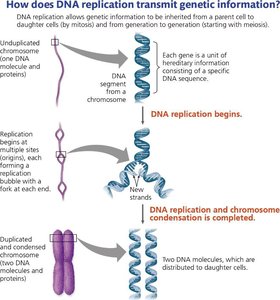
During DNA replication, the double helix unwinds and each strand serves as a template for the synthesis of a new complementary strand, following the base pairing rules.
As a result, each new DNA molecule consists of one original (parental) strand and one newly synthesized strand. This is known as semiconservative replication.
After replication, the cell divides (by mitosis or meiosis), and each daughter cell inherits one complete set of DNA, ensuring the transmission of genetic information.
To complete your answer, consider how this process maintains genetic continuity across generations and why accurate replication is essential for heredity.
Try solving on your own before revealing the answer!
Final Answer:
DNA replication transmits genetic information to the next generation by producing two identical DNA molecules from one original molecule. Each daughter cell receives one complete copy of the DNA during cell division. Because the sequence of bases is preserved through complementary base pairing, the genetic instructions are faithfully passed from parent to offspring, ensuring continuity of traits and functions across generations.
This process is essential for heredity, as it allows organisms to inherit genetic information that determines their characteristics.
