 Back
Molecular Basis of Inheritance: DNA Structure, Replication, and Genetic Information
Study Guide - Smart Notes
 Tailored notes based on your materials, expanded with key definitions, examples, and context.
Q2. Describe how DNA replication transmits genetic information to the next generation in a species.
Background
Topic: DNA Replication and Heredity
This question tests your understanding of how the process of DNA replication ensures that genetic information is accurately passed from parent to offspring, both in asexual (mitosis) and sexual (meiosis) reproduction.
Key Terms and Concepts:
DNA Replication: The process by which a cell makes an exact copy of its DNA before cell division.
Genetic Information: The sequence of nucleotides in DNA that encodes instructions for building proteins and regulating cellular activities.
Base Pairing Rules: Adenine (A) pairs with Thymine (T), and Cytosine (C) pairs with Guanine (G).
Template Strand: The original DNA strand used to synthesize a new complementary strand.
Daughter Cells: The cells that result from cell division, each receiving a complete set of genetic information.
Step-by-Step Guidance
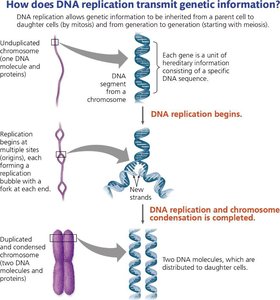
Recall that before a cell divides, it must duplicate its DNA so that each new cell receives a full set of genetic instructions.
During DNA replication, the double helix unwinds and each strand serves as a template for the synthesis of a new complementary strand, following the base pairing rules.
Enzymes such as DNA polymerase add nucleotides to the growing new strand, ensuring that the sequence is copied accurately from the template strand.
After replication, each chromosome consists of two identical DNA molecules (sister chromatids), which are then distributed to daughter cells during cell division.
Think about how this process ensures that each new cell (or offspring, in the case of reproduction) receives the same genetic information as the parent cell.
Try solving on your own before revealing the answer!
Final Answer:
DNA replication transmits genetic information to the next generation by making an exact copy of the DNA before cell division. Each new cell receives one original (parental) strand and one newly synthesized strand, ensuring the genetic code is preserved. This process allows hereditary information to be passed from parent to offspring, maintaining the continuity of genetic traits across generations.
Accurate base pairing and the use of each strand as a template ensure fidelity in the transmission of genetic information.
Q4. Using the picture to the right, describe the structure of nucleic acids. Be sure to include the phosphate, sugar, and nucleotide.
Background
Topic: Structure of Nucleic Acids
This question is about the molecular components that make up nucleic acids (DNA and RNA), focusing on how nucleotides are organized and connected.
Key Terms and Concepts:
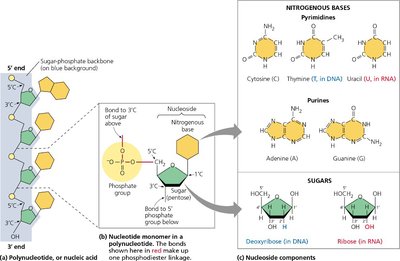
Nucleotide: The basic building block of nucleic acids, consisting of a phosphate group, a five-carbon sugar (deoxyribose in DNA, ribose in RNA), and a nitrogenous base.
Phosphate Group: Links the sugars of two nucleotides together, forming the backbone of the nucleic acid.
Sugar-Phosphate Backbone: The repeating chain of sugar and phosphate groups that forms the structural framework of DNA and RNA.
Nitrogenous Base: The part of the nucleotide that varies (A, T, C, G in DNA; A, U, C, G in RNA) and encodes genetic information.
Step-by-Step Guidance
Identify the three main components of a nucleotide: phosphate group, sugar, and nitrogenous base.
Observe how nucleotides are joined together by phosphodiester bonds between the phosphate group of one nucleotide and the sugar of the next.
Note that the sugar-phosphate backbone runs along the outside of the molecule, while the nitrogenous bases point inward and participate in base pairing.
Consider how the sequence of nitrogenous bases encodes genetic information.
Try solving on your own before revealing the answer!
Final Answer:
Nucleic acids are composed of repeating units called nucleotides. Each nucleotide consists of a phosphate group, a five-carbon sugar (deoxyribose in DNA or ribose in RNA), and a nitrogenous base. The phosphate and sugar form the backbone of the molecule, while the nitrogenous bases extend from the backbone and are involved in base pairing.
The structure allows for the storage and transmission of genetic information.
Q7. Describe the Griffith and Hershey and Chase experiments that led to the discovery that DNA could be hereditary information.
Background
Topic: Experimental Evidence for DNA as Genetic Material
This question asks you to explain two classic experiments that demonstrated DNA, not protein, is the molecule responsible for heredity.
Key Terms and Concepts:
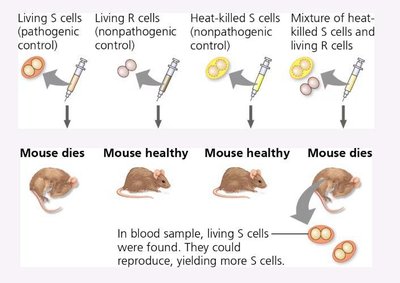
Griffith Experiment: Showed that a "transforming principle" from dead pathogenic bacteria could make harmless bacteria pathogenic.
Hershey-Chase Experiment: Used bacteriophages labeled with radioactive isotopes to show that DNA, not protein, enters bacterial cells and directs viral replication.
Transformation: The process by which genetic material is transferred from one organism to another.
Step-by-Step Guidance
Summarize Griffith's experiment: He mixed heat-killed pathogenic bacteria with live non-pathogenic bacteria and observed that the harmless bacteria became pathogenic.
Explain the concept of a "transforming principle" that could transfer genetic traits.
Describe how Hershey and Chase used radioactive labeling to distinguish DNA from protein in viruses that infect bacteria.
Note that only the DNA, not the protein, entered the bacterial cells and directed the production of new viruses.
Try solving on your own before revealing the answer!
Final Answer:
Griffith's experiment showed that a "transforming principle" from dead pathogenic bacteria could make harmless bacteria pathogenic, suggesting that some molecule carried genetic information. Hershey and Chase confirmed that DNA, not protein, is the hereditary material by showing that only DNA from viruses entered bacterial cells and directed viral replication.
These experiments provided strong evidence that DNA is the molecule responsible for heredity.
Q13. Describe the general process of DNA replication and the functions of enzymes DNA polymerase, Helicase, primase, and topoisomerase.
Background
Topic: DNA Replication Enzymes and Mechanisms
This question focuses on the coordinated action of several enzymes during DNA replication and their specific roles in the process.
Key Terms and Concepts:
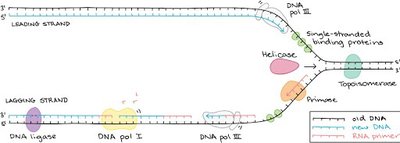
DNA Polymerase: Synthesizes new DNA strands by adding nucleotides to a primer or existing strand.
Helicase: Unwinds the DNA double helix to create single-stranded templates.
Primase: Synthesizes short RNA primers needed to start DNA synthesis.
Topoisomerase: Relieves tension and prevents supercoiling ahead of the replication fork.
Step-by-Step Guidance
Recall that DNA replication begins at specific origins, where the double helix is unwound by helicase, creating a replication fork.
Primase synthesizes a short RNA primer to provide a starting point for DNA polymerase.
DNA polymerase adds nucleotides to the 3' end of the primer, synthesizing the new DNA strand in the 5' to 3' direction.
Topoisomerase works ahead of the replication fork to relieve the strain caused by unwinding the DNA.
Consider how these enzymes work together to ensure accurate and efficient DNA replication.
Try solving on your own before revealing the answer!
Final Answer:
During DNA replication, helicase unwinds the double helix, primase synthesizes RNA primers, DNA polymerase extends the new DNA strand by adding nucleotides, and topoisomerase relieves supercoiling tension. These enzymes work together to accurately copy the DNA so that each daughter cell receives a complete set of genetic information.
This coordination ensures the fidelity and efficiency of DNA replication.
