 Back
Molecular Basis of Inheritance: DNA Structure, Replication, and Genetic Information
Study Guide - Smart Notes
 Tailored notes based on your materials, expanded with key definitions, examples, and context.
Q2. Describe how DNA replication transmits genetic information to the next generation in a species.
Background
Topic: DNA Replication and Heredity
This question tests your understanding of how the process of DNA replication ensures that genetic information is faithfully passed from parent to offspring, both in cell division (mitosis) and in the formation of gametes (meiosis).
Key Terms and Concepts:
DNA Replication: The process by which a cell copies its DNA before cell division.
Genetic Information: The sequence of nucleotides in DNA that encodes instructions for building proteins and regulating cellular activities.
Template Strand: The original DNA strand used as a guide for creating a new complementary strand.
Semiconservative Replication: Each new DNA molecule consists of one old (parental) strand and one newly synthesized strand.
Step-by-Step Guidance
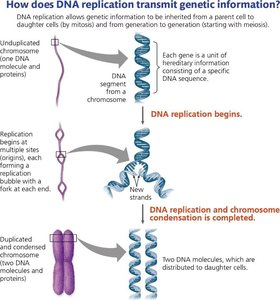
Recall that DNA replication occurs before a cell divides, ensuring that each daughter cell receives a complete set of genetic instructions.
Understand that the double-stranded DNA molecule unwinds, and each strand serves as a template for the synthesis of a new complementary strand.
Base pairing rules (A with T, C with G) ensure that the new strands are accurate copies of the original DNA sequence.
After replication, each daughter cell inherits a DNA molecule that is identical to the original, preserving the genetic information across generations.
Think about how this process allows for the transmission of hereditary traits from parent to offspring, both in asexual (mitosis) and sexual (meiosis) reproduction.
Try solving on your own before revealing the answer!
Final Answer:
DNA replication transmits genetic information to the next generation by producing two identical DNA molecules from one original molecule. Each new DNA molecule contains one parental strand and one newly synthesized strand (semiconservative replication). This ensures that when cells divide, each daughter cell receives an exact copy of the genetic information, allowing hereditary traits to be passed on accurately from parent to offspring.
