 Back
Molecular Basis of Inheritance – Guided Study Notes
Study Guide - Smart Notes
 Tailored notes based on your materials, expanded with key definitions, examples, and context.
Q7. Describe the Griffith and Hershey-Chase experiments that led to the discovery that DNA could be hereditary information.
Background
Topic: Discovery of DNA as Genetic Material
This question tests your understanding of the classic experiments that demonstrated DNA, not protein, is the molecule responsible for heredity.
Key Terms and Concepts:
Transformation
Bacteriophage
Pathogenic vs. nonpathogenic bacteria
Radioactive labeling
Step-by-Step Guidance
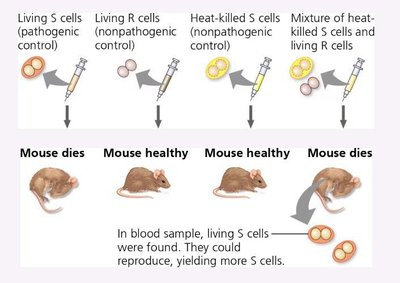
Review the setup of Griffith's experiment: He worked with two strains of Streptococcus pneumoniae—the S (smooth, virulent) and R (rough, non-virulent) strains.
Understand the key result: When mice were injected with a mixture of heat-killed S cells and living R cells, the mice died, and living S cells were recovered from them.
Think about what this result suggests: Some "transforming principle" from the dead S cells converted R cells into S cells.
For Hershey and Chase: They used bacteriophages labeled with radioactive sulfur (proteins) and phosphorus (DNA) to infect bacteria.
Consider what they found in the infected bacteria and what this means for the molecule of heredity.
Try solving on your own before revealing the answer!
Final Answer:
Griffith's experiment showed that a "transforming principle" from heat-killed pathogenic S bacteria could make harmless R bacteria deadly, suggesting the transfer of genetic material. Hershey and Chase used radioactive labeling to show that DNA, not protein, entered bacterial cells during viral infection and directed the production of new viruses. Together, these experiments demonstrated that DNA is the hereditary material.
Q8. Describe the "directionality" of a nucleotide strand. How do we determine the 5' and 3' ends?
Background
Topic: Nucleic Acid Structure
This question tests your understanding of the chemical structure of DNA and RNA strands, specifically how the ends are defined and why directionality matters.
Key Terms and Concepts:
5' (five-prime) end
3' (three-prime) end
Phosphodiester bond
Deoxyribose/ribose sugar
Step-by-Step Guidance
Recall that nucleic acids are polymers of nucleotides linked by phosphodiester bonds.
Identify the numbering of carbon atoms in the sugar ring (1' to 5').
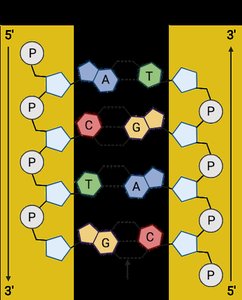
Understand that the 5' end has a free phosphate group attached to the 5' carbon, while the 3' end has a free hydroxyl group on the 3' carbon.
Think about why this directionality is important for processes like DNA replication and transcription.
Try solving on your own before revealing the answer!
Final Answer:
Nucleotide strands have directionality because each nucleotide is joined to the next via a phosphodiester bond between the 3' hydroxyl of one sugar and the 5' phosphate of the next. The 5' end has a free phosphate group, and the 3' end has a free hydroxyl group. This directionality is essential for DNA replication and gene expression.
Q9. Describe Chargaff's rule.
Background
Topic: DNA Base Pairing
This question tests your knowledge of the quantitative relationships between the bases in DNA.
Key Terms and Concepts:
Adenine (A), Thymine (T), Guanine (G), Cytosine (C)
Base pairing
Step-by-Step Guidance
Recall that Chargaff analyzed the base composition of DNA from different organisms.
Note the key finding: the amount of A equals T, and the amount of G equals C.
Think about how this relates to the structure of the DNA double helix.
Try solving on your own before revealing the answer!
Final Answer:
Chargaff's rule states that in DNA, the amount of adenine (A) always equals thymine (T), and the amount of guanine (G) always equals cytosine (C). This is due to specific base pairing in the double helix.
Q10. How does Chargaff's rule allow you to distinguish between DNA and RNA?
Background
Topic: Differences between DNA and RNA
This question tests your ability to apply Chargaff's rule to identify nucleic acid types based on base composition.
Key Terms and Concepts:
Uracil (U) in RNA
Thymine (T) in DNA
Base pairing rules
Step-by-Step Guidance
Recall that DNA contains A, T, G, and C, while RNA contains A, U, G, and C.
Think about how the ratios of bases would differ in single-stranded RNA versus double-stranded DNA.
Consider what you would expect to see if you analyzed the base composition of a sample and how you could tell if it was DNA or RNA.
Try solving on your own before revealing the answer!
Final Answer:
Chargaff's rule applies to double-stranded DNA, where A = T and G = C. In RNA, thymine is replaced by uracil, and the base ratios do not necessarily match because RNA is usually single-stranded. Thus, if you see equal amounts of A and T (but no U), it's likely DNA; if you see U and unequal ratios, it's likely RNA.
Q11. Describe the double strand and antiparallel structure of DNA. Which bonds hold the nucleotides together and which bonds hold the double strand together? Discuss the features of the "ends" of each strand and how this makes it antiparallel.
Background
Topic: DNA Structure
This question tests your understanding of the molecular structure of DNA, including the types of bonds and the orientation of the strands.
Key Terms and Concepts:
Phosphodiester bonds
Hydrogen bonds
Antiparallel orientation
5' and 3' ends
Step-by-Step Guidance
Recall that DNA is composed of two strands forming a double helix.
Each strand has a sugar-phosphate backbone with bases projecting inward.
Phosphodiester bonds connect nucleotides within a strand; hydrogen bonds connect complementary bases between strands.
One strand runs 5' to 3', the other 3' to 5', making them antiparallel.
Think about how the 5' and 3' ends are defined and why this orientation is important for replication and function.
Try solving on your own before revealing the answer!
Final Answer:
DNA consists of two antiparallel strands held together by hydrogen bonds between complementary bases (A-T, G-C). The nucleotides within each strand are joined by phosphodiester bonds. The 5' end has a phosphate group, and the 3' end has a hydroxyl group, making the strands run in opposite directions.
