 Back
BackMolecular Biology: DNA Structure, Gene Expression, and Genetic Engineering
Study Guide - Smart Notes
 Tailored notes based on your materials, expanded with key definitions, examples, and context.
DNA Structure and Organization
Nucleotide Structure
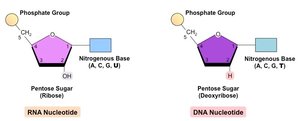
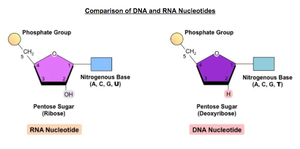
Nucleotides are the fundamental building blocks of nucleic acids, such as DNA and RNA. Each nucleotide consists of three components: a phosphate group, a five-carbon sugar (deoxyribose in DNA, ribose in RNA), and a nitrogenous base. The four nitrogenous bases in DNA are adenine (A), thymine (T), cytosine (C), and guanine (G); in RNA, uracil (U) replaces thymine.
Phosphate Group: Links nucleotides together via phosphodiester bonds.
Pentose Sugar: Deoxyribose in DNA (lacking an oxygen at the 2' position), ribose in RNA (with an OH at the 2' position).
Nitrogenous Base: Purines (A, G) and pyrimidines (C, T, U).
Nucleotide Polymer Structure
Sugar-Phosphate Backbone: The backbone of DNA and RNA is formed by alternating sugar and phosphate groups, providing structural stability.
Base Sequence: The order of nitrogenous bases encodes genetic information, with specific sequences forming genes.
The double helix model, elucidated by Watson and Crick, revealed that DNA consists of two antiparallel strands held together by complementary base pairing (A with T, C with G), explaining the mechanism of genetic inheritance.
DNA Replication
DNA Polymerase: An enzyme that adds nucleotides to the 3' end of a growing DNA strand and proofreads for errors, ensuring fidelity during replication.
Semiconservative Replication: Each new DNA molecule contains one parental and one newly synthesized strand, preserving genetic continuity.
Organization of DNA in Eukaryotic Chromosomes
DNA Packaging: Eukaryotic DNA is highly compacted to fit within the nucleus, involving coiling and folding mechanisms.
Histones and Nucleosomes: DNA wraps around histone proteins to form nucleosomes, which further coil into higher-order structures, regulating gene accessibility and expression.
Gene Expression
Central Dogma of Molecular Biology
The central dogma describes the flow of genetic information: DNA → RNA → Protein. This involves two main processes:
Transcription: Synthesis of RNA from a DNA template in the nucleus.
Translation: Synthesis of proteins from mRNA in the cytoplasm, facilitated by ribosomes.
Gene Structure and Regulation
Promoters: DNA sequences where RNA polymerase binds to initiate transcription.
Terminators: Sequences signaling the end of transcription.
Transcription Factors: Proteins that regulate the binding of RNA polymerase to promoters, controlling gene expression.
RNA Structure and Types
RNA Nucleotide: Composed of ribose, phosphate, and bases (A, C, G, U).
mRNA (Messenger RNA): Carries genetic code from DNA to ribosomes; synthesized in the nucleus, functions in the cytoplasm.
tRNA (Transfer RNA): Brings amino acids to ribosomes during translation; synthesized in the nucleus, functions in the cytoplasm.
rRNA (Ribosomal RNA): Structural and catalytic component of ribosomes; produced in the nucleolus, functions in ribosomes.
The Genetic Code
Universal (Nearly): The genetic code is shared by almost all organisms, enabling gene transfer across species.
Start Codon (AUG): Signals the start of translation and codes for methionine.
Stop Codons (UAA, UGA, UAG): Signal the end of translation.
Translation
Ribosomes: Composed of rRNA and proteins; site of protein synthesis.
tRNA: Contains an anticodon that pairs with mRNA codons, ensuring correct amino acid incorporation.
mRNA: Sequence of codons determines the amino acid sequence of the protein.
Stages of Translation:
Initiation: Assembly of ribosome, mRNA, and initiator tRNA at the start codon.
Elongation: Sequential addition of amino acids as tRNAs bring them to the ribosome.
Termination: Release of the completed polypeptide when a stop codon is reached.
Mutations
Types of Mutations
Point Mutations: Single nucleotide changes; can be silent, missense (conservative or radical), or nonsense.
Frameshift Mutations: Insertions or deletions not in multiples of three, altering the reading frame.
Consequences of Mutations
Germ Cell Mutations: Passed to offspring, contributing to genetic diversity and evolution.
Somatic Cell Mutations: Affect only the individual, can lead to diseases like cancer.
Causes of Mutations
DNA Replication Errors
Radiation
Chemicals and Free Radicals
Regulation of Gene Expression
Lactose Operon (lac operon) in Prokaryotes
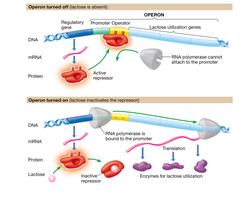
The lac operon is a model for understanding transcriptional regulation in bacteria. It includes a promoter, operator, and structural genes for lactose metabolism. The operon is regulated by a repressor protein that binds to the operator in the absence of lactose, blocking transcription. When lactose is present, it inactivates the repressor, allowing gene expression.
Post-Transcriptional Control: RNA Splicing
RNA Splicing: Removal of introns and joining of exons in pre-mRNA, allowing for alternative splicing and increased protein diversity.
Split Genes: Allow for flexible gene expression and adaptation through alternative splicing.
Translational and Post-Translational Control
Translational Control: Regulation of gene expression at the level of mRNA translation.
Post-Translational Control: Modifications to proteins after synthesis, such as phosphorylation or glycosylation, affecting protein function and stability.
mRNA Modifications
5' Cap: Modified guanine nucleotide added to the 5' end, aiding in mRNA stability and translation initiation.
Poly(A) Tail: String of adenines added to the 3' end, enhancing mRNA stability and export from the nucleus.
Cancer Biology
Characteristics of Cancer Cells
Lack of Contact Inhibition
Increased Vascularity (Angiogenesis)
Plasma Membrane and Cytoskeleton Changes
Abnormal, Disorganized Growth
Genes Involved in Cancer
Proto-oncogenes/Oncogenes: Normal genes that, when mutated, drive uncontrolled cell division.
Tumor Suppressor Genes: Inhibit cell division; mutations lead to loss of growth control.
DNA Repair Genes: Maintain genome integrity; mutations increase cancer risk.
Apoptosis: Programmed cell death, essential for removing damaged cells.
Genetic Engineering
Vectors
Plasmids: Circular DNA molecules used to transfer genes into bacteria.
Viruses: Can deliver genetic material into host cells, used in gene therapy.
Restriction Enzymes
Function: Cut DNA at specific sequences, enabling gene cloning and recombinant DNA technology.
Transformation
Definition: Introduction of foreign DNA into a host cell, commonly used in bacteria for gene cloning.
Polymerase Chain Reaction (PCR)
Purpose: Amplifies specific DNA sequences exponentially.
Steps: Denaturation, annealing, extension; repeated cycles double the DNA each time.
Transgenic Organisms
Definition: Organisms with genes from another species, created using recombinant DNA technology.
Applications: Agriculture (pest-resistant crops), medicine (pharmaceutical production), research (disease models).
