 Back
BackMolecular Biology: DNA Structure, Replication, and Gene Expression
Study Guide - Smart Notes
 Tailored notes based on your materials, expanded with key definitions, examples, and context.
Unit 7: Molecular Biology
Chapter 1: DNA Replication
Nucleic Acids
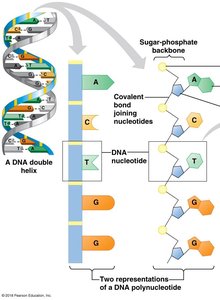
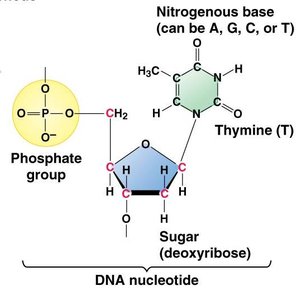
Nucleic acids are essential biomolecules that store and transmit genetic information in all living organisms. The two main types are deoxyribonucleic acid (DNA) and ribonucleic acid (RNA). Both are polymers composed of nucleotide monomers, each consisting of a sugar, a phosphate group, and a nitrogenous base.
DNA: Contains deoxyribose sugar; stores genetic information.
RNA: Contains ribose sugar; involved in protein synthesis and gene regulation.
Nucleotide structure: Each nucleotide is made up of a five-carbon sugar (deoxyribose in DNA, ribose in RNA), a phosphate group, and a nitrogenous base.
Nitrogenous Bases
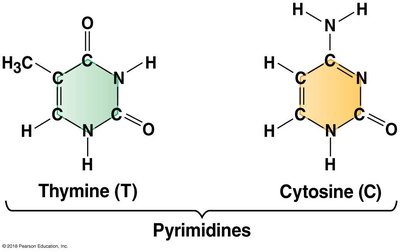
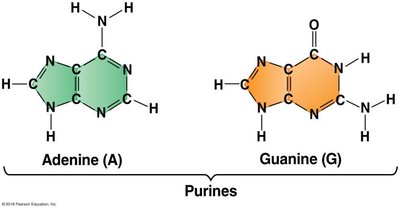
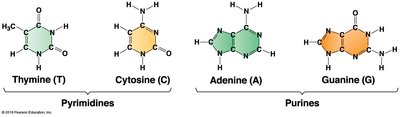
Nitrogenous bases are categorized into two groups based on their ring structures:
Purines: Double-ring structures; include adenine (A) and guanine (G).
Pyrimidines: Single-ring structures; include thymine (T), cytosine (C), and uracil (U) (uracil is found only in RNA).
Base Pairing
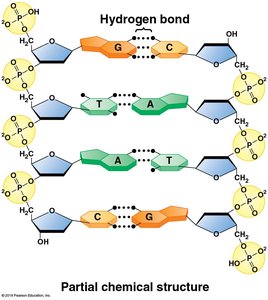
Base pairing in nucleic acids is governed by hydrogen bonding between specific pairs:
DNA: Adenine (A) pairs with Thymine (T); Guanine (G) pairs with Cytosine (C).
RNA: Adenine (A) pairs with Uracil (U) instead of Thymine.
Base pairing ensures the accurate replication and transcription of genetic information.
DNA Structure
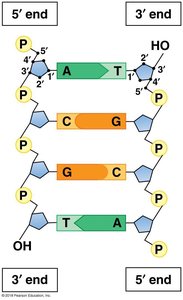
DNA is a double-stranded molecule forming a double helix, as described by the Watson-Crick model. The two strands are held together by complementary base pairing and have a uniform diameter. The strands are antiparallel, meaning one runs 5' to 3' and the other 3' to 5'.
Sugar-phosphate backbone: The sides of the helix are formed by alternating sugars and phosphates.
Antiparallel orientation: Each strand has a 3' end (with a free OH group) and a 5' end (with a phosphate group).
DNA Replication
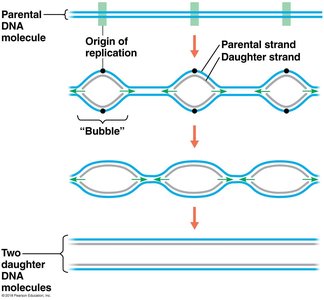
DNA replication is the process by which a cell copies its DNA before cell division. It follows the semiconservative model, where each daughter DNA molecule contains one parental and one newly synthesized strand.
Origin of replication (ori): Specific sites where replication begins.
Replication bubble: Formed as DNA unwinds at multiple origins, allowing replication to proceed in both directions.
Enzymes involved:
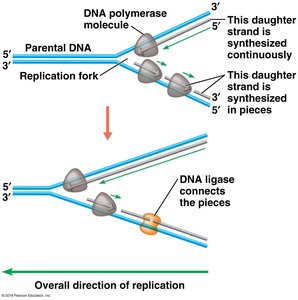
DNA polymerase: Synthesizes new DNA by adding nucleotides to the 3' end.
DNA ligase: Joins Okazaki fragments on the lagging strand.
Leading strand: Synthesized continuously toward the replication fork.
Lagging strand: Synthesized discontinuously in short fragments (Okazaki fragments) away from the replication fork.
Repair of DNA Damage
DNA polymerase and DNA ligase also play roles in repairing DNA damage caused by radiation, chemicals, or errors during replication. Unrepaired damage can lead to mutations and diseases such as cancer.
Chapter 2: Protein Synthesis
Gene Expression: From DNA to Protein
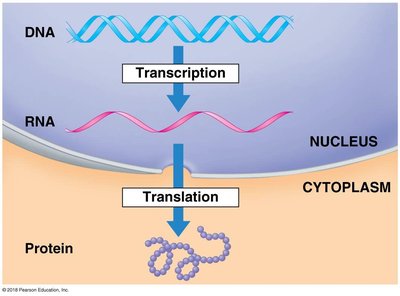
Gene expression is the process by which information from a gene is used to synthesize a functional gene product, typically a protein. This process involves two main steps: transcription and translation.
Genotype: The genetic makeup of an organism.
Phenotype: The observable traits resulting from gene expression.
Gene expression: The link between genotype and phenotype, involving the synthesis of proteins.
Transcription
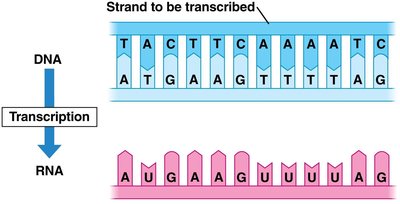
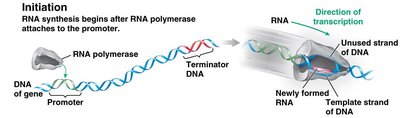
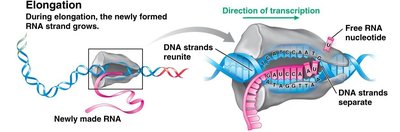
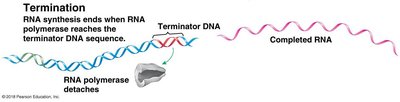
Transcription is the synthesis of RNA from a DNA template. It occurs in three stages: initiation, elongation, and termination.
Initiation: RNA polymerase binds to the promoter region of the gene and unwinds the DNA.
Elongation: RNA polymerase adds complementary RNA nucleotides to the growing RNA strand.
Termination: RNA polymerase reaches a terminator sequence and releases the newly formed RNA.
mRNA Processing (Eukaryotes)
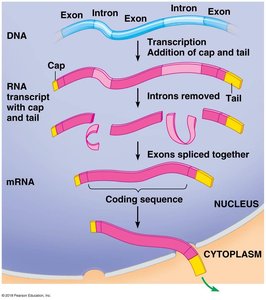
In eukaryotic cells, the primary RNA transcript (pre-mRNA) undergoes processing before becoming mature mRNA:
5' cap: Modified guanine nucleotide added to the 5' end.
3' poly-A tail: String of adenine nucleotides added to the 3' end.
RNA splicing: Removal of noncoding introns and joining of coding exons.
Translation
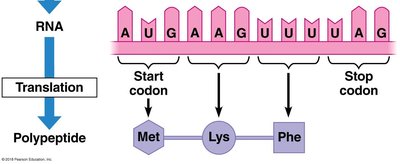
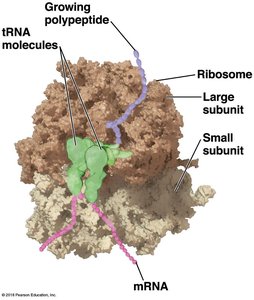
Translation is the process by which the nucleotide sequence of mRNA is decoded to build a polypeptide (protein). This occurs in the cytoplasm and involves ribosomes, tRNA, and various enzymes.
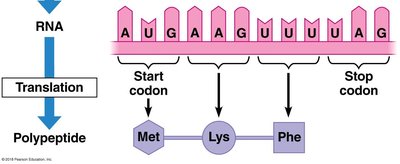
Codons: Triplets of nucleotides in mRNA that specify amino acids.
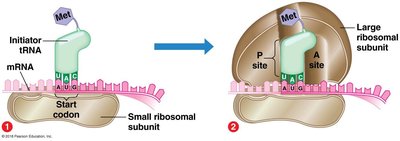
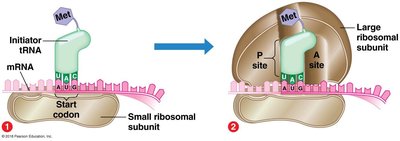
Start codon: AUG (methionine); Stop codons: UAA, UAG, UGA.
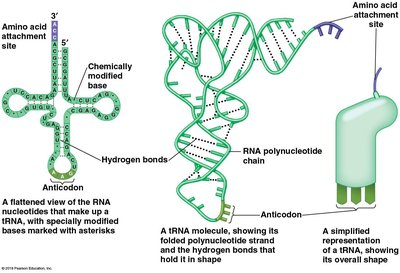
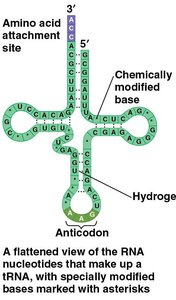
tRNA: Transfers specific amino acids to the ribosome, matching codons with anticodons.
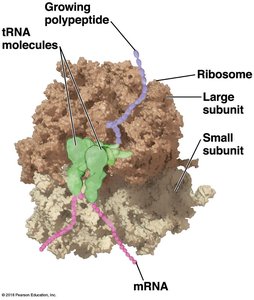
Ribosome: Composed of rRNA and proteins; facilitates the assembly of amino acids into polypeptides.
Steps of Translation
Initiation: mRNA, the first tRNA, and ribosomal subunits assemble.
Elongation: Amino acids are added one by one to the growing chain.
Termination: The ribosome reaches a stop codon, releasing the completed polypeptide.
Mutations
Mutations are changes in the genetic material that can affect protein synthesis:
Substitution: One base is replaced by another (silent, missense, or nonsense mutations).
Frameshift: Insertion or deletion of bases alters the reading frame, usually resulting in nonfunctional proteins.
Causes: Spontaneous errors, mutagens (e.g., radiation, chemicals).
Chapter 3: Gene Expression and Regulation
Gene Regulation in Prokaryotes
Gene regulation allows cells to control which genes are expressed in response to environmental changes.
Operon: A cluster of genes regulated as a unit (e.g., lac operon for lactose metabolism).
Inducible operon: Normally off, can be turned on (e.g., lac operon).
Repressible operon: Normally on, can be turned off (e.g., trp operon).
Gene Regulation in Eukaryotes
DNA packaging: DNA is wrapped around histones, forming nucleosomes; tightly packed DNA is less accessible for transcription.
Chemical modifications: Methylation represses, acetylation activates gene expression.
Epigenetic inheritance: Heritable changes in gene expression not involving DNA sequence changes.
X inactivation: In female mammals, one X chromosome is inactivated in each cell, forming a Barr body.
Gene Expression Control Points
Transcription initiation (transcription factors, enhancers)
RNA splicing (alternative splicing)
mRNA breakdown
Translation initiation
Protein processing and degradation
Cell signaling (signal transduction pathways)
Cancer and Gene Expression
Oncogenes: Mutated genes that cause cancer.
Proto-oncogenes: Normal genes that can become oncogenes.
Tumor-suppressor genes: Inhibit cell division; mutations can lead to cancer.
Multiple mutations are usually required for cancer to develop.
Chapter 4: DNA Technology and Genomics
DNA Profiling
DNA profiling analyzes DNA samples to determine identity or relationships. It relies on genetic markers that vary among individuals.
Polymerase Chain Reaction (PCR)
PCR is a technique to amplify specific DNA sequences rapidly. It involves cycles of heating (to denature DNA), cooling (to anneal primers), and extension (to synthesize new DNA).
Gel Electrophoresis
Gel electrophoresis separates DNA fragments by size using an electric field. Smaller fragments move faster through the gel matrix.
Genomics and Bioinformatics
Genomics: Study of whole genomes, including sequencing and analysis.
Bioinformatics: Application of computational tools to manage and analyze biological data (e.g., BLAST for sequence comparison).
Proteomics: Study of the full set of proteins (proteome) produced by an organism.
Comparative Genomics
Comparing genomes of different species reveals evolutionary relationships. For example, humans and chimpanzees differ by only 1.2% in single nucleotide substitutions.
Additional info: This guide covers the structure and function of nucleic acids, the mechanisms of DNA replication, gene expression, regulation, and modern molecular biology techniques, providing a comprehensive overview for college-level biology students.
