 Back
Molecular Biology of the Gene: DNA Structure, Replication, and Gene Expression CH. 12
Study Guide - Smart Notes
 Tailored notes based on your materials, expanded with key definitions, examples, and context.
12.1 The Genetic Material
Discovery of DNA as Genetic Material
The identification of DNA as the hereditary material was a pivotal moment in molecular biology. Early experiments by Frederick Griffith demonstrated that virulence could be transferred between bacterial strains, a process known as transformation. Avery and colleagues later showed that DNA, not protein, was responsible for this transformation, establishing DNA as the genetic material.
Transformation: The uptake and incorporation of DNA from dead cells into living cells, altering their genotype.
Requirements for Genetic Material: Must store information, be stable and replicable, and allow for mutations.
Hershey and Chase Experiment: Used radioactively labeled DNA and protein in viruses to show that only DNA enters bacteria and directs viral replication.
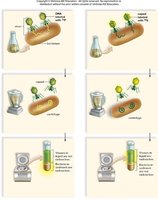
Example: Griffith's experiment with S and R strains of Streptococcus pneumoniae demonstrated transformation, while Hershey and Chase confirmed DNA as the genetic material.
Structure of DNA
Nucleotide Composition and Chargaff's Rules
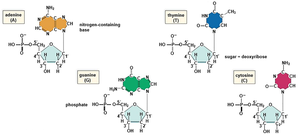
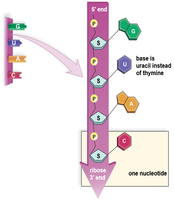
DNA is composed of nucleotides, each containing a phosphate group, a deoxyribose sugar, and a nitrogenous base. The four bases are divided into purines (adenine, guanine) and pyrimidines (thymine, cytosine). Chargaff's rules state that the amount of adenine equals thymine, and guanine equals cytosine, supporting the concept of complementary base pairing.
Purines: Adenine (A), Guanine (G)
Pyrimidines: Thymine (T), Cytosine (C)
Chargaff's Rules: A = T, G = C in any species
Example: Human chromosomes contain about 140 million base pairs, allowing for immense genetic diversity.
Evidence for DNA Structure: Franklin's X-ray Diffraction
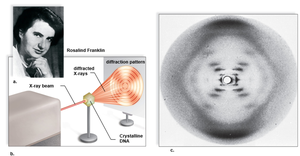
Rosalind Franklin's X-ray diffraction studies provided crucial evidence that DNA is a helical molecule with repeating features. Her photographs revealed the characteristic X-shaped pattern of a double helix.
X-ray Diffraction: Technique used to determine the three-dimensional structure of DNA.
Helical Structure: DNA is a double helix with repeating units.
Watson and Crick Model of DNA
James Watson and Francis Crick proposed the double helix model of DNA, likening it to a twisted ladder. The sugar-phosphate backbone forms the sides, while hydrogen-bonded base pairs form the rungs. The two strands are antiparallel, and information is read in the 5′ to 3′ direction.
Double Helix: Two antiparallel strands with complementary base pairing (A-T, G-C).
Sugar-Phosphate Backbone: Provides structural stability.
Hydrogen Bonds: Hold base pairs together.
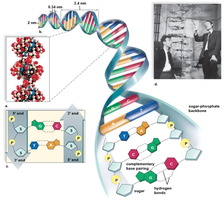
Example: The double helix model explains how DNA can be replicated and how genetic information is stored.
12.2 Replication of DNA
Semiconservative Replication
DNA replication is the process by which a cell copies its DNA before cell division. The semiconservative model states that each new DNA molecule consists of one old (parental) strand and one newly synthesized strand.
Template Mechanism: Each parental strand serves as a template for a new strand.
Complementary Base Pairing: Ensures accurate copying of genetic information.
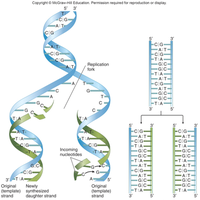
Equation: (each daughter contains one parental and one new strand)
Enzymes in DNA Replication
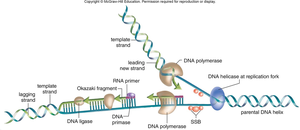
Several enzymes coordinate the process of DNA replication. DNA helicase unwinds the double helix, single-stranded binding proteins stabilize the separated strands, DNA primase adds RNA primers, and DNA polymerase synthesizes new DNA. DNA ligase joins fragments on the lagging strand.
DNA Helicase: Unwinds the DNA helix.
SSB Proteins: Prevent re-formation of the helix.
DNA Primase: Adds RNA primers.
DNA Polymerase: Synthesizes new DNA.
DNA Ligase: Joins Okazaki fragments on the lagging strand.
Prokaryotic vs. Eukaryotic DNA Replication
Prokaryotes have a single circular DNA molecule, and replication proceeds in both directions from a single origin. Eukaryotes have multiple linear chromosomes, and replication begins at many points, forming replication bubbles.
Prokaryotic Replication: Circular DNA, single origin, bidirectional.
Eukaryotic Replication: Linear DNA, multiple origins, replication bubbles.
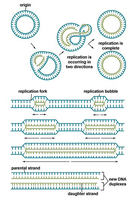
Example: Replication in bacteria takes about 40 minutes, but cell division occurs every 20 minutes due to overlapping rounds of replication.
12.3 Gene Expression: RNA and the Genetic Code
The Flow of Genetic Information
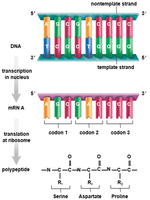
Gene expression is the process by which information in DNA is used to produce proteins. The flow of genetic information follows the central dogma: DNA → RNA → Protein. RNA acts as the intermediary, carrying instructions from DNA to the ribosome for protein synthesis.
DNA: Stores genetic information.
RNA: Transfers information and participates in protein synthesis.
Protein: Carries out cellular functions.
Major Classes of RNA
There are three main types of RNA involved in gene expression:
Messenger RNA (mRNA): Carries genetic information from DNA to ribosomes.
Transfer RNA (tRNA): Brings amino acids to the ribosome during translation.
Ribosomal RNA (rRNA): Forms the core of the ribosome and catalyzes peptide bond formation.
The Genetic Code
The genetic code is a set of rules by which information encoded in mRNA is translated into proteins. Each codon, a sequence of three RNA nucleotides, specifies a particular amino acid. The code is universal, redundant, and unambiguous.
Codon: Three-nucleotide sequence in mRNA.
Redundancy: Multiple codons can code for the same amino acid.
Unambiguous: Each codon codes for only one amino acid.
Start Codon: AUG (methionine)
Stop Codons: UAA, UAG, UGA
Example: UCU codes for phenylalanine; UGU and UGC both code for cysteine.
12.4 Gene Expression: Transcription
Transcription Process
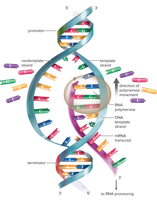
Transcription is the synthesis of RNA from a DNA template. Only one strand of DNA (the template strand) is transcribed. RNA polymerase builds the RNA strand in the 5′ to 3′ direction.
Initiation: RNA polymerase binds to the promoter region.
Elongation: RNA polymerase reads the template strand and adds complementary RNA nucleotides.
Termination: RNA polymerase reaches a stop sequence and releases the mRNA transcript.
Equation:
Summary
This chapter covers the molecular basis of heredity, including the discovery and structure of DNA, the process of DNA replication, and the mechanisms of gene expression through transcription and translation. Understanding these processes is fundamental to modern biology and genetics.
