 Back
Molecular Biology of the Gene: DNA Structure, Replication, and Gene Expression CH. 12
Study Guide - Smart Notes
 Tailored notes based on your materials, expanded with key definitions, examples, and context.
Molecular Biology of the Gene
Overview
This chapter explores the molecular basis of heredity, focusing on the structure and function of DNA, its replication, and the mechanisms of gene expression. These concepts are central to understanding how genetic information is stored, transmitted, and utilized in living organisms.
The Genetic Material
Discovery of DNA as Genetic Material
The identification of DNA as the hereditary material was a pivotal moment in biology. Early experiments by Frederick Griffith demonstrated transformation in Streptococcus pneumoniae, showing that genetic traits could be transferred from dead to living cells. Avery and colleagues later confirmed that DNA was the transforming substance, and the Hershey-Chase experiment provided definitive evidence that DNA, not protein, is the genetic material in viruses.
Transformation: The process by which genetic material from dead cells is incorporated into living cells, altering their traits.
Griffith's Experiment: Showed that virulence could be transferred between bacterial strains.
Avery's Experiment: Used enzymes to show that only DNA could cause transformation.
Hershey-Chase Experiment: Used radioactive labeling to demonstrate that DNA enters bacterial cells during viral infection, not protein.
Key Requirements for Genetic Material: Must store information, be stable and replicable, and allow for mutations.
Example: The Hershey-Chase experiment used T-phage viruses labeled with radioactive isotopes to track DNA and protein during infection of E. coli.
Structure and Composition of DNA
DNA is composed of four nucleotides: adenine (A), guanine (G), thymine (T), and cytosine (C). The base composition is constant within a species but varies between species. Complementary base pairing (A with T, G with C) is fundamental to DNA's function.
Purines: Adenine and Guanine
Pyrimidines: Thymine and Cytosine
Base Pairing: Equal amounts of A and T, G and C in each species
Human Chromosomes: Average about 140 million base pairs
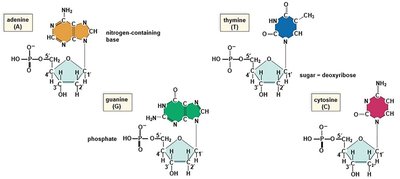
Example: The nucleotide composition of DNA is illustrated by the chemical structures of A, T, G, and C.
Discovery of DNA Structure
Rosalind Franklin's X-ray diffraction studies revealed that DNA is a helical structure. Watson and Crick used this information to propose the double helix model, with antiparallel strands and a sugar-phosphate backbone.
X-ray Diffraction: Provided evidence for the helical structure of DNA.
Double Helix Model: Two antiparallel strands, sugar-phosphate backbone, hydrogen-bonded base pairs.
Directionality: DNA is read and replicated in the 5’ to 3’ direction.
Example: The double helix model explains how genetic information is stored and replicated.
Replication of DNA
Mechanism of DNA Replication
DNA replication is the process by which a DNA molecule is copied. It is semiconservative, meaning each new molecule contains one old strand and one new strand. The process involves several enzymes and occurs differently in prokaryotes and eukaryotes.
Semiconservative Replication: Each strand serves as a template for a new strand.
Key Enzymes: DNA helicase (unwinds DNA), DNA polymerase (synthesizes new DNA), DNA primase (adds primers), DNA ligase (joins fragments).
Single-Stranded Binding Proteins: Prevent the helix from reforming.
Replication Accuracy: DNA polymerase corrects errors, making replication highly accurate.
Example: DNA replication involves the formation of replication forks and the synthesis of leading and lagging strands.
Replication in Prokaryotes and Eukaryotes
Replication in prokaryotes occurs on circular DNA and proceeds in both directions from the origin. In eukaryotes, replication begins at multiple points along linear chromosomes, forming replication bubbles.
Prokaryotes: Circular DNA, bidirectional replication, produces two identical circles.
Eukaryotes: Linear chromosomes, multiple origins, replication bubbles spread bidirectionally.
Telomeres: Ends of chromosomes replicated by telomerase; unregulated activity can affect cell function.
Example: Replication bubbles in eukaryotes allow for rapid and efficient DNA synthesis.
Gene Expression: RNA and the Genetic Code
Mechanism of Gene Expression
Gene expression is the process by which information from DNA is used to synthesize proteins. DNA specifies the sequence of nucleotides in RNA, which in turn determines the amino acid sequence of proteins.
DNA: Contains genetic information.
RNA: Transcribes information from DNA.
Protein: Synthesized based on RNA sequence.
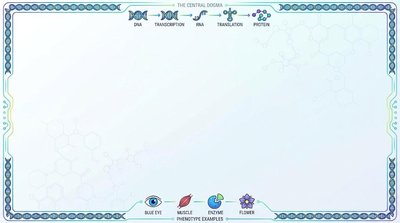
Example: The central dogma illustrates the flow of genetic information from DNA to RNA to protein.
Types of RNA
RNA is a polymer of nucleotides with ribose sugar and uracil instead of thymine. There are three main types of RNA involved in gene expression.
Messenger RNA (mRNA): Carries genetic information from DNA to ribosomes.
Transfer RNA (tRNA): Brings amino acids to the ribosome.
Ribosomal RNA (rRNA): Combines with proteins to form ribosomes.
Example: mRNA, tRNA, and rRNA work together to translate genetic information into proteins.
The Genetic Code
The genetic code consists of codons, which are sequences of three RNA nucleotides. Each codon specifies an amino acid, and the code is universal among organisms.
Codons: Unique arrangements of three RNA nucleotides.
Redundancy: Multiple codons can code for the same amino acid, but each codon codes for only one amino acid.
Start and Stop Codons: One start codon (AUG), three stop codons (UAA, UAG, UGA).
Universality: The genetic code is nearly universal, supporting the theory of a common ancestor.
Example: The codon UCU codes for phenylalanine; UGU and UGC both code for cysteine.
Gene Expression: Transcription
Transcription Process
Transcription is the process of synthesizing an mRNA molecule from a DNA template. It occurs in three stages: initiation, elongation, and termination.
Initiation: RNA polymerase binds to the promoter region, defining the start and direction of transcription.
Elongation: RNA polymerase reads the DNA template and synthesizes complementary RNA bases.
Termination: RNA polymerase reaches a stop sequence, releasing the mRNA transcript.
Example: Only one side of the DNA is transcribed into mRNA, which is built in the 5’ to 3’ direction.
mRNA Processing in Eukaryotes
Before mRNA leaves the nucleus, it undergoes several modifications. These include the addition of a 5’ cap, a poly-A tail, and the removal of introns through splicing.
5’ Cap: Modified guanine nucleotide that helps ribosomes attach for translation.
Poly-A Tail: 150-200 adenines added to the 3’ end, facilitating transport and protecting mRNA from degradation.
Exons and Introns: Exons are expressed; introns are removed by spliceosomes or self-splicing.
Spliceosome: Uses ribozymes to cut and remove introns, splicing exons together.
Example: Mature mRNA transcript is ready for translation after processing.
Gene Expression: Translation
Translation Process
Translation is the process by which the mRNA codon sequence is converted into a protein sequence at the ribosome. It involves initiation, elongation, and termination stages.
Initiation: Small ribosomal subunit, mRNA, initiator tRNA, large ribosomal subunit, and initiation factors assemble. Initiator tRNA carries methionine and binds to the P site.
Elongation: Ribosome reads codons, tRNA brings amino acids, peptide bonds form between amino acids, and tRNA moves through A, P, and E sites.
Termination: Ribosome reads a stop codon, release factor binds, polypeptide is released, and ribosome dissociates.
Example: The anticodon of tRNA pairs with the mRNA codon, ensuring correct amino acid placement.
Summary of Gene Expression
Key Points
Gene Expression: A gene is expressed when its product (protein or RNA) is made and functions in the cell.
DNA Replication: Occurs in the nucleus (eukaryotes).
Transcription: Occurs in the nucleus, forms mRNA transcript.
Translation: Occurs at the ribosome, produces polypeptides.
Protein Processing: Polypeptides may be modified and transported within or outside the cell.
Example: Proteins can be further processed by the addition of sugars, phosphates, or lipids, and transported by vesicles.
Table: Comparison of DNA and RNA
Feature | DNA | RNA |
|---|---|---|
Sugar | Deoxyribose | Ribose |
Bases | A, T, G, C | A, U, G, C |
Structure | Double helix | Single strand |
Function | Genetic storage | Protein synthesis |
Additional info: Table inferred for clarity and comparison.
