 Back
BackMolecular Biology of the Gene: From DNA to Protein and Mutations
Study Guide - Smart Notes
 Tailored notes based on your materials, expanded with key definitions, examples, and context.
Molecular Biology of the Gene
Introduction to Genes and Proteins
Genes are segments of DNA that encode the instructions for building proteins, which are essential molecules responsible for most cellular functions. The process by which genetic information is converted into functional proteins is central to molecular biology and is summarized by the "central dogma": DNA → RNA → Protein.
Gene: A segment of DNA specifying the sequence of amino acids in a protein.
Central Dogma: The flow of genetic information from DNA to RNA (transcription) and from RNA to protein (translation).
Proteins: Polymers composed of amino acid monomers; they perform structural, enzymatic, and regulatory roles in the cell.
One gene-one protein hypothesis: Each gene typically codes for one protein, though exceptions exist.
Example: The gene for hemoglobin codes for the hemoglobin protein, which carries oxygen in the blood.
Gene Expression: Transcription and Translation
Overview of Gene Expression
Gene expression involves two main steps: transcription and translation. During transcription, the DNA sequence of a gene is copied into messenger RNA (mRNA). During translation, the mRNA sequence is decoded to build a polypeptide (protein).
Transcription: Synthesis of RNA from a DNA template.
Translation: Synthesis of a polypeptide using the information in mRNA.

DNA vs. RNA
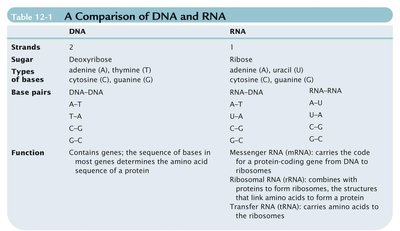
DNA and RNA are nucleic acids with distinct structures and functions. Understanding their differences is crucial for grasping gene expression.
DNA | RNA | |
|---|---|---|
Strands | 2 | 1 |
Sugar | Deoxyribose | Ribose |
Bases | A, T, C, G | A, U, C, G |
Base pairs | A-T, C-G | A-U, C-G |
Function | Stores genetic information | Transfers and translates genetic information |
Types of RNA
Three main types of RNA are involved in gene expression:
Messenger RNA (mRNA): Carries genetic code from DNA to ribosomes.
Transfer RNA (tRNA): Brings amino acids to the ribosome during translation.
Ribosomal RNA (rRNA): Structural and catalytic component of ribosomes.
Transcription: DNA to RNA
Mechanism of Transcription
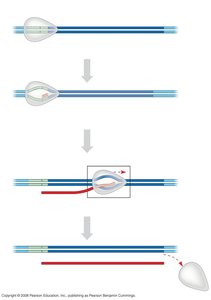
Transcription is the process by which a gene's DNA sequence is copied to make an mRNA molecule. It occurs in three main stages:
Initiation: RNA polymerase binds to the promoter region of DNA, determining the start site and direction of transcription.
Elongation: RNA polymerase moves along the template strand, synthesizing a complementary RNA strand in the 5' to 3' direction.
Termination: RNA polymerase reaches a terminator sequence and releases the newly formed mRNA transcript.
Transcription Unit
A transcription unit includes the promoter, the gene(s) being transcribed, and the terminator. Sometimes, more than one gene is transcribed as a single unit.
mRNA Processing in Eukaryotes
In eukaryotes, the initial mRNA (pre-mRNA) undergoes processing before leaving the nucleus:
RNA splicing: Removal of non-coding introns and joining of coding exons.
5' Cap and Poly-A Tail: Added to protect mRNA and facilitate export and translation.
The Genetic Code
Codons and the Genetic Code
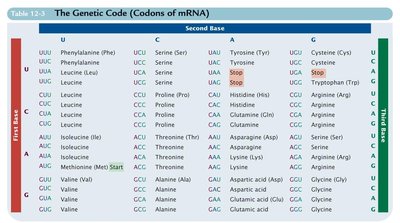
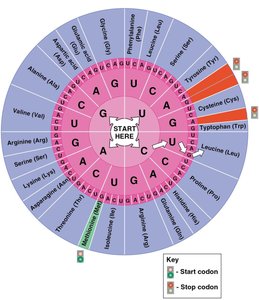
The genetic code is a set of rules by which the sequence of nucleotides in mRNA is translated into the sequence of amino acids in a protein. Each group of three nucleotides (codon) specifies one amino acid.
Universal: Nearly all organisms use the same code.
Redundant: Multiple codons can code for the same amino acid.
Unambiguous: Each codon codes for only one amino acid.
Start and Stop Codons: AUG (methionine) is the start codon; UAA, UAG, and UGA are stop codons.
Translation: RNA to Protein
Mechanism of Translation
Translation is the process by which ribosomes synthesize proteins using the mRNA sequence as a template. It occurs in three steps:
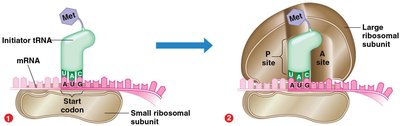
Initiation: Ribosomal subunits, mRNA, and initiator tRNA assemble at the start codon.
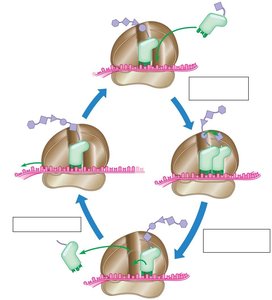
Elongation: tRNAs bring amino acids to the ribosome, matching their anticodons to mRNA codons, and the ribosome links the amino acids together.
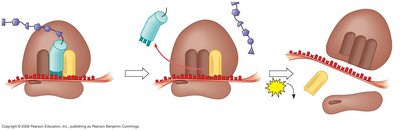
Termination: When a stop codon is reached, the ribosome releases the completed polypeptide.
tRNA Structure and Function
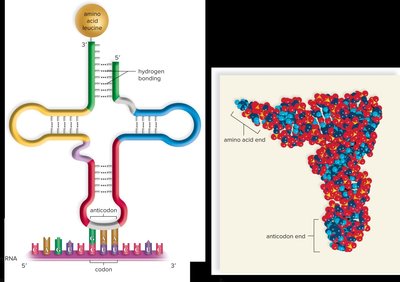
Transfer RNA (tRNA) molecules have a characteristic cloverleaf structure and carry specific amino acids to the ribosome. Each tRNA has an anticodon that pairs with a complementary codon on the mRNA.
Mutations and Their Effects
Types of Mutations
Mutations are changes in the DNA sequence that can affect protein structure and function. They are a source of genetic variation and can be caused by errors in DNA replication, recombination, or environmental mutagens.
Point Mutation: Change in a single base pair.
Base-pair Substitution: One base is replaced by another.
Silent Mutation: No change in amino acid sequence.
Missense Mutation: Changes one amino acid in the protein.
Nonsense Mutation: Changes a codon to a stop codon, truncating the protein.
Insertion/Deletion: Addition or loss of base pairs, potentially causing a frameshift mutation.
Frameshift Mutation: Alters the reading frame, changing all downstream amino acids.
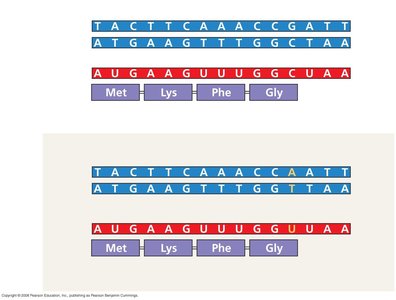
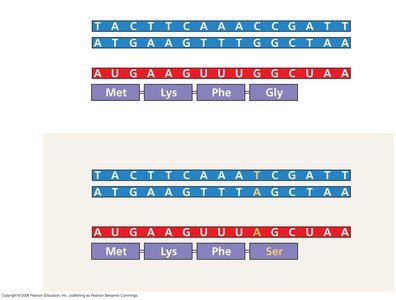
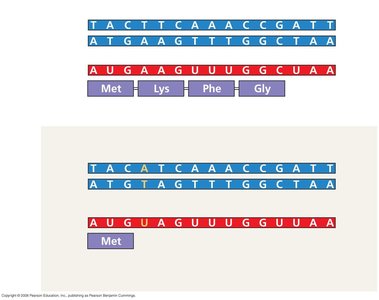
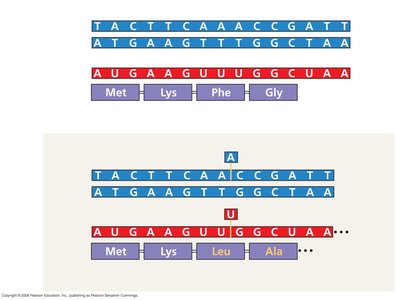
Consequences of Mutations
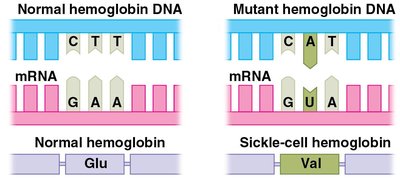
Mutations can have various effects, from no impact to causing diseases such as cystic fibrosis and sickle cell anemia. Only mutations in germ cells (gametes) can be passed to offspring and contribute to evolution.
Cancer and Mutations
Genetic Basis of Cancer
Cancer is a disease of unregulated cell division, often caused by mutations in genes that control the cell cycle. These include proto-oncogenes (stimulate division) and tumor suppressor genes (inhibit division). Multiple mutations are usually required for cancer to develop.
Proto-oncogenes: Normal genes that promote cell division; mutations can convert them to oncogenes, causing uncontrolled division.
Tumor Suppressor Genes: Inhibit cell division; mutations can disable these brakes, leading to cancer.
Carcinogens: Environmental agents that increase mutation rates and cancer risk (e.g., UV light, tobacco).
Comparison of Cancer Cells and Normal Cells:
Cancer Cells | Normal Cells |
|---|---|
Abnormal, non-differentiated | Differentiated |
No apoptosis | Normal apoptosis |
No contact inhibition | Contact inhibition |
Disorganized, multilayered tissues | Organized, proper layers |
Promote angiogenesis | Do not promote angiogenesis |
Metastasis (spread) | Cells remain in place |
Summary Table: Types of Point Mutations and Their Effects
Mutation Type | DNA Change | Effect on Protein | Example |
|---|---|---|---|
Silent | Base substitution | No change in amino acid | GAA → GAG (both code for Glu) |
Missense | Base substitution | One amino acid changed | Sickle cell anemia (Glu → Val) |
Nonsense | Base substitution | Early stop codon | UAC (Tyr) → UAA (Stop) |
Frameshift | Insertion/deletion | All downstream amino acids changed | Cystic fibrosis (deletion) |
Additional info: The central dogma and the genetic code are foundational concepts for understanding molecular genetics, biotechnology, and the molecular basis of many diseases.
