 Back
BackMolecular Biology of the Gene: Key Experiments and Discoveries
Study Guide - Smart Notes
 Tailored notes based on your materials, expanded with key definitions, examples, and context.
Molecular Biology of the Gene
Introduction
The molecular biology of the gene explores the structure, function, and transmission of genetic material. This field has been shaped by a series of landmark experiments that identified DNA as the hereditary material and elucidated its structure.
Historical Experiments Demonstrating DNA as Genetic Material
Fredrick Griffith’s Experiments (1928)
Fredrick Griffith conducted experiments with Streptococcus pneumoniae to understand how certain bacteria cause pneumonia. He discovered the phenomenon of transformation, where genetic material is transferred from one organism to another.
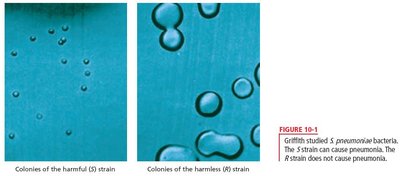
S-strain (Smooth): Virulent, disease-causing, surrounded by a polysaccharide capsule, forms smooth-edged colonies.
R-strain (Rough): Non-virulent, lacks capsule, forms rough colonies.
Transformation: The process by which genetic material from dead S-strain bacteria transformed live R-strain bacteria into virulent forms.
Griffith’s Experimental Design
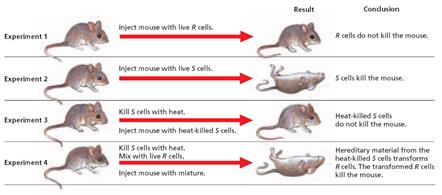
Experiment 1: Injected mice with live R cells – mice survived.
Experiment 2: Injected mice with live S cells – mice died.
Experiment 3: Injected mice with heat-killed S cells – mice survived.
Experiment 4: Injected mice with a mixture of heat-killed S cells and live R cells – mice died.
Conclusion: A hereditary factor from the dead S cells transformed the R cells into virulent S cells.
Identification of DNA as the Transforming Principle
Oswald Avery’s Experiments (1940s)
Oswald Avery and his colleagues sought to identify the molecule responsible for transformation. They systematically destroyed proteins, RNA, or DNA in heat-killed S cells and tested their ability to transform R cells.
Protease treatment: Destroyed proteins; transformation still occurred.
RNase treatment: Destroyed RNA; transformation still occurred.
DNase treatment: Destroyed DNA; transformation did not occur.
Conclusion: DNA is the molecule responsible for transformation in bacteria.
Hershey-Chase Experiment (1952)
Alfred Hershey and Martha Chase used bacteriophages (viruses that infect bacteria) to determine whether DNA or protein is the hereditary material transferred by viruses.
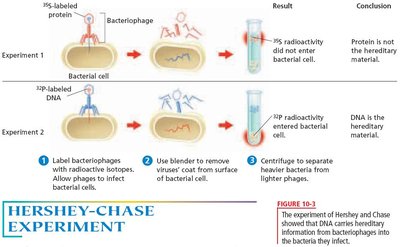
Labeling: Used radioactive sulfur (35S) to label protein and radioactive phosphorus (32P) to label DNA.
Infection: Allowed labeled phages to infect Escherichia coli bacteria.
Separation: Used a blender and centrifuge to separate phage coats from bacterial cells.
Results: Only radioactive DNA entered the bacterial cells, not protein.
Conclusion: DNA is the hereditary molecule in viruses.
Discovery of DNA Structure
Watson and Crick’s Double Helix Model (1953)
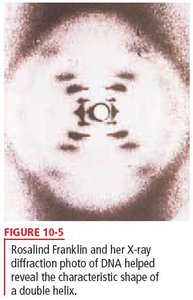
James Watson and Francis Crick, using data from Rosalind Franklin’s X-ray crystallography, proposed the double helix structure of DNA. Their model explained how DNA could replicate and store genetic information.
Double Helix: Two strands of nucleotides wound around each other.
Base Pairing: Adenine pairs with thymine, and guanine pairs with cytosine.
Nobel Prize: Watson and Crick received the Nobel Prize in 1962 for their discovery.
Chargaff’s Rules
Erwin Chargaff’s Findings
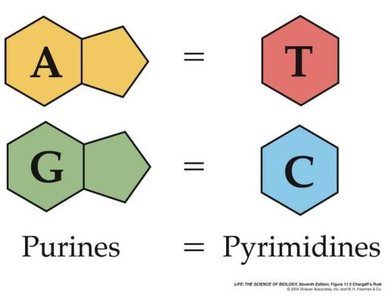
Erwin Chargaff analyzed the base composition of DNA from various organisms and discovered that the amount of adenine (A) equals thymine (T), and the amount of guanine (G) equals cytosine (C). This provided key evidence for the base-pairing rules in DNA structure.
Chargaff’s Rule: [A] = [T] and [G] = [C]
Purines: Adenine (A) and Guanine (G)
Pyrimidines: Thymine (T) and Cytosine (C)
Summary Table: Key Experiments in Molecular Genetics
Experiment | Key Finding | Conclusion |
|---|---|---|
Griffith (1928) | Transformation of R cells by heat-killed S cells | Hereditary material can be transferred between cells |
Avery (1940s) | DNA is required for transformation | DNA is the genetic material in bacteria |
Hershey-Chase (1952) | DNA, not protein, enters bacteria during viral infection | DNA is the hereditary material in viruses |
Watson & Crick (1953) | Double helix structure of DNA | Explains replication and genetic information storage |
Chargaff (1950s) | Base pairing regularities | [A]=[T], [G]=[C] in DNA |
Key Terms and Concepts
Transformation: The genetic alteration of a cell by the direct uptake and expression of foreign DNA.
Bacteriophage: A virus that infects bacteria.
Double Helix: The structure formed by double-stranded molecules of nucleic acids such as DNA.
Base Pairing: The specific hydrogen bonding between purines and pyrimidines in DNA.
