 Back
Molecular Biology of the Gene: Structure, Replication, and Expression
Study Guide - Smart Notes
 Tailored notes based on your materials, expanded with key definitions, examples, and context.
The Structure of the Genetic Material
Discovery of DNA as Genetic Material
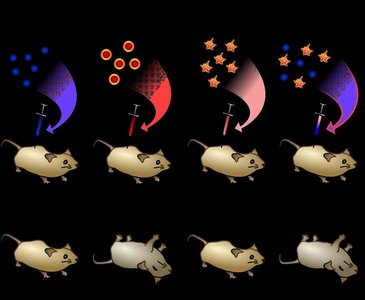
Early 20th-century experiments established DNA as the molecule responsible for inheritance. Key experiments by Frederick Griffith, and later by Hershey and Chase, demonstrated that DNA, not protein, carries genetic information.
Griffith's Experiment: Showed that non-pathogenic bacteria could be transformed into pathogenic forms by exposure to heat-killed pathogenic bacteria, indicating a 'transforming principle' (later identified as DNA).
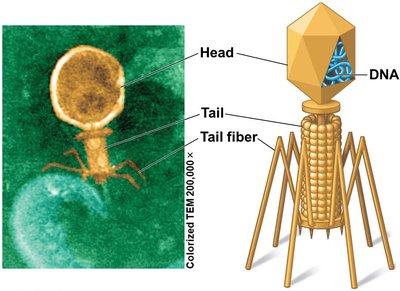
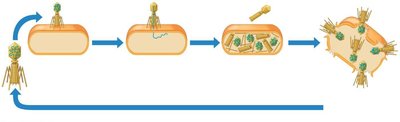
Hershey-Chase Experiment: Used bacteriophages labeled with radioactive isotopes to confirm that DNA, not protein, is injected into bacteria and directs viral replication.
DNA and RNA: Polymers of Nucleotides
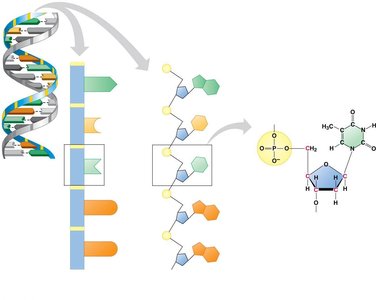
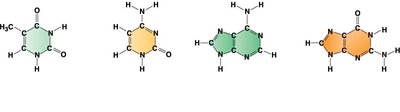
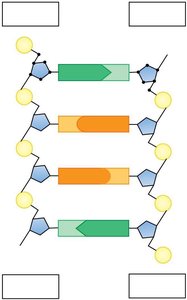
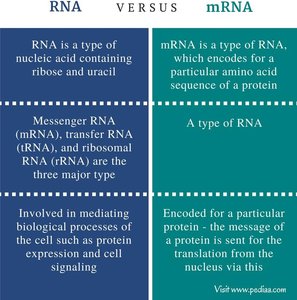
DNA and RNA are nucleic acids composed of long chains of nucleotides. Each nucleotide consists of a nitrogenous base, a five-carbon sugar, and a phosphate group. The sequence of these nucleotides encodes genetic information.
DNA Nucleotides: Adenine (A), Cytosine (C), Guanine (G), Thymine (T)
RNA Nucleotides: Adenine (A), Cytosine (C), Guanine (G), Uracil (U)
Sugar: DNA contains deoxyribose; RNA contains ribose.
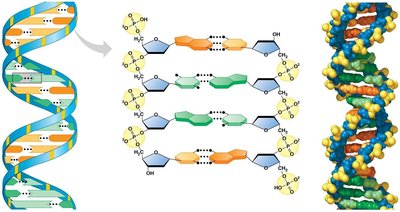
Backbone: Nucleotides are joined by covalent bonds between the sugar of one nucleotide and the phosphate of the next, forming a sugar-phosphate backbone.
Double Helix Structure of DNA
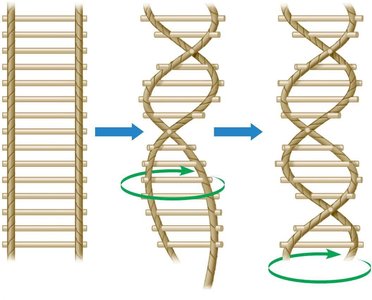
Watson and Crick determined that DNA is a double helix, with two antiparallel strands held together by hydrogen bonds between complementary bases (A-T and G-C). This structure explains how DNA can store and replicate genetic information.
Base Pairing: Adenine pairs with Thymine (A-T), Guanine pairs with Cytosine (G-C).
Antiparallel Strands: The two strands run in opposite directions (5' to 3' and 3' to 5').
Hydrogen Bonds: Provide specificity and stability to the double helix.
DNA Replication
Semiconservative Model of Replication
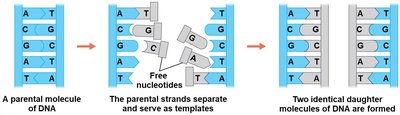
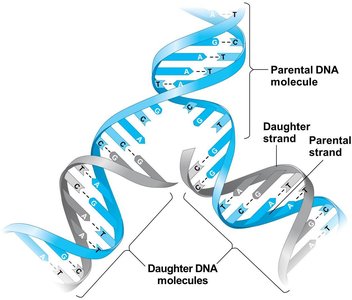
DNA replication is semiconservative: each new DNA molecule consists of one parental strand and one newly synthesized strand. This ensures accurate transmission of genetic information during cell division.
Strand Separation: The two DNA strands separate, and each serves as a template for a new complementary strand.
Base Pairing: Free nucleotides pair with exposed bases on the template strands.
Mechanism and Enzymes of DNA Replication
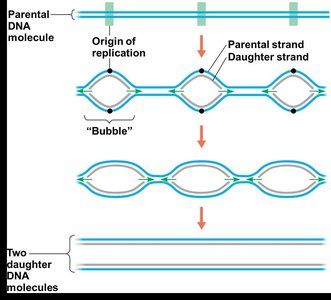
DNA replication proceeds in both directions from multiple origins of replication. Key enzymes coordinate the process:
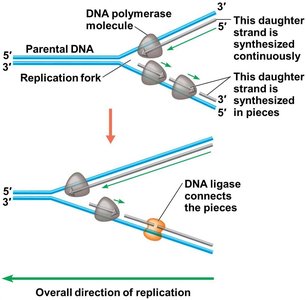
DNA Polymerase: Synthesizes new DNA strands by adding nucleotides to the 3' end.
DNA Ligase: Joins short DNA fragments (Okazaki fragments) on the lagging strand.
Other Enzymes: Helicase unwinds the DNA helix; primase synthesizes RNA primers.
The Flow of Genetic Information: From DNA to RNA to Protein
Central Dogma: Transcription and Translation
The central dogma of molecular biology describes the flow of genetic information: DNA is transcribed into RNA, which is then translated into protein. This process determines the phenotype of an organism.
Transcription: Synthesis of RNA from a DNA template.
Translation: Synthesis of a polypeptide (protein) from an mRNA template.
The Genetic Code
The genetic code is a set of rules by which information encoded in mRNA is translated into amino acids. Each codon (a sequence of three nucleotides) specifies a particular amino acid or a stop signal.
Start Codon: AUG (methionine) signals the start of translation.
Stop Codons: UAA, UAG, UGA signal the end of translation.
Universality: The genetic code is nearly universal among organisms.
Transcription: Synthesis of RNA
During transcription, RNA polymerase binds to a promoter region on DNA and synthesizes a complementary RNA strand until it reaches a terminator sequence.
Promoter: DNA sequence where RNA polymerase initiates transcription.
Terminator: DNA sequence signaling the end of transcription.
mRNA Processing (Eukaryotes): Introns are removed, exons are spliced together, and a cap and tail are added before mRNA exits the nucleus.
Translation: Protein Synthesis
Translation occurs in the cytoplasm, where ribosomes read mRNA codons and tRNAs bring the corresponding amino acids to build a polypeptide chain.
tRNA: Transfer RNA molecules have an anticodon that pairs with mRNA codons and carry specific amino acids.
Ribosome: Composed of rRNA and proteins, it facilitates the binding of tRNA and the formation of peptide bonds.
Phases: Initiation (assembly of the translation complex), elongation (addition of amino acids), and termination (release of the completed polypeptide).
Mutations and Their Effects
Types of Mutations
Mutations are changes in the genetic material that can affect gene function. They may arise spontaneously or be induced by mutagens (e.g., radiation, chemicals).
Nucleotide Substitutions: Replacement of one base pair with another. Effects include silent, missense, or nonsense mutations.
Insertions/Deletions: Addition or loss of nucleotides, potentially causing frameshift mutations that alter the reading frame and usually result in nonfunctional proteins.
Mutagenesis: The process by which mutations are produced, either spontaneously or by external agents.
