 Back
BackMolecular Biology of the Gene: Structure, Function, and Expression
Study Guide - Smart Notes
 Tailored notes based on your materials, expanded with key definitions, examples, and context.
Chapter 10: Molecular Biology of the Gene
Introduction: Viruses and the Genetic Material
Understanding the molecular basis of heredity is essential for combating viral diseases such as measles. The study of DNA and RNA, the molecules of heredity, provides the foundation for modern genetics and molecular biology.
The Structure of the Genetic Material
Experiments Demonstrating DNA as Genetic Material
Early 20th-century experiments sought to identify the molecule responsible for inheritance. Frederick Griffith's transformation experiment and subsequent work by Avery, McCarty, and MacLeod demonstrated that DNA is the hereditary material.
Griffith's Experiment: Showed that non-pathogenic bacteria could be transformed into pathogenic forms by exposure to heat-killed pathogenic bacteria.
Avery, McCarty, and MacLeod: Identified DNA as the transforming substance by using enzymes to selectively degrade proteins, RNA, or DNA.
Enzyme Added | Result in Mice |
|---|---|
Protease | Mice Die |
RNase | Mice Die |
DNase | Mice Live |
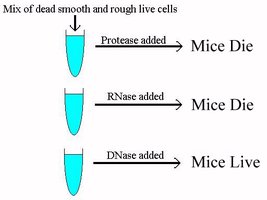
Interpretation: Only DNase (which destroys DNA) prevented transformation, indicating DNA is the genetic material.
The Hershey-Chase Experiment
Hershey and Chase used bacteriophages to confirm that DNA, not protein, is the genetic material injected into bacteria to direct viral replication.
Phage T2: Consists of DNA and protein; only DNA enters the bacterial cell during infection.
DNA and RNA Structure
Polymers of Nucleotides
DNA and RNA are nucleic acids composed of long chains of nucleotides. Each nucleotide consists of a nitrogenous base, a five-carbon sugar, and a phosphate group.
DNA Bases: Adenine (A), Cytosine (C), Thymine (T), Guanine (G)
RNA Bases: Adenine (A), Cytosine (C), Uracil (U), Guanine (G)
Sugar: Deoxyribose in DNA, ribose in RNA
Double Helix Structure
Watson and Crick determined that DNA is a double helix, with two antiparallel strands held together by hydrogen bonds between complementary bases (A-T, G-C).
Base Pairing: A pairs with T, G pairs with C
Genetic Information: Encoded in the sequence of nucleotides
DNA Replication
Semiconservative Model
DNA replication involves the separation of strands and synthesis of complementary strands, resulting in two DNA molecules, each with one old and one new strand.
Enzymes: DNA polymerase synthesizes new DNA; DNA ligase joins fragments on the lagging strand.
The Flow of Genetic Information: DNA → RNA → Protein
Gene Expression
Genes control phenotypic traits by directing the synthesis of proteins through two main processes: transcription and translation.
Transcription: Synthesis of RNA from a DNA template.
Translation: Synthesis of a polypeptide using the information in mRNA.
The Genetic Code
The genetic code consists of codons—triplets of nucleotides in mRNA—that specify amino acids. The code is nearly universal among organisms.
Codon: Three-base sequence in mRNA that codes for an amino acid.
Start Codon: AUG (methionine) signals the start of translation.
Stop Codons: UAA, UAG, UGA signal termination of translation.
Transcription and RNA Processing
Transcription
RNA polymerase binds to a promoter sequence and synthesizes RNA until it reaches a terminator sequence.
Promoter: DNA sequence where RNA polymerase initiates transcription.
Terminator: Sequence signaling the end of a gene.
RNA Processing in Eukaryotes
Before mRNA leaves the nucleus, it undergoes processing:
Introns are removed, exons are spliced together.
A 5' cap and a 3' poly-A tail are added for stability and export.
Translation and Protein Synthesis
tRNA and Ribosomes
tRNA molecules match amino acids to codons in mRNA via their anticodon regions. Ribosomes facilitate the coupling of tRNA anticodons with mRNA codons and catalyze peptide bond formation.
Stages of Translation
Initiation: Assembly of the translation machinery at the start codon.
Elongation: Addition of amino acids to the growing polypeptide chain.
Termination: Release of the completed polypeptide when a stop codon is reached.
Mutations and Their Effects
Types of Mutations
Mutations are changes in the DNA sequence that can affect gene function.
Substitution: One base is replaced by another; may result in silent, missense, or nonsense mutations.
Insertion/Deletion: Addition or loss of nucleotides; may cause frameshift mutations, altering downstream amino acid sequence.
Mutations can arise spontaneously or be induced by mutagens (physical or chemical agents).
Summary Table: DNA vs. RNA
Feature | DNA | RNA |
|---|---|---|
Sugar | Deoxyribose | Ribose |
Bases | A, T, C, G | A, U, C, G |
Strands | Double-stranded | Single-stranded |
Function | Genetic information storage | Protein synthesis, gene regulation |
Key Equations
Base Pairing Rule: ,
Central Dogma:
Additional info: This summary integrates foundational experiments, molecular structures, and the flow of genetic information, providing a comprehensive overview suitable for exam preparation in a college-level biology course.
