 Back
Molecular Diversity of Life and Gene Expression: From DNA to Protein
Study Guide - Smart Notes
 Tailored notes based on your materials, expanded with key definitions, examples, and context.
Molecular Diversity of Life: DNA, RNA, and Gene Function
Introduction to DNA as Life’s Blueprint
Deoxyribonucleic acid (DNA) is the hereditary material in all living organisms, encoding the instructions for life’s processes. Genes, segments of DNA, serve as the fundamental units of heredity, determining phenotypes and enabling heritable variation that drives evolution.
The Discovery and Structure of DNA
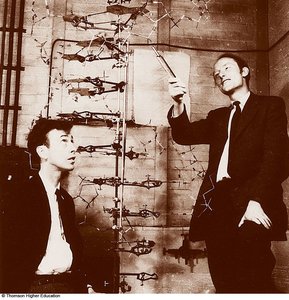
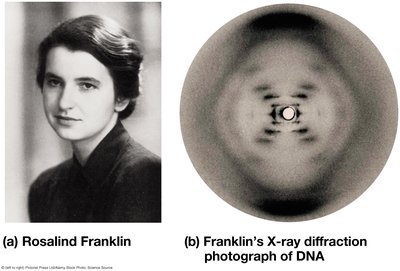
The elucidation of DNA’s structure was a pivotal moment in biology, involving contributions from many scientists. The double helix model, supported by X-ray diffraction data, revealed how genetic information is stored and replicated.
Components of Nucleic Acids
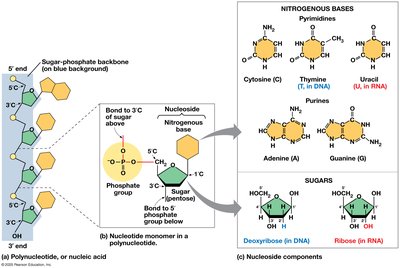
Nucleic acids are polymers called polynucleotides, composed of nucleotide monomers. Each nucleotide consists of:
A nitrogenous base (cytosine, thymine, uracil, adenine, guanine)
A pentose sugar (deoxyribose in DNA, ribose in RNA)
One or more phosphate groups
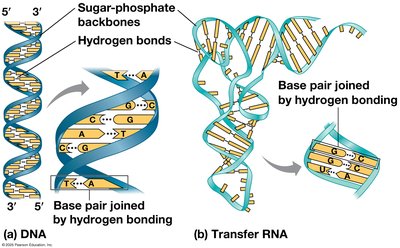
Thymine is unique to DNA, uracil to RNA; the other bases are found in both. The sugar-phosphate backbone forms the structural framework of nucleic acids.
Nucleotide Polymers and Base Pairing
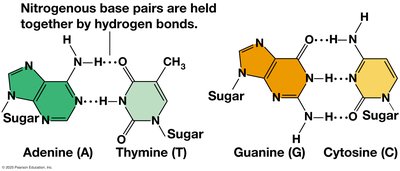
Nucleotides are joined by covalent bonds between the sugar of one nucleotide and the phosphate of the next, forming a sugar-phosphate backbone. Nitrogenous bases extend from this backbone and pair via hydrogen bonds:
Adenine (A) pairs with Thymine (T) in DNA or Uracil (U) in RNA
Guanine (G) pairs with Cytosine (C)
This complementary base pairing is essential for DNA replication and function.
Structures of DNA and tRNA
DNA forms a double helix with two antiparallel strands held together by hydrogen bonds between complementary bases. Transfer RNA (tRNA) has a complex three-dimensional structure, also stabilized by base pairing, and plays a key role in translation.
Gene Expression: From Gene to Protein
Overview of Gene Expression
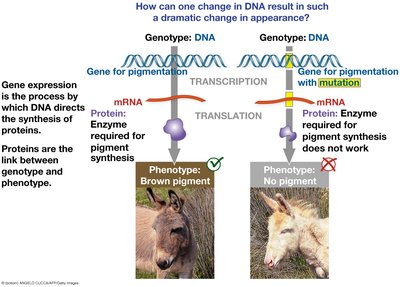
Gene expression is the process by which information from a gene is used to synthesize a functional gene product, typically a protein. This process involves two main stages: transcription and translation. Genetic variation in DNA can lead to phenotypic variation, which is the basis for evolution.
Transcription and Translation
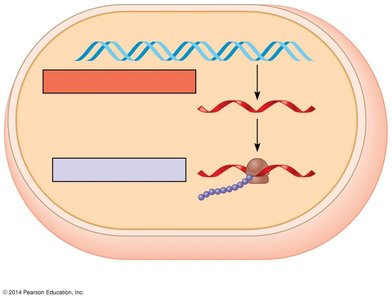
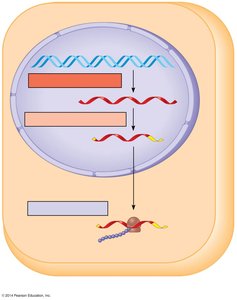
Transcription is the synthesis of RNA from a DNA template, producing messenger RNA (mRNA). Translation is the synthesis of a polypeptide (protein) using the information in mRNA. Ribosomes are the molecular machines that facilitate translation.
Transcription: DNA → mRNA
Translation: mRNA → Protein
The Central Dogma of Biology
The central dogma describes the flow of genetic information within a biological system: DNA is transcribed into RNA, which is then translated into protein.
Primary transcript: The initial RNA transcript from a gene before processing.

Differences Between DNA and RNA
RNA differs from DNA in three main ways:
RNA contains ribose sugar; DNA contains deoxyribose.
RNA uses uracil (U) instead of thymine (T).
RNA is usually single-stranded; DNA is double-stranded.
The Genetic Code and Codons
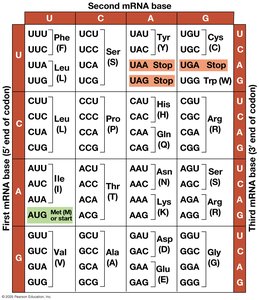
The genetic code is a set of rules by which information encoded in DNA or mRNA sequences is translated into proteins by living cells. It is based on a triplet code, where each codon (three nucleotides) specifies a particular amino acid.
There are 64 possible codons; 61 code for amino acids, 3 are stop signals.
The code is redundant (more than one codon per amino acid) but not ambiguous (each codon specifies only one amino acid).
Transcription and Translation in Cells
In prokaryotes, transcription and translation occur in the cytoplasm. In eukaryotes, transcription occurs in the nucleus, and mRNA is processed before translation in the cytoplasm.

Genetic Variation and Mutation
Types of Mutations
Mutations are changes in the genetic material of a cell or virus. They can be classified as:
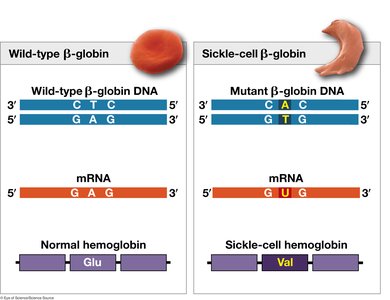
Point mutations: Changes in a single nucleotide pair (silent, missense, or nonsense mutations).
Frameshift mutations: Insertions or deletions that alter the reading frame of a gene.
Impact of Mutations on Phenotype
Mutations can lead to changes in protein structure and function, resulting in phenotypic variation. This variation is the raw material for evolution by natural selection.
Sickle-Cell Disease: A Case Study
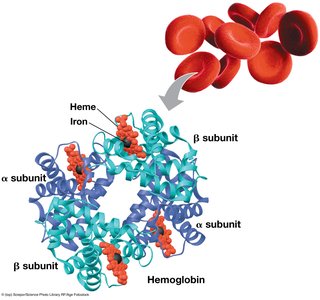
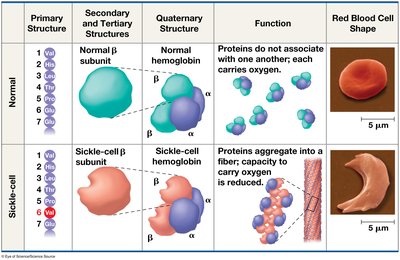
Sickle-cell disease is an inherited blood disorder caused by a single amino acid substitution in the protein hemoglobin. This mutation alters the primary structure of hemoglobin, leading to abnormal red blood cell shape and impaired oxygen transport.
Summary and Key Concepts
DNA is the genetic material, encoding instructions for life.
Gene expression involves transcription (DNA to RNA) and translation (RNA to protein).
The genetic code is universal, redundant, and unambiguous.
Mutations in DNA can lead to changes in phenotype, providing variation for evolution.
