 Back
Moles, Molarity, and pH: Essential Chemistry Concepts for Biology
Study Guide - Smart Notes
 Tailored notes based on your materials, expanded with key definitions, examples, and context.
Moles and Avogadro’s Number
Definition and Importance
The mole is a fundamental unit in chemistry used to quantify the amount of substance. It allows scientists to count atoms, molecules, or ions in a practical way, bridging the gap between the microscopic and macroscopic worlds.
1 mole of atoms contains 6.022 × 10²³ atoms, known as Avogadro’s number.
Avogadro’s number forms the basis for the concept of the mole, enabling conversions between atomic scale and laboratory scale measurements.
Calculating Atoms, Moles, and Mass
Conversion Factors and Methods
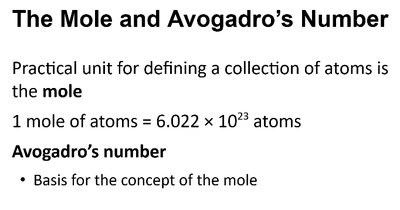
To relate atoms, moles, and mass, several conversion factors are used in calculations:
Density: Converts between grams and milliliters.
Atomic mass unit (amu): Converts between amu and grams.
Avogadro’s number: Converts between moles and number of atoms.
Molar mass: Converts between grams and moles.
Example Calculation: Mass from Moles
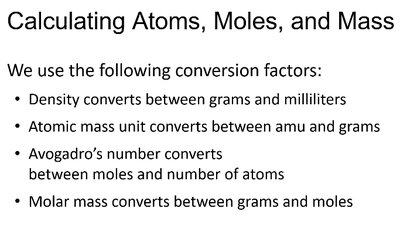
To find the mass of a substance given the number of moles, multiply the moles by the molar mass:
Given: 3.01 mol of sulfur (S)
Molar mass of S: 32.06 g/mol
Calculation:
Dimensional Analysis: Grams, Moles, and Particles
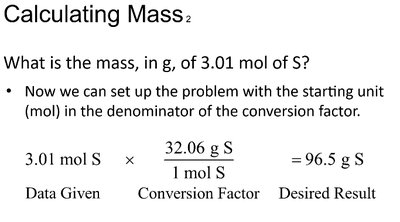
Dimensional analysis is a systematic method for converting between units. The relationships between grams, moles, and particles are summarized below:
From | To | Conversion |
|---|---|---|
Grams | Moles | Divide by molar mass |
Moles | Grams | Multiply by molar mass |
Moles | Particles | Multiply by Avogadro’s number |
Particles | Moles | Divide by Avogadro’s number |
Molarity
Definition and Calculation
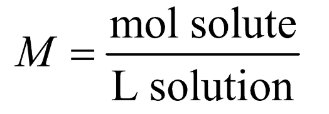
Molarity (M) is the most common concentration unit in chemistry and biology, defined as the number of moles of solute per liter of solution:
Formula:
Units: Moles per liter (mol/L)
Always convert volume to liters and mass to moles before using the formula.
Example: Preparing a Solution
To prepare a 0.5 M NaCl solution with a final volume of 500 mL:
Convert 500 mL to liters:
Molarity formula:
Calculate moles needed:
Convert moles to grams using molar mass (NaCl = 58.5 g/mol):
Key Point: Always check units and conversions to ensure accuracy.
pH Scale
Definition and Calculation
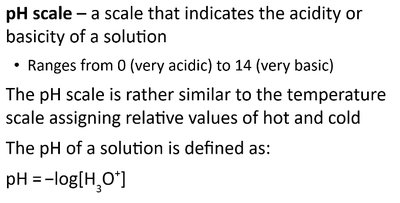
The pH scale measures the acidity or basicity of a solution, ranging from 0 (very acidic) to 14 (very basic). It is similar to a temperature scale, assigning relative values to acidity and basicity.
pH is defined as:
Lower pH values indicate higher acidity; higher pH values indicate higher basicity.
Application in Biology
Understanding moles, molarity, and pH is essential for studying biochemical reactions, cellular processes, and laboratory techniques in biology. These concepts are foundational for topics such as enzyme activity, cellular respiration, and solution preparation.
