 Back
BackMonitoring Gene Expression: Techniques and Applications
Study Guide - Smart Notes
 Tailored notes based on your materials, expanded with key definitions, examples, and context.
Monitoring Expression of Specific Genes
Gene Expression and Cellular Diversity
Cells in multicellular organisms differ because they express different genes from an identical genome. Understanding which genes are expressed in specific cells is fundamental to studying cell types, development, and diseases such as cancer. The most direct way to monitor gene expression is to identify the mRNAs produced by cells.
Studying the Expression of Single Genes
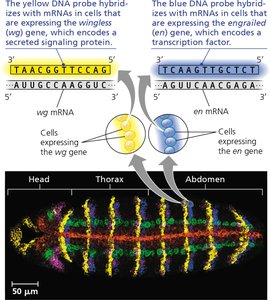
To determine where a gene is expressed, researchers often use nucleic acid hybridization, which relies on base pairing between complementary nucleotide sequences. A nucleic acid probe is synthesized to be complementary to the mRNA of interest. This probe can be labeled with a fluorescent tag to visualize gene expression in tissues or embryos.
In situ hybridization: Allows detection of mRNA in place (in situ) within an intact organism. Different probes labeled with distinct fluorescent dyes can reveal the spatial expression patterns of multiple genes.
Example: In a Drosophila embryo, probes for different mRNAs show which cells express specific genes, such as wingless (wg) and engrailed (en).
Reverse Transcriptase–Polymerase Chain Reaction (RT-PCR)
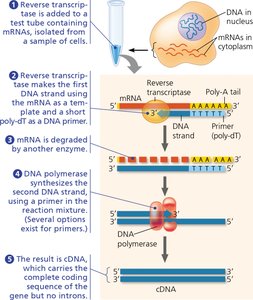
RT-PCR is a widely used method to compare the amounts of a specific mRNA in different samples. It involves converting mRNA into complementary DNA (cDNA) using the enzyme reverse transcriptase, followed by PCR amplification.
Steps:
Reverse transcriptase synthesizes a DNA strand using mRNA as a template.
mRNA is degraded, and DNA polymerase synthesizes the second DNA strand.
The resulting double-stranded DNA is called cDNA.
Application: RT-PCR can be used to compare gene expression across different embryonic stages, tissues, or conditions.
RT-PCR Analysis of Single Genes
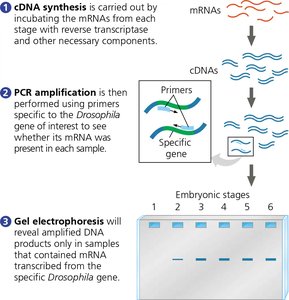
After cDNA synthesis, PCR amplification is performed using primers specific to the gene of interest. Gel electrophoresis reveals amplified DNA products only in samples that originally contained the mRNA.
Example: In Drosophila embryos, RT-PCR can show the timing of gene expression across six embryonic stages.
Quantitative RT-PCR (qRT-PCR): Uses fluorescent dyes to measure PCR product, providing quantitative data on mRNA levels without electrophoresis.
Studying the Expression of Groups of Genes
Genome-Wide Expression Studies
With sequenced genomes, researchers can study the expression of large groups of genes using a systems approach. The goal is to identify networks of gene expression across an entire genome.
RNA Sequencing (RNA-seq)
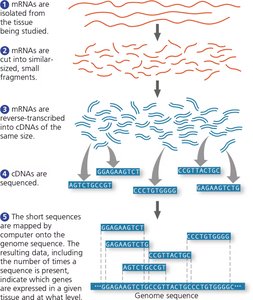
RNA-seq is a powerful technique for genome-wide expression analysis. It involves sequencing cDNA generated from mRNA samples, allowing researchers to determine which genes are expressed and their expression levels.
Steps:
mRNAs are isolated and cut into fragments.
Fragments are reverse-transcribed into cDNAs.
cDNAs are sequenced.
Sequences are mapped to the genome to identify expressed genes and quantify expression.
Advantages:
Does not require prior knowledge of genomic sequences.
Measures expression levels over a wide range.
Provides information on alternative splicing.
DNA Microarray Assays
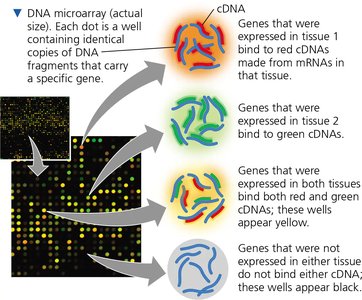
DNA microarrays (DNA chips) are used for genome-wide expression studies. Each dot on the microarray contains DNA fragments representing different genes. Labeled cDNAs from different samples are hybridized to the array, and the resulting pattern reveals which genes are expressed.
Steps:
mRNAs are reverse-transcribed into labeled cDNAs.
cDNAs are hybridized to the microarray.
Fluorescent labels indicate expression in different tissues (e.g., red for tissue 1, green for tissue 2, yellow for both, black for neither).
Applications: Used in disease studies, such as comparing gene expression in cancerous and normal tissues.
Role of Complementary Base Pairing
RT-PCR: Primers hybridize to specific sequences on cDNA, enabling amplification.
DNA Microarray: Labeled cDNAs hybridize to complementary DNA fragments on the array.
RNA-seq: cDNA synthesis relies on base pairing between mRNA and DNA primers.
Summary Table: Comparison of Gene Expression Techniques
Technique | Main Purpose | Key Steps | Advantages |
|---|---|---|---|
In situ hybridization | Spatial localization of gene expression | Hybridize labeled probes to mRNA in tissue | Visualizes expression in intact organism |
RT-PCR/qRT-PCR | Quantitative comparison of gene expression | Reverse transcription, PCR amplification, detection | Sensitive, quantitative, compares multiple samples |
RNA-seq | Genome-wide expression profiling | Fragmentation, cDNA synthesis, sequencing, mapping | Comprehensive, quantitative, detects alternative splicing |
DNA microarray | Genome-wide expression comparison | Hybridize labeled cDNAs to array, detect fluorescence | High-throughput, compares many genes |
Applications and Implications
Genome-wide expression studies contribute to understanding diseases and developing diagnostic techniques.
Comparing gene expression in cancerous and normal tissues can inform treatment protocols.
These methods provide a big-picture view of gene networks maintaining organismal health.
Additional info: These techniques are foundational in molecular biology, developmental biology, and medical research, enabling precise analysis of gene regulation and cellular function.
