 Back
Monocot vs Dicot Seed Morphology and Identification
Study Guide - Smart Notes
 Tailored notes based on your materials, expanded with key definitions, examples, and context.
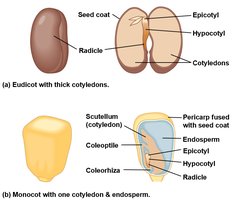
Q1. What are the differences between monocot and dicot seed morphology? Identify the following parts: seed coat, epicotyl, hypocotyl, radicle, cotyledons, scutellum, coleoptile, coleorhiza, pericarp, and endosperm.
Background
Topic: Seed Morphology in Angiosperms
This question tests your understanding of the structural differences between monocot and dicot seeds, as well as your ability to identify key anatomical parts in each type.
Key Terms:
Monocot: A seed with one cotyledon (e.g., corn).
Dicot (Eudicot): A seed with two cotyledons (e.g., bean).
Seed coat: Protective outer layer.
Epicotyl: Embryonic shoot above the cotyledons.
Hypocotyl: Embryonic stem below the cotyledons.
Radicle: Embryonic root.
Cotyledon: Seed leaf; stores nutrients.
Scutellum: Specialized cotyledon in monocots.
Coleoptile: Protective sheath covering the shoot in monocots.
Coleorhiza: Protective sheath covering the root in monocots.
Pericarp: Fruit wall fused with seed coat in monocots.
Endosperm: Nutrient-rich tissue supporting embryo in monocots.
Step-by-Step Guidance
Examine the diagram and note the number of cotyledons: dicots have two, monocots have one.
Identify the seed coat in both diagrams; it is the outermost layer protecting the seed.
Locate the epicotyl, hypocotyl, and radicle in both seed types. The epicotyl is above the cotyledons, the hypocotyl is below, and the radicle is the embryonic root.
In monocots, identify the scutellum (cotyledon), coleoptile (shoot sheath), coleorhiza (root sheath), pericarp, and endosperm. Compare these to the dicot structure.
Consider the function of each part: cotyledons store nutrients in dicots, while monocots rely on endosperm for nutrition.
Try solving on your own before revealing the answer!
Final Answer:
Dicot seeds have two cotyledons, a thick seed coat, and store nutrients in the cotyledons. Monocot seeds have one cotyledon (scutellum), a fused pericarp and seed coat, and store nutrients in the endosperm. Key parts are labeled in the diagram above.
Understanding these differences helps in identifying seed types and their adaptations for germination and growth.
