 Back
Mutations and Chromosome Errors: Point Mutations, Chromosome-Level Mutations, and Nondisjunction
Study Guide - Smart Notes
 Tailored notes based on your materials, expanded with key definitions, examples, and context.
Mutations and Chromosome Errors
Point Mutations
Point mutations are changes to one or a few bases in the DNA sequence. These mutations can have a variety of effects on protein structure and function, depending on the type of mutation and its location within a gene.
Missense Mutation: A base change results in a different amino acid. The effect can be deleterious (e.g., sickle cell anemia, Glu→Val) or neutral, depending on the importance of the amino acid change.
Silent Mutation: A base change results in the same amino acid due to redundancy in the genetic code. These mutations are typically neutral and do not affect protein function.
Nonsense Mutation: A base change creates a premature STOP codon, leading to a truncated, usually nonfunctional protein. These are typically deleterious.
Frameshift Mutation: Insertion or deletion of bases not in multiples of three shifts the reading frame, changing all downstream codons. This is usually severely deleterious.
In-frame Insertions/Deletions: Insertions or deletions of three bases add or remove one amino acid, which is less severe than a frameshift.
Example: Sickle cell disease is caused by a missense mutation in the hemoglobin gene.
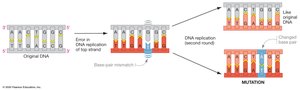
Additional info: Point mutations can arise during DNA replication when errors are not repaired, leading to permanent changes in the DNA sequence.
Chromosome-Level Mutations
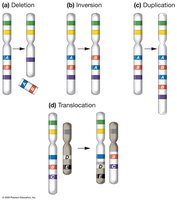
Chromosome-level mutations involve larger structural changes that can be observed in a karyotype. These mutations can affect many genes and are often associated with diseases such as cancer.
Inversion: A chromosome segment breaks off, flips 180°, and rejoins, reversing the gene order.
Translocation: A segment moves to a different, non-homologous chromosome.
Deletion: A segment is lost entirely from the chromosome.
Duplication: A segment is present in extra copies, which can lead to new gene evolution.
Example: Cancer cells often exhibit multiple chromosome mutations, including aneuploidy, inversions, translocations, deletions, and duplications.
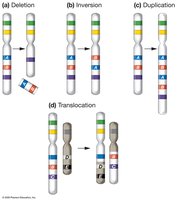
Additional info: Karyotype analysis is clinically useful for detecting large structural mutations and aneuploidy, especially in prenatal diagnosis.
Fitness Effects of Mutations
Mutations can be classified by their effect on organismal fitness. Most mutations are neutral or deleterious, and their evolutionary fate depends on their impact.
Beneficial: Increases fitness; rare but important for adaptive evolution (e.g., antibiotic resistance in bacteria).
Neutral: No effect on fitness; includes silent mutations and those in non-coding regions. Most common type.
Deleterious: Decreases fitness; includes most point mutations that change amino acids and loss-of-function mutations in essential genes.
Evolutionary Fate:
Beneficial mutations increase in frequency via natural selection.
Neutral mutations change frequency randomly (genetic drift).
Deleterious mutations are removed by purifying selection, though heterozygous carriers may retain them at low frequency.
Key Point: Mutations are random with respect to fitness; they do not arise because the organism "needs" them.
Nondisjunction and Aneuploidy
Nondisjunction occurs when chromosomes fail to separate correctly during meiosis, resulting in gametes with abnormal chromosome numbers. This can lead to aneuploidy, which is the presence of an abnormal number of chromosomes in a cell.
Nondisjunction in Meiosis I: Both homologs go to the same cell, affecting both daughter cells.
Nondisjunction in Meiosis II: Sister chromatids fail to split, affecting only two of four daughter cells.
Results: n+1 gametes (trisomy, 2n+1) or n−1 gametes (monosomy, 2n−1) after fertilization.
Condition | Chromosome Number | Phenotype |
|---|---|---|
Trisomy 21 (Down syndrome) | +chr21 (47 chromosomes) | Intellectual disability, characteristic facial features |
Turner syndrome | 45,X (monosomy X) | Female phenotype, infertile |
Klinefelter syndrome | 47,XXY | Male phenotype, reduced fertility |
Additional info: Aneuploidy is often detected by karyotype analysis and is a major cause of developmental disorders and infertility.
Summary Table: Types of Mutations
Mutation Type | Definition | Effect |
|---|---|---|
Missense | Base change → different amino acid | Deleterious or neutral |
Silent | Base change → same amino acid | Neutral |
Nonsense | Base change → premature stop codon | Deleterious |
Frameshift | Insertion/deletion not in multiples of 3 | Severely deleterious |
Inversion | Segment flips 180° | Gene order reversed |
Translocation | Segment moves to another chromosome | Gene disruption |
Deletion | Segment lost | Loss of genetic material |
Duplication | Segment duplicated | Extra genetic material |
Key Equations
Chromosome Number in Aneuploidy:
