 Back
Mutations and Their Effects on Protein Structure: Focus on CFTR and Cystic Fibrosis
Study Guide - Smart Notes
 Tailored notes based on your materials, expanded with key definitions, examples, and context.
Mutations: Definition and Impact
What Are Mutations?
Mutations are permanent changes in the genetic material of a cell, often affecting the structure and function of proteins. They can occur spontaneously during DNA replication or be induced by external agents called mutagens.
Point mutations: Changes in a single nucleotide pair within a gene.
Mutagens: Physical or chemical agents (e.g., UV light, x-rays, chemicals) that cause mutations.
Alleles: Alternative forms of the same gene, resulting from mutations.
Types of Small-Scale (Point) Mutations
Single Nucleotide-Pair Substitutions
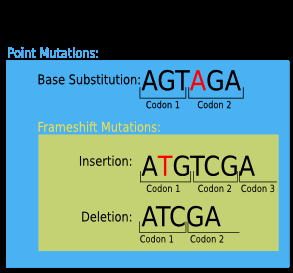
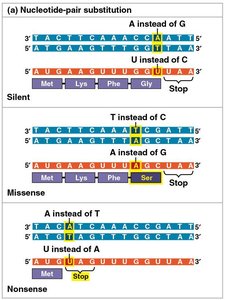
Substitution mutations replace one nucleotide and its partner with another pair. The effects depend on how the change alters the encoded protein.
Silent mutations: No effect on the amino acid sequence due to redundancy in the genetic code.
Missense mutations: Change one amino acid to another, potentially altering protein function.
Nonsense mutations: Change an amino acid codon to a stop codon, usually resulting in a nonfunctional protein.

Nucleotide-Pair Insertions and Deletions
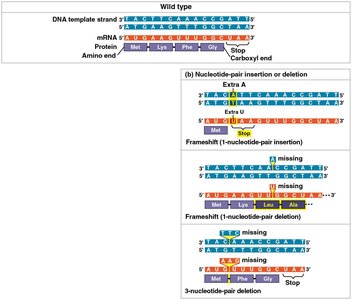
Insertions and deletions add or remove nucleotide pairs, often causing frameshift mutations that disrupt the reading frame of the genetic message.
Frameshift mutations: Result from insertions or deletions not in multiples of three, altering downstream codons and usually producing a nonfunctional protein.
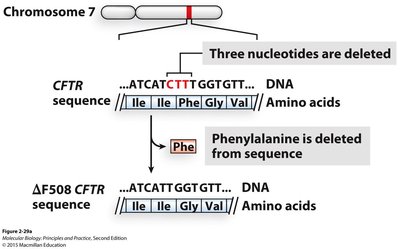
Three-nucleotide deletions: Remove a single amino acid without shifting the reading frame.
Mutations and Alleles
Alleles and Chromosome Types
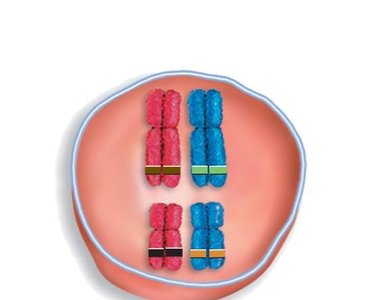
Alleles are variants of a gene that encode the same trait but may produce different protein forms. Different alleles are found on homologous chromosomes, not sister chromatids.
Homologous chromosomes: Carry different alleles for the same gene.
Sister chromatids: Identical copies, carrying the same allele.
Examples of Human Disorders Caused by Single-Gene Mutations
Types of Mutations and Associated Disorders
Single-gene mutations can cause various human disorders, depending on the molecular change:
Type of Mutation | Disorder | Molecular Change |
|---|---|---|
Missense | Achondroplasia | Glycine to arginine at position 380 of FGFR3 gene |
Nonsense | Marfan syndrome | Tyrosine to Stop codon at position 2113 of fibrillin-1 gene |
Insertion | Familial hypercholesterolemia | Various short insertions throughout the LDLR gene |
Deletion | Cystic fibrosis | Three-base-pair deletion of phenylalanine codon at position 508 of CFTR gene |
Trinucleotide repeat expansions | Huntington disease | Greater than 40 repeats of (CAG) sequence in coding region of Huntingtin gene |
The CFTR Gene and Cystic Fibrosis
Gene Structure and Function
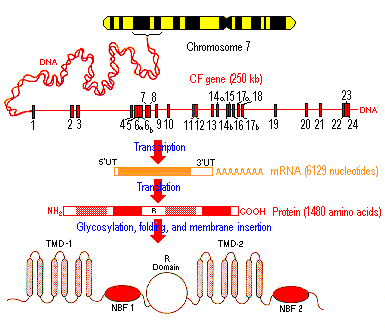
The CFTR gene encodes the Cystic Fibrosis Transmembrane Conductance Regulator, a channel protein that transports chloride ions across epithelial cell membranes. Proper function is essential for maintaining thin mucus in various organs.
Gene length: Approximately 250 kb
Protein length: 1480 amino acids
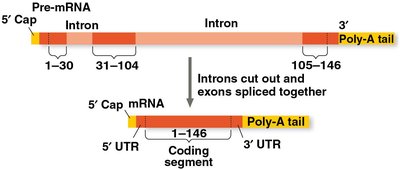
Gene structure: Includes exons and introns, with promoter, 5' UTR, protein coding region, and 3' UTR
Protein Structure and Domains
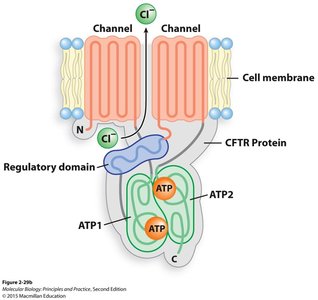
The CFTR protein consists of five domains: two transmembrane domains, two nucleotide binding domains (NBDs), and a regulatory domain. It is also glycosylated, which affects its folding and function.
Transmembrane domains: Form the channel for chloride ions
Nucleotide binding domains: Bind ATP for channel regulation
Regulatory domain: Anchors the channel to the cytoskeleton
Glycosylation: Addition of sugar groups to the protein
Effects of Mutations on CFTR Function
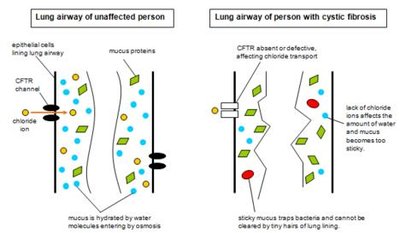
Mutations in the CFTR gene can lead to a nonfunctional or missing protein, resulting in thick, sticky mucus and impaired water movement. The most common mutation, ΔF508, deletes three nucleotides, removing phenylalanine at position 508 and causing abnormal protein folding and degradation.
ΔF508 mutation: Three-nucleotide deletion, loss of phenylalanine, defective protein folding
Clinical impact: Thick mucus, respiratory and digestive issues, increased infection risk
Most Commonly Found CFTR Mutations
Mutation Database and Frequencies
Thousands of unique mutations have been identified in the CFTR gene, with ΔF508 being the most frequent. Other mutations include nonsense, missense, and splicing defects.
Protein Name | # of Alleles in CFTR2 | Frequency in Database |
|---|---|---|
F508del (del1521-1523) | 98,735 | 0.69856 |
p.Gly542X (1624G>T) | 3,594 | 0.02543 |
p.Gly551Asp (1652G>A) | 2,984 | 0.02111 |
p.Asn1303Lys | 2,226 | 0.01575 |
p.Trp1282X (3846G>A) | 1,722 | — |
p.R117H (350G>A) | 1,852 | — |
621+1G→T | 1,318 | — |
p.Arg553X | 1,323 | — |
1000+ unique mutations | — | — |
Key Terms and Concepts
Mutation: Permanent change in DNA sequence
Allele: Variant form of a gene
Frameshift mutation: Insertion/deletion altering reading frame
Missense mutation: Single amino acid change
Nonsense mutation: Codon changed to stop codon
CFTR: Cystic Fibrosis Transmembrane Conductance Regulator
Equations and Genetic Code
Genetic code translation:
Example codon translation:
Additional info: Academic context was added to clarify mutation types, gene structure, and protein function, as well as to expand on the clinical impact of CFTR mutations and cystic fibrosis.
