 Back
BackMutations: Effects on Protein Structure and Function
Study Guide - Smart Notes
 Tailored notes based on your materials, expanded with key definitions, examples, and context.
Mutations and Their Impact on Protein Structure and Function
Introduction to Mutations
Mutations are changes in the genetic information of a cell and are the ultimate source of genetic diversity. They can occur at various scales, from large chromosomal rearrangements to small-scale changes affecting one or a few nucleotide pairs. Small-scale mutations, especially those within protein-coding genes, can have significant effects on protein structure and function, sometimes resulting in genetic disorders or hereditary diseases.
Types of Small-Scale Mutations
Point Mutations
Point mutations involve changes in a single nucleotide pair of a gene. These mutations can be classified into two main categories:
Nucleotide-pair substitutions: Replacement of one nucleotide and its partner with another pair.
Nucleotide-pair insertions or deletions: Addition or loss of one or more nucleotide pairs.
Substitution Mutations
Substitution mutations can have varying effects depending on their nature:
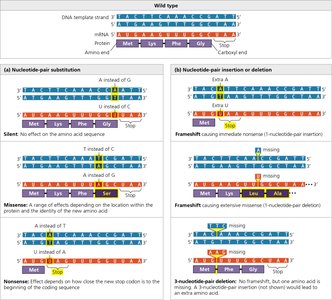
Silent mutations: Change a codon to another that codes for the same amino acid, resulting in no observable effect on the phenotype.
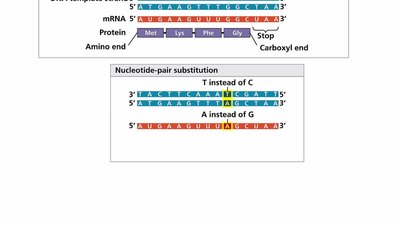
Missense mutations: Change one amino acid to another. The effect depends on the properties of the new amino acid and its position in the protein. Some missense mutations can have dramatic effects, such as in sickle-cell disease or albinism in the Asinara donkey.
Nonsense mutations: Change a codon for an amino acid into a stop codon, causing premature termination of translation and usually resulting in a nonfunctional protein.
Insertions and Deletions
Insertions and deletions are additions or losses of nucleotide pairs in a gene. These mutations often have more severe effects than substitutions because they can alter the reading frame of the genetic message, leading to a frameshift mutation. Frameshift mutations usually result in extensive missense mutations and premature stop codons, producing nonfunctional proteins.
Examples of Mutation Effects
Sickle-Cell Disease: A Case Study
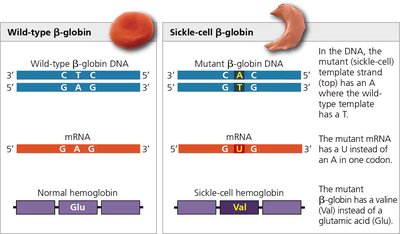
Sickle-cell disease is caused by a single nucleotide substitution in the gene encoding the β-globin polypeptide of hemoglobin. This point mutation changes the codon from GAG (glutamic acid) to GTG (valine), resulting in abnormal hemoglobin that causes red blood cells to sickle under low oxygen conditions.
Other Examples
Familial cardiomyopathy: Point mutations in genes encoding muscle proteins can lead to heart conditions.
Albinism in Asinara donkey: A missense mutation in the tyrosinase gene changes an aspartic acid to a histidine, preventing copper binding and resulting in a lack of pigment.
Mutation Analysis in Medical Genetics
Identifying Disease-Causing Mutations
With advances in genome sequencing, doctors can now analyze patient DNA to identify mutations responsible for diseases. For example, in neonatal diabetes, nucleotide-pair substitutions in the insulin gene can be identified by comparing patient cDNA sequences to the wild-type sequence. The effect of each mutation is determined by examining the resulting amino acid change and its impact on protein function.


Origins of Mutations
Spontaneous Mutations
Spontaneous mutations arise from errors during DNA replication or recombination. Although DNA proofreading and repair systems correct most errors, some persist and are passed on to future generations. The estimated mutation rate is about one nucleotide per 1010 nucleotides per generation.
Mutagens
Mutagens are physical or chemical agents that cause mutations. Examples include:
Physical mutagens: High-energy radiation (e.g., X-rays, UV light) that can damage DNA.
Chemical mutagens: Nucleotide analogs, chemicals that insert into DNA, or agents that alter base pairing properties.
Many mutagens are also carcinogens, substances that can cause cancer.
Defining a Gene
Modern Definition
The concept of a gene has evolved from a simple unit of inheritance to a region of DNA that can be expressed to produce a functional product, either a polypeptide or an RNA molecule. This definition encompasses both protein-coding genes and genes for functional RNAs (e.g., tRNA, rRNA).
Summary Table: Types of Point Mutations and Their Effects
Mutation Type | DNA Change | Effect on Protein | Example |
|---|---|---|---|
Silent | Base substitution | No change in amino acid | GGC to GGU (both code for Gly) |
Missense | Base substitution | One amino acid changed | Sickle-cell disease (Glu to Val) |
Nonsense | Base substitution | Premature stop codon | CAG (Gln) to UAG (Stop) |
Frameshift | Insertion/deletion (not multiple of 3) | Extensive missense, early stop | Many genetic disorders |
Key Equations and Concepts
Central Dogma:
Mutation Rate: nucleotides per generation
Concept Check
What happens when one nucleotide pair is lost from the middle of the coding sequence of a gene? Answer: This causes a frameshift mutation, altering the reading frame and usually resulting in a nonfunctional protein.
Why do individuals heterozygous for the sickle-cell allele show effects under some circumstances? Answer: Both normal and mutant hemoglobin are produced, and under low oxygen, some cells may sickle due to the presence of mutant hemoglobin.
Draw and analyze the effect of a nucleotide insertion in a gene sequence. Answer: Insertion changes the reading frame, leading to different amino acids downstream and likely a nonfunctional protein.
