 Back
BackNatural Selection and Adaptive Evolution: Mechanisms and Constraints
Study Guide - Smart Notes
 Tailored notes based on your materials, expanded with key definitions, examples, and context.
Natural Selection and Adaptive Evolution
Overview of Natural Selection
Natural selection is the only evolutionary mechanism that consistently leads to adaptive evolution. It operates through a combination of chance (the occurrence of new genetic variation) and sorting (the differential survival and reproduction of individuals with certain traits). This process increases the frequency of alleles that confer reproductive advantages, resulting in populations that are better adapted to their environments over time.
Relative Fitness
Definition and Importance
Relative fitness refers to the contribution an individual makes to the gene pool of the next generation compared to other individuals. While the phrases "struggle for existence" and "survival of the fittest" are often used, reproductive success is usually determined by a variety of factors, not just direct competition. Selection acts directly on phenotypes, and only indirectly on genotypes, as the phenotype is the expression of the genotype in a given environment.
Example: A barnacle that collects food more efficiently or a moth with better camouflage may have higher relative fitness due to increased survival or reproductive output.
Modes of Selection
Directional, Disruptive, and Stabilizing Selection
Natural selection can alter the frequency distribution of heritable traits in three main ways:
Directional Selection: Favors individuals at one extreme of a phenotypic range, shifting the population's trait distribution in one direction. Common when environments change or populations migrate.
Disruptive Selection: Favors individuals at both extremes over intermediate phenotypes, often resulting in increased variation and potentially leading to speciation.
Stabilizing Selection: Favors intermediate variants and acts against extreme phenotypes, reducing variation and maintaining the status quo for a trait.
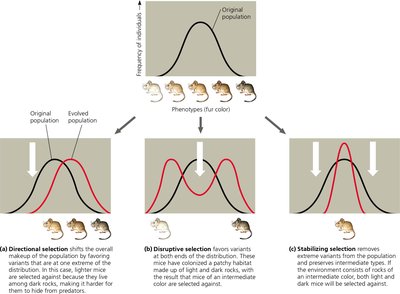
Example: Directional selection in Galápagos finches led to increased beak depth when large seeds became more abundant.
Adaptive Evolution and the Role of Natural Selection
Adaptations and Environmental Change
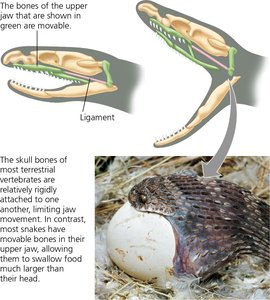
Adaptations are traits that enhance survival and reproduction. Natural selection increases the frequency of alleles that contribute to these traits, leading to adaptive evolution. However, because environments change, adaptive evolution is a continuous process, and what constitutes a "good match" between organism and environment can shift over time.
Example: Octopuses that change color for camouflage, or snakes with specialized jaws for swallowing large prey.
Balancing Selection
Maintaining Genetic Variation
While many forms of selection reduce genetic variation, balancing selection maintains it by preserving multiple alleles at a locus. Two main mechanisms are heterozygote advantage and frequency-dependent selection.
Heterozygote Advantage
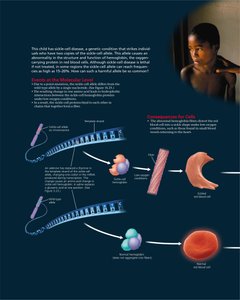
Occurs when heterozygotes have higher fitness than either homozygote. This maintains both alleles in the population. A classic example is the sickle-cell allele in regions where malaria is prevalent.
Heterozygotes (carriers) are protected against severe malaria, while homozygotes for the normal allele are more susceptible to malaria, and homozygotes for the sickle-cell allele develop sickle-cell disease.

Frequency-Dependent Selection
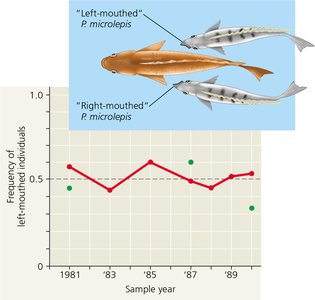
In this form of selection, the fitness of a phenotype depends on its frequency in the population. For example, in the scale-eating fish Perissodus microlepis, left-mouthed and right-mouthed individuals are favored in alternating years, depending on which is less common, maintaining both phenotypes in the population.
Sexual Selection
Mechanisms and Consequences
Sexual selection is a form of natural selection in which individuals with certain inherited traits are more likely to obtain mates. It can result in sexual dimorphism, or differences in secondary sexual characteristics between males and females.
Intrasexual selection: Competition among individuals of the same sex (often males) for mates.
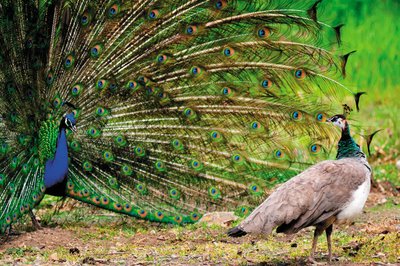
Intersexual selection (mate choice): Individuals of one sex (usually females) choose mates based on certain traits, which may signal genetic quality.
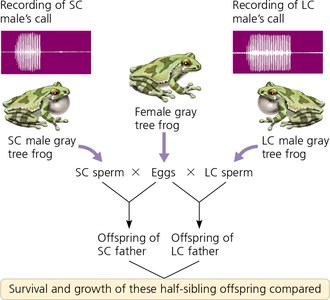
Example: Female gray tree frogs prefer males with longer calls, which are correlated with higher offspring survival and growth.
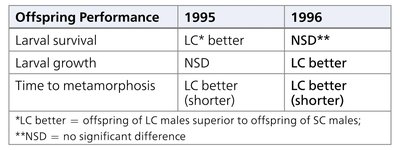
Offspring Performance | 1995 | 1996 |
|---|---|---|
Larval survival | LC* better | NSD** |
Larval growth | NSD | LC better |
Time to metamorphosis | LC better (shorter) | LC better (shorter) |
*LC better = offspring of LC males superior to offspring of SC males; **NSD = no significant difference | ||
Constraints on Natural Selection
Why Natural Selection Cannot Fashion Perfect Organisms
Despite its power, natural selection has several constraints:
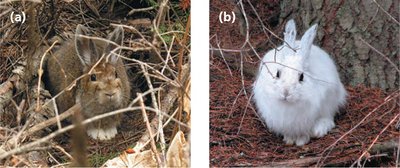
Selection can act only on existing variation: New advantageous alleles do not arise on demand. For example, snowshoe hares may not adapt quickly to changing snowfall patterns if their gene pool lacks the necessary alleles.
Evolution is limited by historical constraints: Evolution modifies existing structures rather than creating new ones from scratch.
Adaptations are often compromises: Traits that are advantageous in one context may be disadvantageous in another due to trade-offs.
Chance, natural selection, and the environment interact: Random events and environmental changes can influence which alleles are present and favored in a population.
Summary Table: Modes of Selection
Mode of Selection | Effect on Phenotype Distribution | Example |
|---|---|---|
Directional | Shifts mean phenotype in one direction | Beak depth in finches |
Disruptive | Favors extremes, increases variation | Beak size in seedcracker finches |
Stabilizing | Favors intermediates, reduces variation | Human birth weight |
Key Terms
Adaptive evolution: Evolution that results in a better match between organisms and their environment.
Relative fitness: The contribution of an individual to the next generation's gene pool relative to others.
Balancing selection: Natural selection that maintains two or more phenotypic forms in a population.
Sexual selection: Selection for traits that increase mating success.
Sexual dimorphism: Differences in secondary sexual characteristics between males and females.
Concept Check
What is the relative fitness of a sterile mule? Explain.
Explain why natural selection is the only evolutionary mechanism that consistently leads to adaptive evolution in a population.
Consider a population in which heterozygotes at a certain locus have an extreme phenotype that confers a selective advantage. Does this situation represent directional, disruptive, or stabilizing selection? Explain your answer.
