 Back
BackLec: 7 Natural Selection and Evidence for Evolution
Study Guide - Smart Notes
 Tailored notes based on your materials, expanded with key definitions, examples, and context.
Natural Selection and Evidence for Evolution
Introduction
This study guide covers the theory of natural selection, its subtleties, and the evidence supporting evolution. It includes Darwin's observations, examples of natural selection in action, and the role of biogeography in understanding evolutionary processes.
Theory of Natural Selection
Subtleties of Natural Selection
Heritable Variation: Evolution by natural selection requires variation in traits that are heritable, meaning they can be passed from parents to offspring.
Progressiveness: Natural selection is not inherently progressive; it does not always lead to greater complexity or improvement, but rather to better adaptation to the current environment.
Darwin’s Observations and Inferences (Ernst Mayr’s Summary)
Observation 1: All species have the capacity to increase in number geometrically if all offspring survive to reproduce.
Observation 2: Populations tend to remain stable in size.
Observation 3: Environmental resources are limited.
Inference 1: There is a struggle for existence; only a fraction of individuals survive to reproduce.
Observation 4: No two individuals in a population are exactly alike.
Observation 5: Some variation is heritable.
Inference 2: Survival depends partly on genetic makeup; individuals with traits best suited to the environment are more likely to survive and reproduce (natural selection).
Inference 3: Unequal survival and reproduction lead to gradual changes in the population (evolution).
Darwin’s Observations in the Galapagos
Island Species and Adaptation
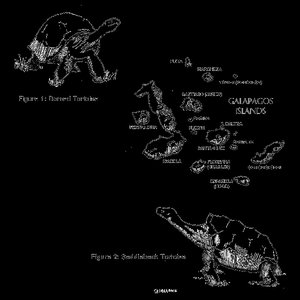
Darwin observed that small, isolated populations on the Galapagos Islands developed distinct traits compared to mainland populations, providing evidence for evolution by natural selection.
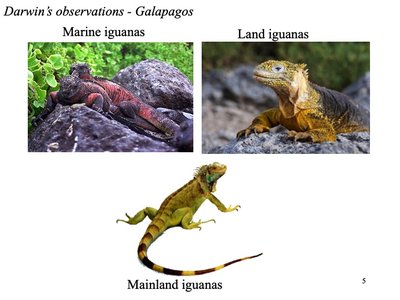
Iguanas: Marine and land iguanas on the Galapagos differ from mainland iguanas, showing adaptation to different environments.
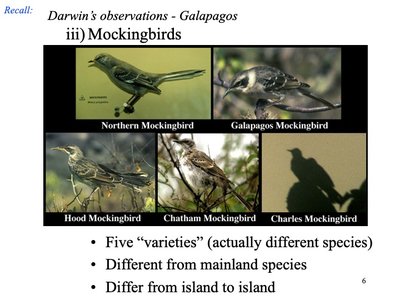
Mockingbirds: Five different species, each unique to specific islands, differing from mainland species.
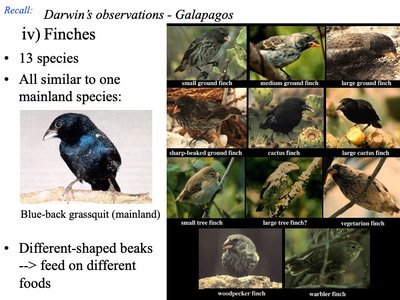
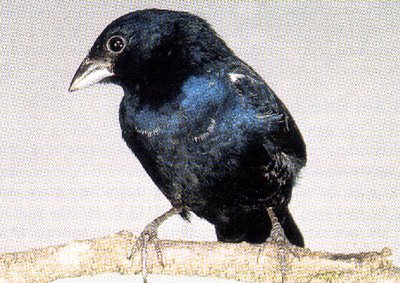
Finches: Thirteen species with different beak shapes adapted to different food sources, all similar to a mainland ancestor.
Tortoises: Shell shape varies from island to island, adapted to different food sources.
Influences on Darwin’s Theory
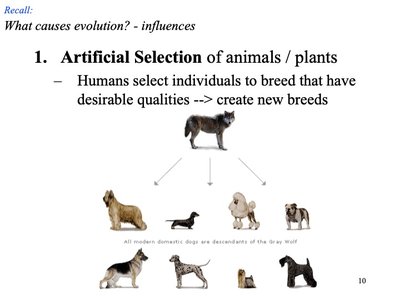
Artificial Selection
Humans breed plants and animals for desirable traits, demonstrating that selection can cause significant changes in populations over generations.
The Writings of T.R. Malthus
Malthus’s essay on population growth influenced Darwin’s understanding of the struggle for existence and the role of limited resources in natural selection.
Key Concepts in Natural Selection
Variation: Natural selection acts on existing variation; it does not create new traits. New variations arise from mutation, genetic recombination, and sexual reproduction.
Heritability: Only heritable (genetic) traits can be acted upon by natural selection. Acquired traits are generally not inherited, with some exceptions due to epigenetic changes.
Fitness: Defined as the ability to survive and reproduce relative to others in the population. Fitness is environment-dependent.
Population as the Unit of Evolution: Evolution occurs at the population level, not in individuals.
Non-progressiveness: Evolution does not have a predetermined direction or goal; it is shaped by environmental pressures.
Examples of Natural Selection in Action
Industrial Melanism: The increase in dark-colored (melanic) moths in polluted environments due to better camouflage from predators.
Drug Resistance in HIV: Mutant viruses resistant to drugs like 3TC survive and proliferate when the drug is present, illustrating selection for pre-existing variation.
Pesticide Resistance: Insect populations develop resistance to pesticides as individuals with resistance genes survive and reproduce.
Colouration in Guppies: Guppy coloration varies with predation pressure; brighter males are favored by females but are more visible to predators, leading to a balance shaped by natural selection.
Biogeography as Evidence for Evolution
Biogeography studies the distribution of species across geographic areas. Closely related species are often found in the same region, supporting the idea of common ancestry and adaptive radiation.
Example: The genetic similarity between the silversword and mountain dubautia in Hawaii, despite different habitats, is greater than between the silversword and the physically similar queen of the Andes in South America. This demonstrates that geographic proximity, not just physical similarity, reflects evolutionary relationships.
Summary Table: Key Evidence for Evolution
Type of Evidence | Example | Key Concept |
|---|---|---|
Direct Observation | Industrial melanism, drug resistance | Natural selection acts on existing variation |
Comparative Anatomy | Galapagos finches, tortoises | Adaptation to local environments |
Biogeography | Silversword and dubautia in Hawaii | Geographic clustering of related species |
