 Back
BackNervous and Sensory Systems: Comparative Organization and Function
Study Guide - Smart Notes
 Tailored notes based on your materials, expanded with key definitions, examples, and context.
Ch. 38: Nervous & Sensory Systems
Introduction to Nervous Systems
The nervous system is essential for gathering, transmitting, and processing information, enabling animals to make rapid and appropriate decisions crucial for survival and fitness. As animal body plans increase in size and complexity, the organization of the nervous system becomes more sophisticated to meet these demands.
Comparative Nervous System Organization
Neural Circuits and Nervous Systems
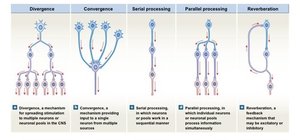
Neural circuits are pathways of information transfer between interconnected neurons. The organization of these circuits varies among organisms, reflecting differences in body plan and complexity. The nervous system consists of neural circuits and supporting cells, forming the basis for information processing in animals.
Evolution of Nervous System Complexity
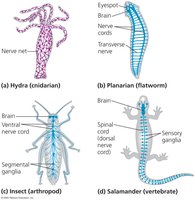
Nervous systems have evolved from simple diffuse networks to highly centralized and specialized structures. The complexity of the nervous system correlates with the complexity of the animal's body plan.
Small, Radial Bodies: Cnidarians
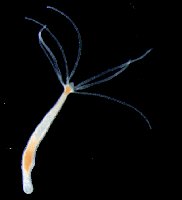
Hydras and other cnidarians are among the simplest animals with nervous systems.
They possess a nerve net, a diffuse network of interconnected neurons that controls basic functions such as contraction and expansion of the gastrovascular cavity.
Cephalization and Centralization
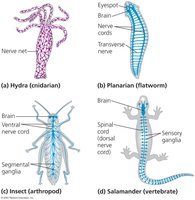
More complex animals exhibit cephalization: clustering of neurons at the anterior end, forming a central nervous system (CNS).
Planarians and other non-segmented worms have a simple brain and longitudinal nerve cords, representing the simplest CNS among animals.
Nerves and Bundling
Nerves are bundles of neuron axons that organize information flow throughout the body, characteristic of more complex, bilaterally symmetrical animals.
Nerves carry information both toward and away from the CNS.
Ventral and Dorsal Nerve Cords
Invertebrates such as insects have a ventral nerve cord (along the belly), coordinating neural signaling between the brain and body.
This structure contains ganglia: clusters of neurons serving as relay points.
Vertebrates have a dorsal nerve cord (along the back), also known as the spinal cord, with sensory ganglia for information transfer.
Vertebrate Nervous Systems
Central and Peripheral Nervous Systems
The vertebrate nervous system is divided into two main components:
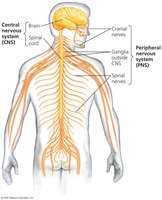
Central Nervous System (CNS): Consists of the brain and spinal cord, responsible for processing and integrating information.
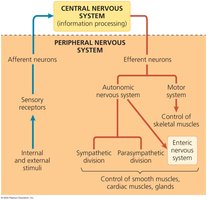
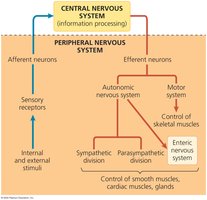
Peripheral Nervous System (PNS): Composed of paired nerves that transmit information to and from the CNS. Most nerves contain both afferent (sensory) and efferent (motor) neurons.
Information Flow in the Nervous System
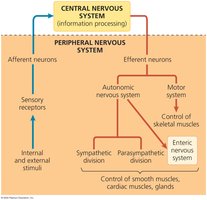
Sensory (afferent) neurons carry information from sensory receptors to the CNS.
After processing, motor (efferent) neurons transmit instructions from the CNS to effectors (muscles or glands).
Divisions of the Peripheral Nervous System
Motor System: Regulates voluntary (skeletal) muscles and reflexes.
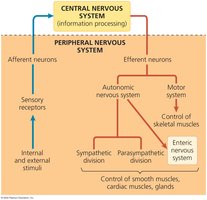
Autonomic Nervous System: Regulates involuntary functions, including cardiac and smooth muscle activity. It is subdivided into:
Sympathetic Division: Prepares the body for "fight-or-flight" responses (increased heart rate, dilated pupils, decreased digestion).
Parasympathetic Division: Promotes "rest and digest" activities (slowed heart rate, increased digestion, constricted pupils).
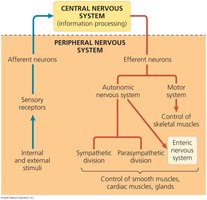
Enteric Division: Controls the digestive tract independently but interacts with the autonomic system.
Autonomic Nervous System: Sympathetic and Parasympathetic
These divisions have complementary, antagonistic effects on organs they both innervate.
Sympathetic neurons promote arousal and energy expenditure, while parasympathetic neurons promote relaxation and energy conservation.
Enteric Nervous System
The enteric nervous system regulates the digestive tract and can function independently of the CNS.
It is sometimes called the "second brain" or "gut brain" and likely evolved early in animal evolution.
The Vertebrate Brain
Major Brain Regions
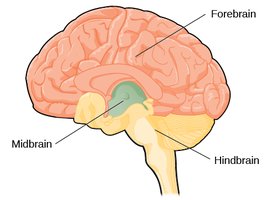
The vertebrate brain is the most complex organ, with regional specialization for different functions. It is divided into three main regions:
Hindbrain: Controls reflex responses and homeostatic functions.
Midbrain: Acts as a sensory routing and integrating center.
Forebrain: Responsible for integration, learning, memory, emotions, and complex processing tasks.
Comparative Brain Structure
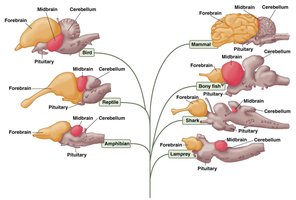
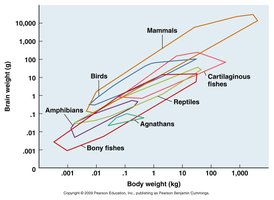
Brain size and structure vary among vertebrates, with birds and mammals having brains several times larger than similarly-sized reptiles.
Differences in brain region sizes reflect adaptations to ecological niches and behaviors.
Specialization in Brain Regions
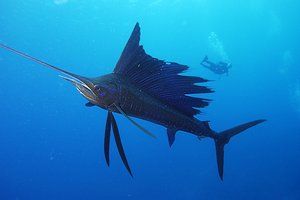
Bony fishes and birds have large cerebellums for interpreting signals and coordinating movement in three-dimensional environments.
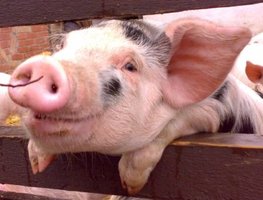
Mammals have a smaller midbrain but a larger cerebrum and forebrain, supporting advanced learning, memory, sociality, and complex behaviors.

The Cerebral Cortex
Structure and Function
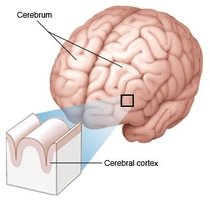
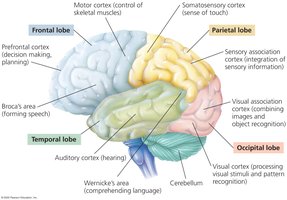
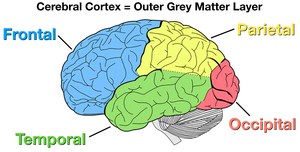
The cerebral cortex is the outermost layer of the forebrain (cerebrum), composed of gray matter (clusters of neuronal cell bodies). It is responsible for voluntary movement, sensory processing, decision-making, and higher cognitive functions.
Sensory areas: Receive and process sensory information (e.g., visual cortex).
Association areas: Integrate information and make decisions (e.g., prefrontal cortex).
Motor areas: Transmit instructions to the body (e.g., motor cortex).
Lobes of the Cerebral Cortex
The cerebral cortex is divided into four main lobes, each with specialized functions:
Frontal lobe: Decision making, planning, voluntary movement.
Parietal lobe: Integration of sensory information, sense of touch.
Temporal lobe: Hearing, language comprehension.
Occipital lobe: Visual processing.
Each lobe's function can differ between the left and right hemispheres, a phenomenon known as lateralization. In mammals, cognitive ability is correlated with the degree of cortical convolution, which is highest in primates and cetaceans.
Summary Table: Comparative Nervous System Organization
Animal Group | Nervous System Structure | Key Features |
|---|---|---|
Cnidarians (Hydra) | Nerve net | Diffuse network, controls basic movements |
Flatworms (Planarian) | Simple CNS | Brain, longitudinal nerve cords |
Arthropods (Insect) | Ventral nerve cord | Segmental ganglia, complex behaviors |
Vertebrates (Salamander) | Dorsal nerve cord (spinal cord) | Brain, sensory ganglia, advanced integration |
